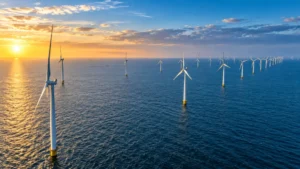
The Willatook wind farm, planned for the southwest of the Australian state of Victoria, seeks to advance its approval process through an updated design that reduces the number of wind turbines and modifies their dimensions.
The 350 MW project, developed by Wind Prospect and in which Engie Australia participates with a purchase option, now contemplates 52 turbines compared to the 59 previously planned. The proposal also modifies the location of some wind turbines to move them away from wetlands and other environmentally sensitive areas.
Additionally, the developers seek to change the permitted dimensions for the turbines. Among the modifications is a reduction in the maximum rotor diameter from 190 to 175 meters and an increase in the minimum distance between the blade tips and the ground from 40 to 60 meters. Furthermore, the maximum total height of the turbines could increase slightly from 250 to 254 meters.
The New Design Seeks to Reduce Impact on Wildlife
Primarily, the modifications respond to concerns about the interaction of the turbines with species present in the area, including the Southern Bent-wing Bat, a bat species that has conditioned part of the project’s environmental process.
The concerns also extend to the Brolga, a bird present in southeastern Australia. The potential effects on both species were determining factors in the environmental conditions previously established for Willatook.
Wind Prospect maintains that the modified configuration reduces the potential risk of ecological interaction compared to the previous design. Its strategy combines measures related to turbine location, greater separation between the blades and the ground, operational controls, post-construction monitoring, and adaptive management.
Likewise, the proposal contemplates reducing the length of access roads and trenches intended for underground electrical cabling. It also includes adjustments to the project boundaries to decrease the affected area.
Willatook Maintains 52 Turbines and a 400 MWh Battery
The design currently presented by the project contemplates up to 52 wind turbines along with a battery energy storage system of 200 MW and 400 MWh.
The associated infrastructure includes a substation, underground cabling, access roads, and other facilities necessary to connect the plant with the Tarrone terminal station.
According to official information from Willatook Wind Farm, the farm would have an estimated production of 1,300 GWh annually and capacity to generate sufficient renewable electricity to supply more than 200,000 homes in Victoria.
The project is located between Orford and Hawkesdale, in Moyne Shire, approximately 22 kilometers north of Port Fairy.
Environmental Restrictions Conditioned the Project
Willatook has been undergoing a complex planning process for years. In 2023, the Victorian Government’s assessment determined that the project could proceed subject to modifications intended to manage its potential effects on the Brolga and the Southern Bent-wing Bat.
Among the conditions subsequently discussed were larger protection zones and temporary restrictions for certain construction activities. Wind Prospect and the Clean Energy Council challenged these conditions, considering that they hindered the development’s viability.
Subsequently, in May 2025, the Victorian Government published new guidelines to manage the impacts of renewable projects on wildlife. This framework introduced clearer criteria for assessing risks related to birds and bats.
From that scenario, Wind Prospect revised Willatook’s configuration through additional environmental studies and new mitigation measures. The developer subsequently submitted a modified application to the Victorian Government.
Willatook Wind Farm Advances Toward a New Phase
Currently, the project continues within the state planning process. Official documentation places Willatook in an advanced planning phase and contemplates the 2027-2029 period for subsequent stages and the start of construction and operation.
In addition to its wind capacity, the 200 MW/400 MWh battery would allow incorporating storage into the facility and strengthening its integration with the electrical system.
Willatook was also selected within a tender of the Australian federal government’s Capacity Investment Scheme, an element that reinforces its role within the country’s expansion of renewable generation and storage.
If it obtains the pending authorizations and maintains the planned schedule, the project could enter operation around 2029 with a different configuration from that originally proposed: fewer turbines, smaller-diameter rotors, and greater separation between the blades and the ground.
Source: Wind Prospect
Photo: Shutterstock