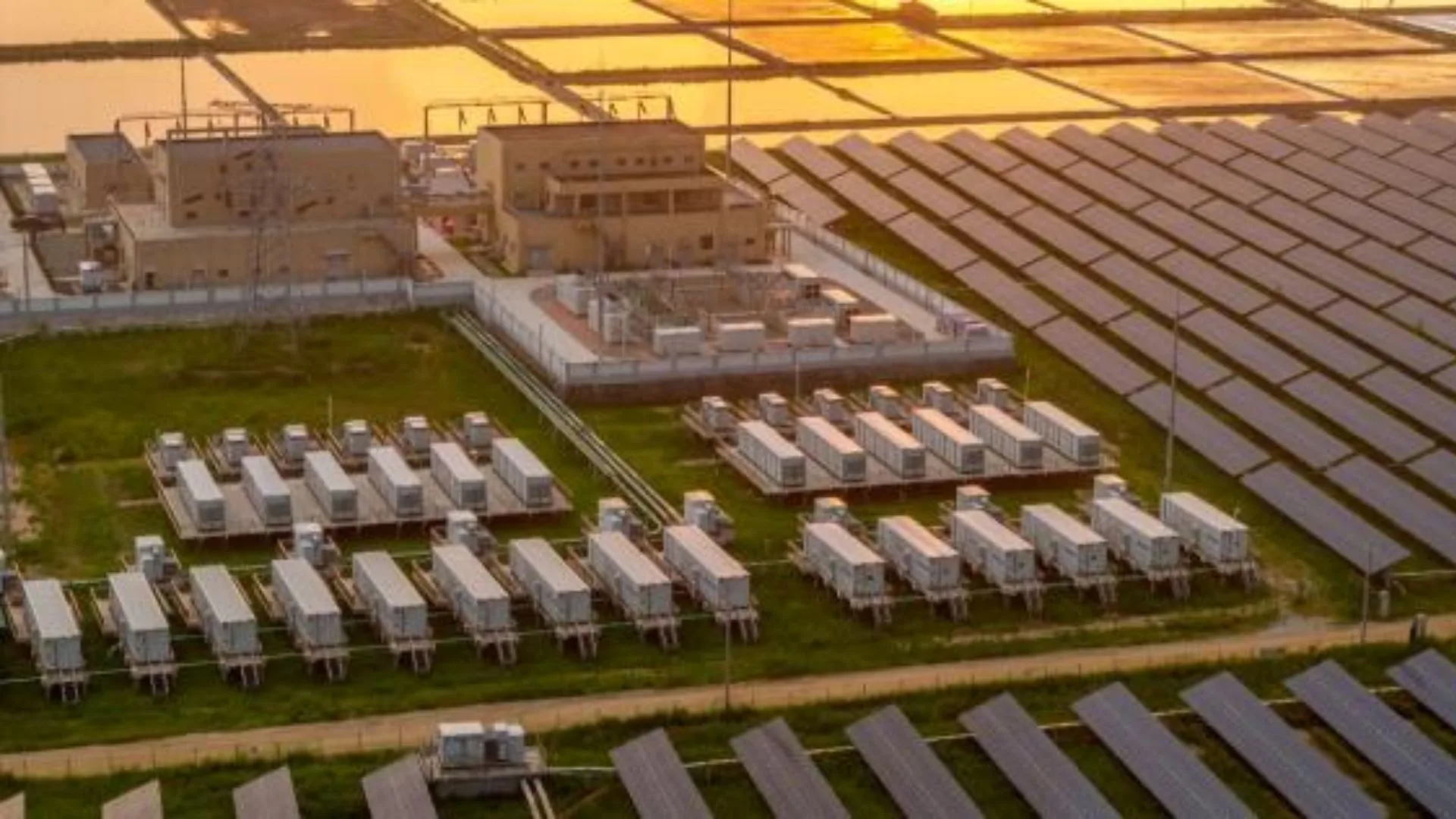
Solar and wind energy with battery storage is no longer a promise of partial backup; it now directly competes with coal and gas in terms of costs. A new report from the International Renewable Energy Agency (IRENA) concludes that 24/7 renewable energies can supply firm and cost-effective electricity in regions with good solar and wind resources.
According to the analysis, hybrid systems combining solar, wind energy, and batteries are achieving firm costs below several new fossil fuel alternatives. In areas with high solar irradiance, solar energy with storage ranges from $54 to $82 per megawatt-hour, compared to $70-$85 per MWh for new coal in China and over $100 per MWh for new gas plants globally.
Batteries Change the Renewable Energy Equation
Furthermore, IRENA points out that the cost reduction has been key for firm renewable energy to gain ground. Since 2010, total installed costs for solar PV decreased by 87%, onshore wind energy by 55%, and battery storage by 93%.
Likewise, construction timelines favor these hybrid projects. After obtaining permits and grid connection, many installations can be built in one to two years, a shorter timeframe than for new gas plants in a good portion of markets.
24/7 Renewable Energies for Data Centers and Industry
Moreover, continuous renewable supply allows for better utilization of grid connections, shifting electricity production to higher-value hours, and reducing exposure to price volatility. This opens an attractive path for large consumers requiring stable electricity, such as data centers, artificial intelligence operations, and energy-intensive industries.
Also, 24-hour renewable energy can support the production of clean fuels for hard-to-decarbonize sectors. In these cases, project economics depend on both electricity price and the ability to operate at high utilization rates.
Comparison with Coal and Gas Gains Strategic Weight
Meanwhile, reliance on fossil fuels remains linked to international market volatility and geopolitical risks. IRENA suggests that solar and wind systems with batteries not only offer a competitive alternative in terms of costs but also a tool to strengthen energy security and economic resilience.
The report estimates that the firm costs of solar energy with batteries decreased from over $100 per MWh in 2020 to a range of $54-$82 per MWh by 2025 in favorable regions. By 2030, IRENA forecasts additional reductions of nearly 30%, and by 2035, an approximate 40% decrease in the best installations.
Hybrid Systems with Lower Storage Needs
For wind energy with storage, estimates for 2025 show costs close to $59 per MWh in Inner Mongolia and between $88 and $94 per MWh in Brazil, Germany, and Australia. By 2030, these values could drop to a range of $49 to $75 per MWh.
Furthermore, combining wind energy with solar PV can further reduce system costs. The reason is technical and simple: generation profiles complement each other, which decreases the need for storage and improves the utilization of electrical infrastructure.
In practice, the Al Dhafra complex in the United Arab Emirates shows where the market is heading. The installation combines solar PV with batteries and can supply 1 gigawatt of clean electricity at about $70 per MWh.
IRENA Reinforces the Argument for Energy Transition
Finally, the IRENA report provides a benchmark for comparing the costs of renewable systems capable of operating all day. The central message is clear: with solar, wind, and battery storage, clean electricity can now compete with new fossil fuel plants in key markets.
For the energy transition, this changes the debate. The discussion no longer revolves solely around installing more renewable capacity, but about designing hybrid systems capable of delivering firm, stable, and economically competitive energy 24 hours a day.
Source and photo: IRENA