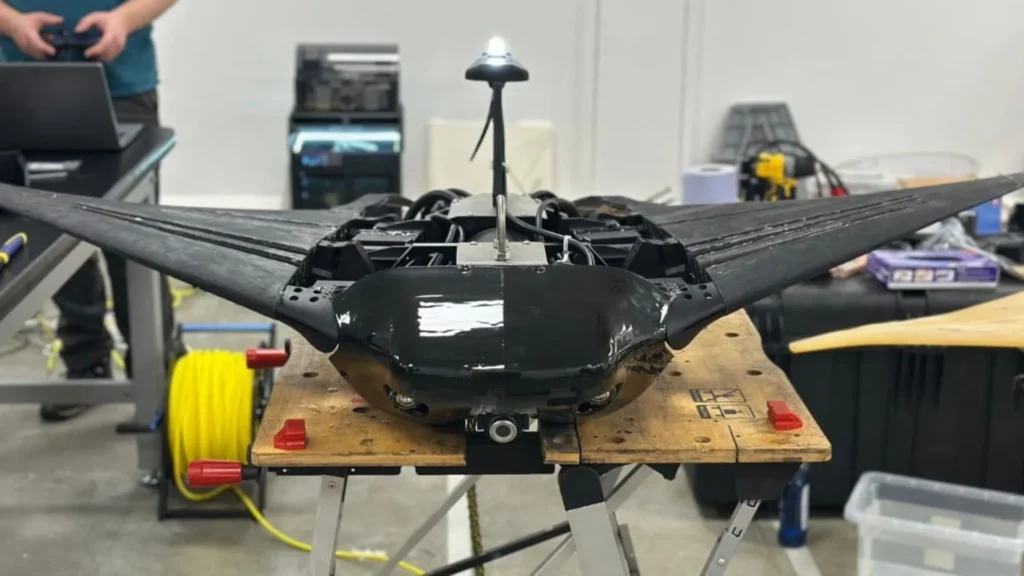
Ray Systems has joined the NOC Innovation Hub in Southampton to accelerate the development of its autonomous underwater vehicles. The British company will have access to engineering facilities, testing environments, oceanographic data, and specialists at the National Oceanography Centre.
The collaboration will enable progress in a new generation of AUVs propelled by oscillating fins, these systems aim to offer greater efficiency, lower noise, and better maneuverability than underwater designs based on conventional propellers.
Ray Systems integrates into the NOC’s technology ecosystem
Firstly, this membership places Ray Systems within one of the UK’s leading communities dedicated to autonomous marine systems. The NOC Innovation Hub brings together scientists, companies, and entrepreneurs working on technologies for ocean research and maritime operations.
The facility opened in 2025 after an investment of £200,000; from there, its members can use specialized equipment, testing areas and data generated by the National Oceanography Centre.
For Ray Systems, this infrastructure will reduce the time needed to test new designs, and will also facilitate contact with operators working in real underwater conditions and with partners capable of supporting the commercial expansion of its technology.
RayDrive replaces propellers with oscillating fins
Furthermore, the main technical element of the platform is RayDrive, a bio-inspired propulsion system that reproduces certain movements of marine fauna through oscillating fins.
This approach allows thrust to be distributed differently than traditional propulsion, according to the company, resulting in quieter, more efficient autonomous underwater vehicles capable of performing precise maneuvers.
Noise reduction can be relevant in scientific observation, underwater inspection, and environmental monitoring. In these operations, the vibrations and sound generated by a propeller can affect data collection or alter the behavior of marine species.
NelsonOS improves battery life in areas without GPS.
Ray Systems also develops NelsonOS, a standalone operating system created for environments where there is no GPS coverage and conventional communications are limited.
Underwater, vehicles must interpret sensor data and adjust their trajectory with minimal human intervention. NelsonOS aims to coordinate these decisions with the propulsion system and vehicle architecture.
The integration of software, navigation, and motion control will allow the company to test more precise responses to currents, obstacles, and mission changes.
More rigorous testing for autonomous underwater vehicles
Furthermore, the collaboration with the NOC will allow RayDrive and NelsonOS to undergo more rigorous validation processes. Ray Systems will be able to compare its results with oceanographic data and work closely with researchers experienced in marine operations.
James Farha, co-founder and CEO of Ray Systems, noted that access to the NOC’s facilities and expertise will allow for more rigorous testing and accelerate technical learning.
Mark Hamson, head of the Innovation Hub, highlighted the potential of biologically inspired propulsion to expand the capabilities of autonomous marine systems.
A platform geared towards the blue economy
Finally, Ray Systems intends to scale its platform to various commercial applications, including infrastructure inspection, oceanographic research, environmental monitoring, and autonomous maritime operations.
The support of the NOC Innovation Hub will provide data, equipment, and industry connections, enabling the company to transform its fin propulsion technology into an operational capability for the underwater market.
The collaboration also reflects a growing interest in designing robots that mimic solutions found in nature, in Ray Systems’ case, this principle translates into autonomous underwater vehicles that use fins instead of propellers to move through the water.
Source and photo: Oceannews