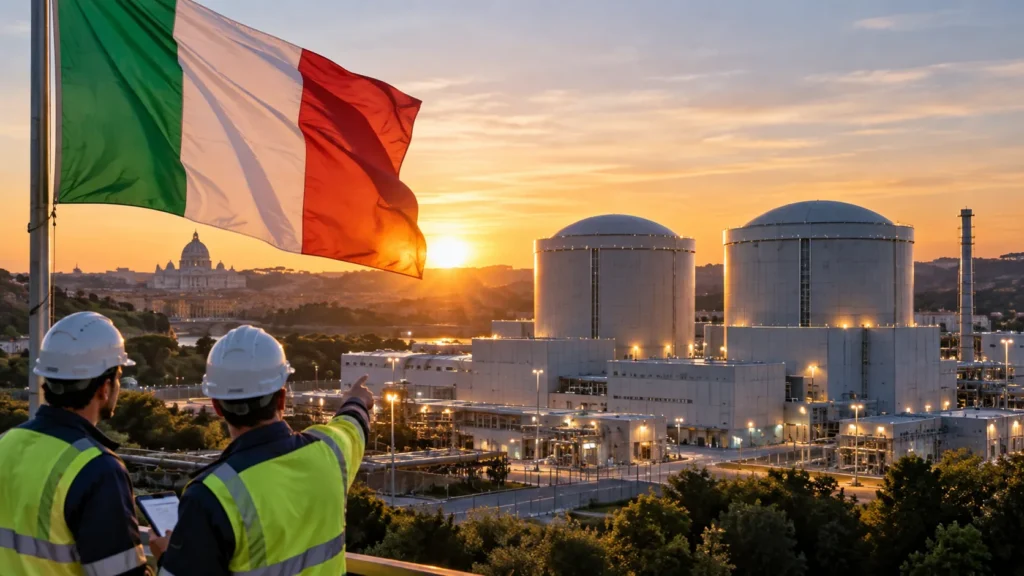
Nuclear energy in Italy is entering a new phase following the final approval of the legislative framework that will allow the Government to move forward with the return of this source of power generation, nearly 40 years after the closure of its reactors. The strategy targets technologies such as small and advanced modular reactors to strengthen energy security, support industrial decarbonization, and reduce dependence on imports.
The shift does not simply seek to revive the model of large nuclear power plants from the past. The strategy is oriented toward small modular reactors (SMRs), advanced modular reactors (AMRs), and other next-generation nuclear technologies, with the aim of incorporating firm, low-carbon generation, supporting industrial decarbonization, and reducing Italy’s exposure to energy imports.
Nuclear energy in Italy enters a new phase
Parliamentary approval does not mean that Italy has already restarted nuclear power generation. The immediate change is regulatory: the new framework gives the Government 12 months to adopt the implementing decrees needed to redevelop the sector, while also including provisions related to the decommissioning of existing facilities and the establishment of an independent regulator.
This process will be decisive because a nuclear program requires much more than selecting a technology. Italy will have to simultaneously develop regulation, licensing, siting, supply chains, fuel and waste management, electrical infrastructure, engineering capabilities, and financial mechanisms.
The country, however, is not starting entirely from scratch. In 2026, ENEA launched a three-year national nuclear research program funded by the Ministry of Environment and Energy Security, which specifically includes the development of SMRs and AMRs, along with fusion technologies and specialized training.
This development connects with a broader European trend. Sweden selected three SMR reactors to expand its nuclear capacity, while other European countries are exploring different models for expanding and renewing their power generation systems.
Advanced modular reactors change the approach
Modular systems seek to introduce a different approach to conventional nuclear construction. Instead of relying exclusively on large reactors built almost entirely at the site, SMR concepts incorporate greater standardization and modular manufacturing, with components that can be produced under controlled industrial conditions before installation.
The European Commission considers that SMRs could simultaneously contribute to decarbonization, industrial competitiveness, and security of supply, although their large-scale commercial deployment still needs to demonstrate competitive costs, schedules, and manufacturing capabilities.
In fact, small modular reactors are advancing across different energy markets, where the need for stable generation is increasing interest in technologies capable of complementing variable renewable energy sources.
Italy also has a potential concrete industrial connection. EDF recently announced plans to develop 10 SMRs in the European Union by 2035 using NUWARD technology and is considering one unit in Italy with the participation of local companies such as Edison, Saipem, and Webuild. The concept envisioned by EDF targets approximately 400 MW per reactor, with the capacity to generate electricity and supply heat for industrial applications.
How much nuclear energy does Italy want to incorporate?
The planned scale is significant. When it presented its strategy, the Government estimated that achieving a nuclear share of at least 11% in the energy mix could reduce decarbonization costs by approximately €17 billion by 2050. The National Integrated Energy and Climate Plan considers that the nuclear share could eventually reach 22%.
The roadmap also has an energy security component. Italy remains highly dependent on imports and, although it does not currently produce nuclear electricity, it consumes electricity from European systems where this technology has a significant share, including France.
In this context, the return of nuclear power is envisioned as a complement to renewables rather than necessarily as a replacement. The ability to provide firm power could help support an electricity system with a growing share of solar and wind generation.
When could Italy produce nuclear electricity again?
The timeline remains long term. Minister of Environment and Energy Security Gilberto Pichetto Fratin stated during the legislative process that the first reactors could enter operation around 2034-2035. That timeline will depend on regulatory development, licensing, selected technology, siting, financing, and project execution.
For this reason, parliamentary approval should be interpreted as the opening of a new phase rather than the immediate start of construction.
Italy’s challenge will be to transform this legislative authorization into technically executable projects. Experiences such as the development of SMR reactors through modular manufacturing show how Europe is attempting to shift part of nuclear construction toward more standardized models, although actual competitiveness will depend on the first projects demonstrating industrial, financial, and regulatory performance.
For Italy, the next 12 months will be particularly important: they will need to transform a strategic decision on nuclear energy into the technical and regulatory framework required to determine which technologies can be built, under what conditions, and what role they will play within the future energy system.