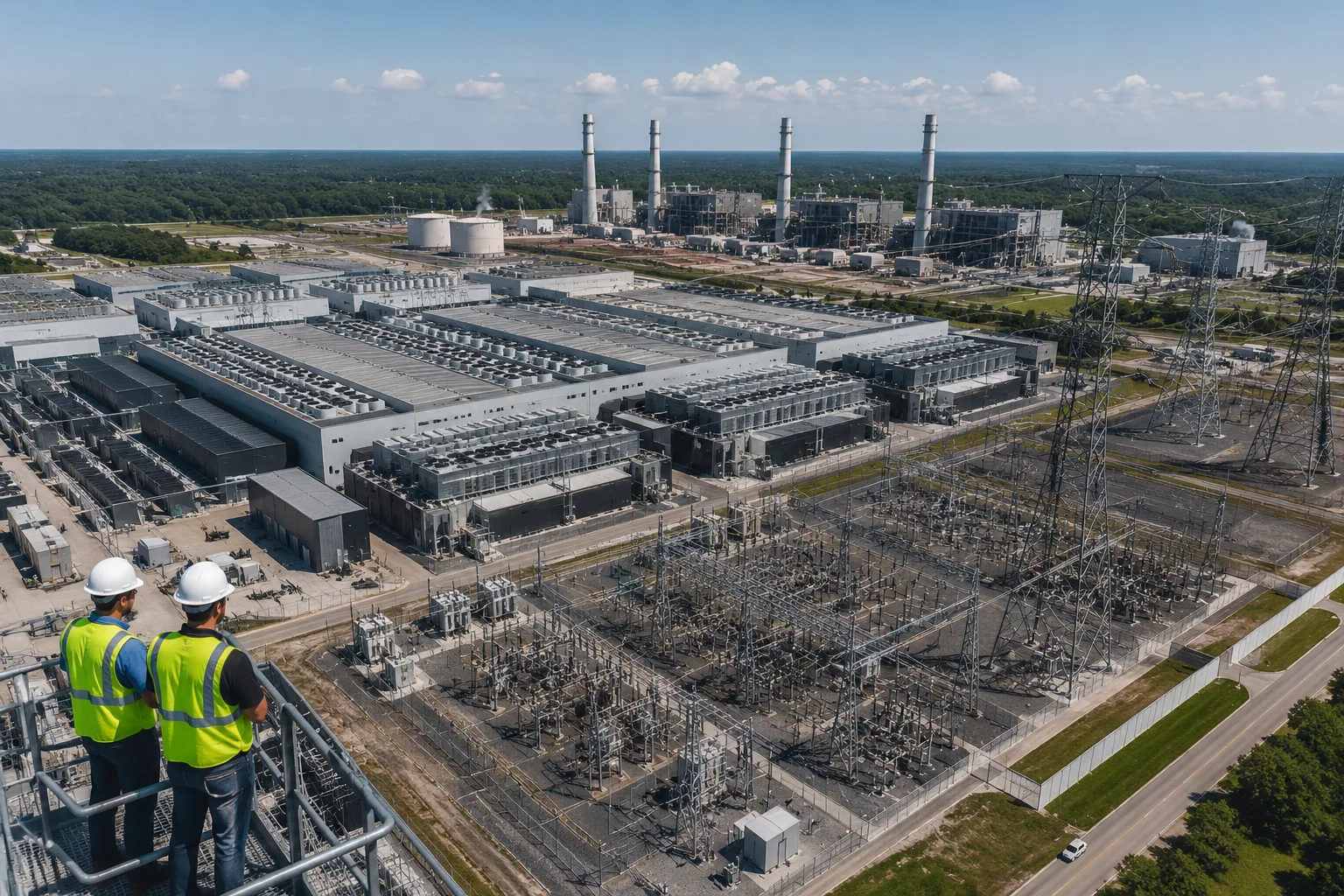
Members of PJM Interconnection approved on June 30, 2026 a set of proposals for PJM data centers electricity demand: to create a mechanism called backstop procurement, designed to ensure additional power supply when private contracting fails to cover the growing demand driven by data centers and artificial intelligence.
PJM operates the largest interconnected power grid in the United States, supplying approximately 65 million people across 13 states plus the District of Columbia. The vote marks a turning point in how the operator manages demand that, until a few years ago, was considered manageable within the usual planning cycles.
PJM data centers drive new capacity rules
The most visible indicator of strain on the system is the capacity market price: since 2024, values have risen by more than 1,000%. This surge reflects the market’s difficulty in attracting new generation quickly enough to offset the retirement of thermal plants and absorb the additional load from large-scale computing facilities.
The PJM data centers initiative responds to a structural shift in U.S. electricity demand, where new artificial intelligence complexes require continuous supply and greater generation capacity to maintain system reliability.
The backstop procurement mechanism works as an institutional safety net: if private contracting processes between generators and large industrial consumers do not produce sufficient supply commitments, PJM is authorized to procure capacity directly in the market, ensuring the system maintains the reserve margins required by North American reliability standards.
AI and data centers redefine the load curve
The proliferation of data centers for training and inference of artificial intelligence models is altering the load curve of power grids at an unprecedented pace. Unlike traditional residential or industrial demand, these facilities operate 24/7 with very high load factors, reducing the nighttime relief periods that historically helped balance the system.
“Load growth associated with data centers is occurring at a scale and speed that energy markets were not structured to absorb immediately,” noted a recent analysis by the Federal Energy Regulatory Commission (FERC), the agency that must review and formally approve the proposals voted on by PJM members before they take effect.
“Backstop procurement mechanisms provide a critical tool to preserve reliability when market price signals are not fast enough to induce new generation supply,” PJM said in documentation submitted to its members ahead of the vote.
FERC must validate the new rules
The approved proposals do not take effect immediately. The regulatory process requires FERC to evaluate them under the criteria of fairness, reasonableness, and non-discrimination that govern U.S. wholesale electricity markets. The review timeline has not been officially announced, but the system’s operational urgency is pushing toward an expedited decision.
For energy infrastructure operators and grid planners, PJM’s decision foreshadows a broader regulatory debate about how electricity markets must adapt to high-density industrial loads that do not respond to price incentives in the same way as conventional consumers.
Approval of the mechanism also raises expectations among other regional grid operators—such as MISO, SPP, and CAISO—that face similar dynamics of accelerated data center integration and need regulatory reference points to update their own capacity planning frameworks.
Implications for system reliability
Beyond the specific mechanism, the vote reinforces a principle: the grid’s operational reliability cannot depend exclusively on price signals when the pace of new demand outstrips the development timelines for new generation. PJM estimates that several gigawatts of data center-related load could connect in its territory over the next five years.
The measure does not eliminate capacity market volatility, but it establishes an institutional floor that reduces the risk of structural shortages in the short term, while the generation sector adjusts its portfolio to the new demand reality.
The PJM data centers decision could become a reference point for other regional operators facing similar challenges stemming from the rapid growth of digital infrastructure and the energy demand associated with artificial intelligence.
Sources: Reuters · Utility Dive · FERC