Ranger Inspection brings 3D scanning to API inspections
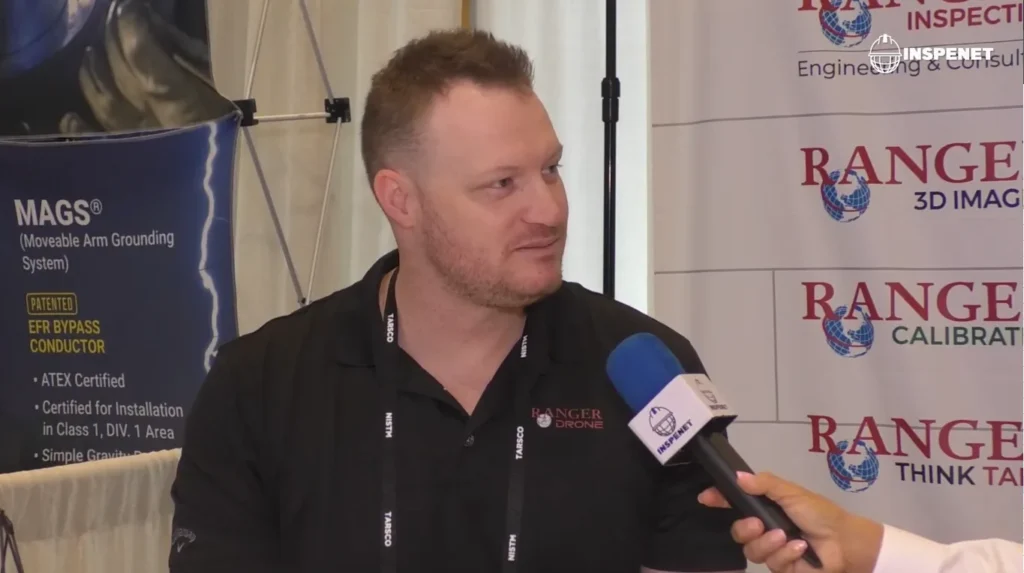
Tank inspections in the oil and gas industry are incorporating high-precision tools to improve operational reliability and regulatory compliance. During NISTM 2026, Gregory Mann, Director of Advanced Services at Ranger Inspection, explained how 3D scanning and drones are transforming industrial inspection processes into critical assets.
Technological advancements in industrial inspections continue to gain traction within the energy sector. During NISTM 2026, one of the most important events for the liquid storage and terminal industry, Ranger Inspection presented its approach based on API inspections supported by advanced technologies such as drones and 3D scanning.
Gregory Mann, explained that the company performs inspections of storage tanks, vessels, and piping systems within the oil and gas industry. The company conducts API 653 inspections for tanks, API 510 inspections for vessels, and API 570 inspections for piping, combining field experience with high-precision digital tools.
In addition, Mann highlighted that the growth of advanced services responds to an increasing market need: to obtain more accurate data on the actual condition of industrial assets.
3D scanning to improve accuracy in API inspections
One of the central aspects of the conversation was the use of 3D scanning in tank inspections. According to Gregory Mann, this technology allows for measurements with millimeter precision and generates a complete representation of the inspected asset.
Previously, many inspection processes relied on conventional methods using hand tools and partial surveys. Now, three-dimensional scanning allows for the analysis of deformations, geometries, and structural conditions with a much greater level of detail.
For companies that operate storage terminals or oil and gas facilities, this type of information facilitates decision-making related to maintenance, repair, and operational continuity.
Likewise, the use of digital models reduces the possibility of omitting critical areas during inspections and allows for more complete records to be kept on the condition of assets over time.
In today's environment, where companies seek to extend the lifespan of their equipment and maintain high levels of mechanical integrity, access to accurate data has become a priority.
Ranger Inspection combines experience and advanced technology
Although technology plays an important role in modern inspections, Gregory Mann stressed that the experience of the staff remains a decisive element in ensuring reliable results.
The executive explained that the accuracy of an inspection depends on both the calibration of the equipment and the technical skill of the inspector operating the tools in the field. In this regard, Ranger Inspection maintains a focus on the training and practical experience of its teams.
Mann mentioned that some of the company's inspectors have participated in thousands of tank inspections throughout their careers. This operational knowledge allows them to identify anomalies, interpret data correctly, and perform assessments more efficiently.
The combination of field experience and digitalization is making a significant difference in API inspections. While advanced systems provide large volumes of information, technical judgment remains essential for validating results and determining corrective actions.
In addition, Ranger Inspection participates in activities related to API standards and technical processes in the sector, which allows it to stay up-to-date on regulatory changes and methodologies applied to asset integrity.
The challenges continue inside the crude oil tanks
Despite technological advancements, industrial inspections still face complex operational challenges. During the interview, Gregory Mann pointed out that one of the main challenges remains the internal cleaning of tanks.
In facilities that store crude oil and other heavy products, the accumulation of residues can affect the quality of the inspection and limit the performance of some measuring equipment.
Mann explained that an inspection depends heavily on the internal conditions of the tank. If the surface is not properly cleaned, some defects or irregularities might be more difficult to detect.
For that reason, preparation tasks continue to be an essential part of any industrial inspection program.
Furthermore, working in confined spaces and large assets requires specific protocols to ensure safety, adequate access, and accurate data collection.
In this context, the use of drones and remote tools also helps to reduce the exposure of personnel in certain operations and facilitates the assessment of complex or hard-to-reach areas.
Technology and operational safety advance together
Another topic addressed during NISTM 2026 was the relationship between technology and compliance with industrial safety standards.
Gregory Mann indicated that digital tools allow for more accurate inspections and improve companies' ability to monitor structural conditions in critical assets.
Within the oil and gas sector, where equipment reliability has a direct impact on operations, the environment, and production continuity, having detailed information is essential to prevent failures and plan interventions.
Ranger Inspection also maintains a corporate culture focused on safety and operational quality. According to the executive, the company strives to perform each inspection under strict technical standards and with constant availability to respond to customer needs.
The growth of technologies such as 3D scanning, industrial drones, and digital data capture is gradually changing the way API inspections are conducted in North America and other energy markets.
Currently, many companies are looking for tools that allow them to obtain faster diagnoses, complete digital records, and greater accuracy regarding the actual condition of their assets.
NISTM 2026 reflects the progress of industrial inspection
Ranger Inspection's participation in NISTM 2026 reflected one of the main trends in the industrial storage sector: the integration of technical expertise and advanced inspection technologies.
As companies face increased regulatory and operational demands, solutions such as drones, 3D scanning, and digital monitoring continue to gain prominence within mechanical integrity programs.
With over 25 years of experience in inspection, evaluation and engineering services, Ranger Inspection maintains a presence in multiple regions and industrial sectors, working on projects related to oil and gas, petrochemicals, mining and industrial storage.
During the event, Gregory Mann made it clear that the company's objective remains the same: to offer reliable inspections, continuous technical support, and solutions tailored to the real challenges facing the energy industry.
For more content about NISTM 2026, visit our LinkedIn profile.
Source: Inspenet.