
Table of Contents
- Difference between predictive and prescriptive maintenance
- Predictive vs. Prescriptive maintenance technical comparative analysis
- Radar profile of capabilities
- Industrial scenario suitability (Bar Chart)
- Selection criteria by scenario
- How AI optimizes industrial assets and maintenance
- Prescriptive analytics for maintenance prioritization
- What data Does a prescriptive AI model need?
- Conclusions
- References
The transition from reactive maintenance to predictive maintenance represented a qualitative leap for industry. However, in highly complex industrial environments, anticipating a failure is no longer enough: the real challenge is knowing what to do with that information, when to act, and how to allocate available resources in the most efficient way. In this context, artificial intelligence introduces a differentiating capability that is redefining asset management in Maintenance 4.0.
As industrial systems integrate increasing numbers of sensors, digital twins, and data historians, the volume of information available to maintenance teams grows at a rate that exceeds human processing capacity. Prescriptive analytics, powered by AI models, closes this gap: it not only identifies anomalies but also generates prioritized action plans, evaluates alternative scenarios, and learns from each intervention.
This article examines, from a technical perspective, how AI is taking industrial maintenance beyond prediction, what the difference is between a predictive and a prescriptive model, what data each approach requires, and what the concrete benefits are for asset management in high-criticality facilities.
Difference between predictive and prescriptive maintenance
Predictive maintenance operates on the premise of anticipation: by analyzing physical signals such as vibration, temperature, ultrasound, or electrical current, machine learning models identify patterns that precede a failure and issue early warnings. The technician receives the information and decides when and how to intervene.
This logic has proven valuable, but ultimately depends on human judgment to translate the alert into action. Prescriptive maintenance goes one step further: it integrates diagnosis with recommendation. A prescriptive system not only detects that a bearing is experiencing accelerated degradation, but also evaluates spare parts availability, operational continuity impact.
The cost of a scheduled shutdown versus an unplanned one, and the workload of the maintenance team, in order to propose the optimal intervention window. Essentially, the system solves the multi-objective optimization problem that a technician would otherwise perform manually.
From an architectural perspective, while predictive maintenance relies on supervised models trained to classify equipment health states, prescriptive maintenance incorporates additional layers: reasoning engines, combinatorial optimization algorithms, and simulation modules that allow scenario comparison before decisions are made.
This difference is significant in facilities where an unplanned shutdown can cost hundreds of thousands of dollars per hour of downtime.
Table: Predictive vs. Prescriptive Maintenance
| Dimension | Predictive Maintenance | Prescriptive Maintenance |
|---|---|---|
| Core function | Detects and anticipates failures | Decides what to do and when |
| System output | Anomaly alert | Prioritized action plan |
| Technology base | Sensors + supervised ML | AI + multi-objective optimization |
| Human intervention | High (technician decides) | Reduced (AI proposes action path) |
| Required data | Vibration, temperature, etc. | Historical + operational context |
| Key value | Prevents unplanned failures | Maximizes availability and ROI |
Predictive vs. Prescriptive maintenance technical comparative analysis
Predictive and prescriptive maintenance represent two of the most advanced stages in the strategic evolution of industrial asset management. Although they share dependence on data and digital technologies, they differ radically in their ultimate objective: one anticipates failure, the other optimizes intervention decisions. This distinction has direct consequences on system architecture, operational model, and return on investment.
The following analysis evaluates both approaches across eight key dimensions, with special emphasis on energy-sector assets: wind turbines, plant compressors, refinery rotating equipment, and electrical distribution networks.
Comparative summary: Predictive vs. Prescriptive analysis
| Criterion | Predictive | Prescriptive |
|---|---|---|
| Definition | Anticipates failures using historical and real-time data | Determines what action to execute, when, and how, optimizing resources automatically |
| Technology base | Supervised ML, vibration analysis, thermography, IoT monitoring | Generative AI, digital twins, constrained optimization, automation |
| Required data | Sensor time series, failure history (2–3 years minimum) | Operational + business context: costs, availability, plant KPIs |
| Action horizon | Days to weeks | Real-time to hours |
| Decision-making | Operator receives alert and decides | System generates work order with instructions |
| Implementation cost | Medium | High (digital twin + ERP/CMMS integration + advanced AI) |
| Market maturity | High | Medium-high (growing post-2020) |
| Estimated ROI | 15–25% reduction in unplanned maintenance costs | 25–40% total optimization (maintenance + availability + energy) |
Radar profile of capabilities
The radar chart allows simultaneous visualization of strengths and gaps across eight technical and operational dimensions. Predictive maintenance excels in technological maturity and diagnostic accuracy, while prescriptive maintenance surpasses in decision automation, response speed, and projected ROI.
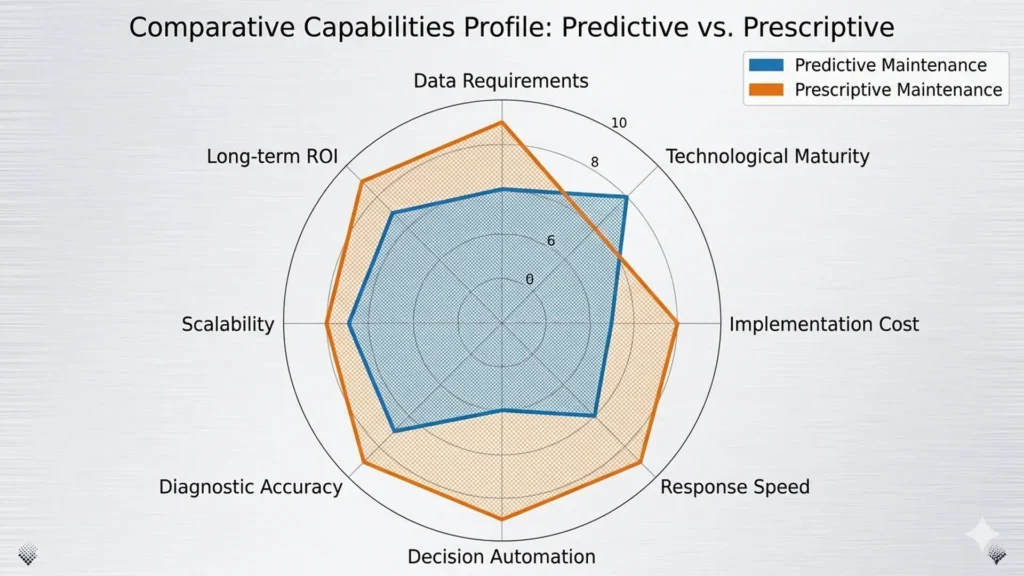
IMPORTANT DATA: Prescriptive maintenance requires between 3 and 5 times more contextual data than predictive maintenance, but it generates directly executable action plans through CMMS systems, eliminating human decision latency.
Industrial scenario suitability (Bar Chart)
Technology selection is not universal: it depends on asset type, existing digital maturity, and operational context. The following chart rates (scale 1–10) the suitability of each approach across six representative energy-sector scenarios.
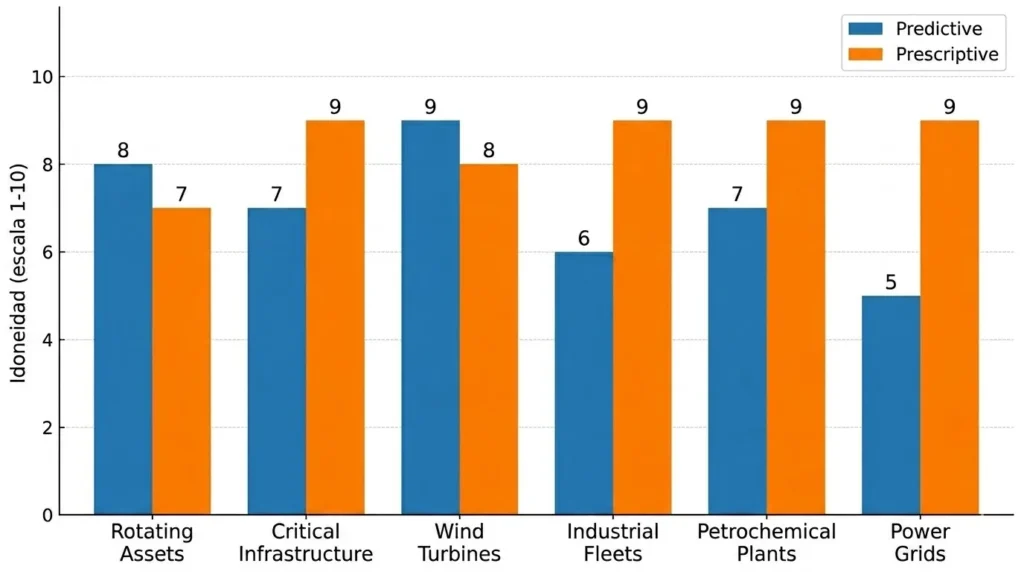
Predictive maintenance retains an advantage in wind turbines due to established platforms such as Vibro-Diagnostics and SCADA-integrated condition monitoring solutions from major OEMs. Prescriptive maintenance, however, delivers greater value in highly interconnected systems: petrochemical plants, electrical grids, and industrial fleets where multi-variable optimization is essential.
IMPORTANT DATA: In electrical grids and generation plants with interconnected assets, prescriptive maintenance can reduce unplanned downtime by up to 65%, compared to 35–40% typical of predictive systems, according to GE Vernova and Siemens Energy studies (2022–2024).
Selection criteria by scenario
When to prioritize predictive maintenance
- Assets with well-documented failure modes and datasets longer than 24 months
- Plants with limited digital transformation budget but existing IoT sensors
- Critical rotating equipment (pumps, compressors, turbines)
- Organizations in early digital maturity stages (Industry 3.5–4.0 transition)
When to prioritize prescriptive maintenance
- High-criticality infrastructure where downtime exceeds $500,000/hour
- Operators with active digital twins and real-time CMMS–ERP integration
- Interdependent asset fleets requiring system-level optimization
- Advanced digital maturity organizations (Industry 4.0+)
How AI optimizes industrial assets and maintenance
One of the most tangible benefits of AI in industrial maintenance is the optimization of scarce resources: specialized technicians, long-lead spare parts, planned shutdown windows, and maintenance budgets.
Prescriptive systems enable a shift from calendar-based planning or individual alert thresholds to dynamic planning that continuously adjusts priorities based on real asset conditions and operational constraints.
In rotating asset management, AI enables Risk-Based Maintenance (RBM) strategies with unprecedented granularity.
The system calculates in real time the criticality index of each asset considering failure probability, consequence severity, and redundancy coverage.
This allows maintenance planners to build a technically objective prioritized backlog, reducing reliance on subjective judgment and bias toward more visible equipment.
From a long-term asset management perspective, AI models provide Remaining Useful Life (RUL) forecasting capabilities, enabling early planning of replacement investments and avoiding both over-maintenance and under-maintenance.
Integration of RUL models with EAM systems and financial planning is emerging as one of the highest-impact applications of Maintenance 4.0.
Prescriptive analytics for maintenance prioritization
A prescriptive model integrates three functional layers operating in coordination.
1. Diagnostic Layer
Real-time sensor data is processed using anomaly detection, spectral analysis, or recurrent neural networks that identify deviations from baseline conditions. This layer feeds the prescriptive system.
2. Contextual Decision Layer
The system integrates additional data sources: maintenance history, spare parts inventory, operational windows, service-level agreements, and production priorities.
The AI engine builds a cost function evaluating possible actions—intervene now, defer, partial maintenance, or increase monitoring—and assigns priority scores.
Optimization methods include mixed-integer programming, deep reinforcement learning, and fuzzy logic heuristics.
3. Continuous Learning Layer
After each intervention, the system compares predicted vs. actual results (repair time, root cause, availability impact) and updates its parameters.
This feedback loop distinguishes mature prescriptive systems from static analytical tools.
What data Does a prescriptive AI model need?
The quality of prescriptive recommendations depends directly on the richness and consistency of input data. Unlike predictive maintenance, which can operate with single-sensor signals, prescriptive models require heterogeneous data integration.
Essential data sources include real-time SCADA/DCS process data, CMMS work order history (SAP PM, Maximo, etc.), spare parts inventory data, inspection records (thermal, oil analysis), and operational context such as production rates and shifts.
Data integration through industrial data lakes or IIoT historians is a technical prerequisite.
Poor maintenance data quality is a major limitation: incomplete CMMS records lead to incorrect learning patterns. Successful implementations therefore include a data cleansing phase before model training.
Conclusions
AI-driven prescriptive analytics represents a significant evolution in industrial maintenance, enabling not only failure prediction but also optimized action recommendations based on operational data and cost-benefit criteria.
The integration of smart sensors, real-time monitoring platforms, and advanced AI models improves operational availability, reduces unplanned downtime, and optimizes the lifecycle of critical assets.
The adoption of prescriptive systems within Maintenance 4.0 is becoming a competitive advantage for industries seeking higher reliability, sustainability, and operational resilience.
References
- McKinsey & Company. (2023). How AI could reshape the economics of the asset-management industry. https://www.mckinsey.com/industries/financial-services/our-insights/how-ai-could-reshape-the-economics-of-the-asset-management-industry
- SAP Community. (2024). Predictive and prescriptive maintenance with artificial intelligence. https://community.sap.com
- Lee, J., Bagheri, B., & Kao, H. A. (2015). A cyber-physical systems architecture for Industry 4.0-based manufacturing systems. Manufacturing Letters, 3, 18–23. https://doi.org/10.1016/j.mfglet.2014.12.001