Table of Contents
- On-stream inspection programs for equipment in service
- Corrosion circuits and damage mechanisms
- Operating windows to control degradation
- Risk-based inspection without stopping operations
- Team roles in an inspection program
- Benefits of an on-stream inspection program
- Conclusions
- References
- Frequently asked questions about on-stream inspection programs
In-service inspection programs are a fundamental strategy for evaluating the mechanical integrity of piping and equipment while they remain in service. Their application allows for the detection of damage mechanisms, control of corrosion circuits, and reduction of failure risk without stopping operations.
In the oil and gas industry, unplanned shutdowns can affect safety, production, and profitability. Therefore, inspecting assets during their operation has become a key practice to improve operational reliability and optimize integrity management.
The effectiveness of these programs depends on correctly identifying corrosion circuits, understanding damage mechanisms, and monitoring process variables that accelerate material degradation. This information allows for establishing priorities and defining more precise inspection strategies.
Supported by standards such as API 570, API RP 571, and the principles of Risk-Based Inspection (RBI), on-stream inspection programs facilitate technical data-driven decision-making, optimize resources, and contribute to extending the useful life of industrial assets.
In this guide, you will learn how to structure an on-stream inspection program, from the selection of circuits and operating windows to the definition of monitoring points and technical responsibilities to strengthen the mechanical integrity of equipment and piping systems.
On-stream inspection programs for equipment in service
On-stream inspection programs allow evaluating the condition of piping and industrial equipment while they continue to operate. Their goal is to detect damage mechanisms before they affect the safety, reliability, or availability of the assets.
This approach helps to plan inspections according to the criticality of each equipment, operating conditions, and corrosion circuits. Thus, it is possible to optimize resources and reduce the need for unplanned shutdowns.
In addition to identifying existing damage, these programs facilitate continuous monitoring of degradation. The information obtained allows for defining repairs, adjusting inspection frequencies, and improving mechanical integrity management.
API 570 is the main reference for in-service piping inspection. Its requirements are complemented by other API standards that cover pressure vessels, heat exchangers, and storage tanks.
Assets covered by the main API standards
| Asset | Standard | Scope |
| Process piping | API 570 | Inspection, repair, and rerating of in-service piping systems. |
| Pressure vessels | API 510 | Inspection, repair, and maintenance of pressure vessels. |
| Heat exchangers | API 572 | Recommended practices for the inspection of pressure vessels and their components. |
| Storage tanks | API 653 | Inspection, repair, alteration, and reconstruction of atmospheric tanks. |
The joint application of these standards allows for the development of more consistent inspection programs. It also strengthens regulatory compliance and improves the operational reliability of the facilities.
Corrosion circuits and damage mechanisms
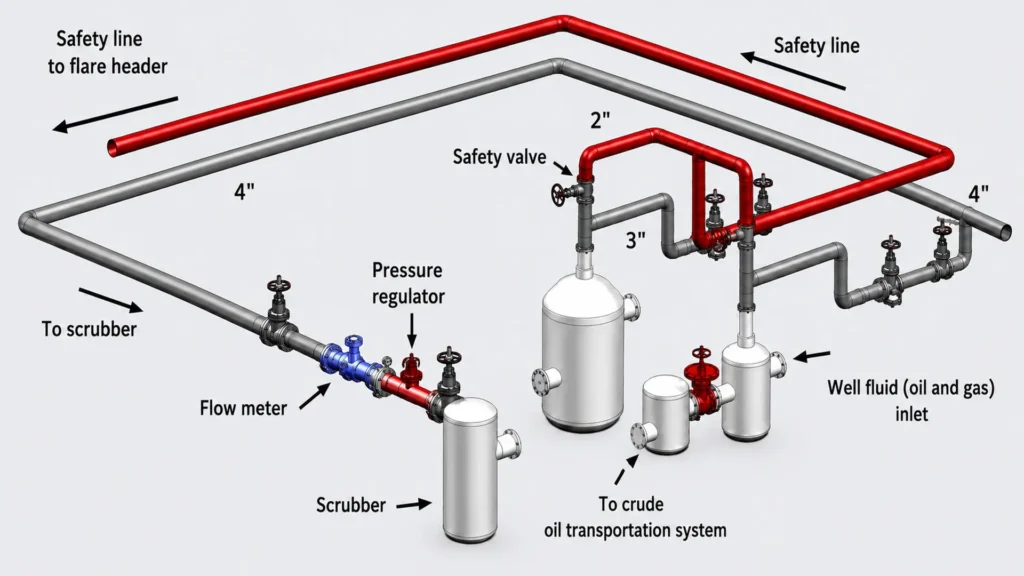
Corrosion circuits are segments of piping or equipment that operate under similar process conditions, construction materials, and exposure to degradation mechanisms. Their identification allows grouping assets with expected deterioration behavior and establishing more efficient inspection strategies.
Each circuit shares variables such as temperature, pressure, fluid composition, flow velocity, and process direction. These conditions determine the damage mechanisms that can develop and help define the most representative inspection and monitoring points.
The correct delimitation of corrosion circuits facilitates the application of on-stream inspection programs. It also allows prioritizing assets according to their criticality and optimizing resource allocation to preserve mechanical integrity.
Damage mechanisms (API 574) correspond to the physical, chemical, or metallurgical processes that cause material degradation during operation. Their identification is essential for selecting inspection techniques, establishing monitoring frequencies, and preventing failures that may affect safety or operational continuity.
Process variables must be kept within previously defined operational limits. When these parameters deviate from the established values, the probability of damage mechanisms accelerating thickness loss, cracking, or equipment deterioration increases.
Relationship between process variables and damage mechanisms
| Process variable | Associated damage mechanism | Potential impact |
| High temperature | Creep | Permanent deformation and reduction of mechanical strength. |
| Presence of H₂S | Sulfidation | Accelerated thickness loss in carbon and low-alloy steels. |
| Free water | Internal corrosion | Localized or generalized attack in piping and vessels. |
| Chlorides | Stress corrosion cracking (SCC) | Formation and propagation of cracks in susceptible materials. |
| Naphthenic acids | Naphthenic acid corrosion (NAC) | Accelerated wear in high-temperature refining units. |
The joint evaluation of corrosion circuits, process variables, and damage mechanisms allows establishing more precise inspection programs. This approach facilitates the early detection of degradation and improves the operational reliability of the facilities.
Operating windows to control degradation
Operating windows are the process limits established to keep equipment within safe operating conditions. Their control allows reducing the probability of materials developing damage mechanisms that compromise the mechanical integrity of the assets.
Each operating window defines acceptable ranges for critical process variables. When any of these parameters exceed the established limits, the risk of corrosion, erosion, cracking, or other degradation mechanisms increases.
Continuous monitoring of these variables allows detecting deviations before they cause significant damage. This information helps adjust the inspection frequency and prioritize circuits with a higher level of risk.
In many on-stream inspection programs, deviations generate technical alerts that trigger additional inspections or increase monitoring of the affected circuit. This approach allows acting preventively and reducing the probability of unexpected failures.
Among the most widely used variables to control operating windows are temperature, pressure, fluid velocity, humidity, pH, and the concentration of corrosive compounds present in the process.
Critical variables in operating windows
| Variable | Associated risk | Possible damage mechanism |
| Temperature | Material overheating | Creep, oxidation, or accelerated corrosion |
| Fluid velocity | Increased turbulence | Erosion-corrosion |
| Humidity | Electrolyte formation | Internal corrosion |
| pH | Corrosive environment | Acidic or alkaline attack |
| CO₂ | Carbonic acid formation | CO₂ corrosion |
| H₂S | Sour environments | Sulfidation and induced cracking |
| Pressure | High stresses | Fatigue or loss of structural integrity |
The control of operating windows complements risk-based inspection and strengthens decision-making during operation. Its proper management allows intervening before process conditions accelerate the degradation of piping and equipment.
Risk-based inspection without stopping operations
Risk-based inspection (RBI) allows prioritizing assets that require more attention according to the probability of failure and its possible consequences. This approach optimizes on-stream inspection programs by concentrating resources where the operational risk is highest.
The methodologies defined in API 580 and API 581 provide a framework for evaluating the risk of in-service piping and equipment. Their application facilitates inspection planning, reduces unnecessary interventions, and improves facility reliability.
Condition monitoring complements RBI through the continuous tracking of process variables and integrity parameters. The combination of both strategies allows detecting changes in asset behavior before they evolve into a failure.
Within this process, Condition Monitoring Locations (CML) and Thickness Measurement Locations (TML) are defined points for measuring material degradation. Their proper selection facilitates tracking thickness loss and the evolution of damage mechanisms.
Corrosion monitoring technologies also allow controlling variables that influence degradation, such as corrosion rate, water content, pH, or the presence of corrosive compounds. This information strengthens decision-making during operation.
The evolution of on-stream inspection is closely related to the digitalization of mechanical integrity programs. Today it is possible to integrate inspection, monitoring, and operational data into platforms that centralize information and improve asset traceability.
In addition, the use of specialized software and artificial intelligence (AI) facilitates the analysis of large volumes of data, the identification of degradation trends, and the prioritization of inspections. These tools support technical decision-making, although the final evaluation remains the responsibility of inspection and engineering personnel.
An example of this technological evolution is Inspect360, TEAM Inc.’s line of solutions, which integrates advanced inspection, 3D scanning, robotics, drones, and digital platforms to support asset inspection while they remain in operation.
These capabilities are part of its Mechanical & Onstream Services division, aimed at strengthening mechanical integrity programs and reducing risk without affecting operational continuity.

Learn about TEAM Inc. solutions on Inspenet
The integration of RBI methodologies, condition monitoring, and digital tools allows for the development of more efficient inspection programs. This approach improves asset availability, strengthens mechanical integrity management, and contributes to safer and more reliable operations.
Team roles in an inspection program
On-stream inspection programs require the coordinated participation of several disciplines. Collaboration among engineering, inspection, maintenance, and operations allows identifying risks, prioritizing assets, and maintaining mechanical integrity throughout the facility’s lifecycle.
The process begins with Process Engineering, which identifies the corrosion circuits and operational variables that can accelerate the degradation of piping and equipment. This information constitutes the basis for the technical analysis.
Subsequently, the corrosion engineer evaluates the damage mechanisms associated with each circuit. They also define the CMLs (Condition Monitoring Locations), TMLs (Thickness Measurement Locations), and inspection zones necessary to control degradation.
With this information, the Inspection Engineer, certified according to ASNT recommended practices, develops and executes the inspection program using the most appropriate non-destructive testing techniques for each asset.
The Maintenance department provides the necessary resources to perform inspections safely. This includes scaffolding, platforms, cranes, insulation removal, and other facilities required to access the equipment.
Finally, Operations and Reliability analyze the results obtained to define preventive actions, adjust process conditions, and optimize the inspection strategy. This joint effort allows reducing risks and improving asset availability. Below is the process infographic:
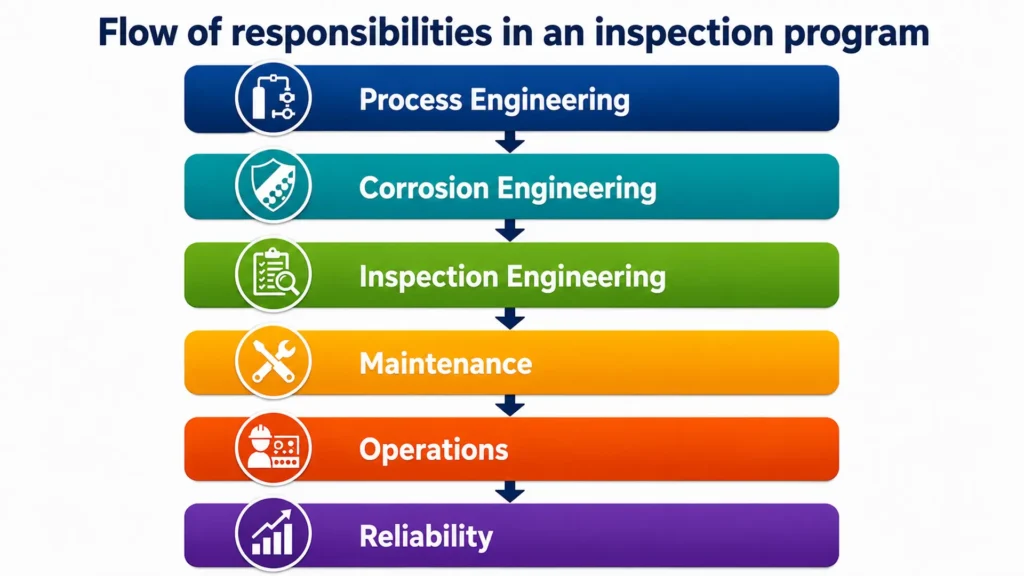
Each area provides essential information for decision-making. The integration of these teams strengthens on-stream inspection programs, improves operational reliability, and facilitates more efficient management of industrial asset mechanical integrity.
Benefits of an on-stream inspection program
An on-stream inspection program allows evaluating asset conditions without interrupting operations. This approach improves facility availability and facilitates the early detection of damage mechanisms.
By knowing the actual state of piping and equipment, organizations can prioritize interventions and avoid unnecessary actions. This promotes more efficient management of inspection and maintenance resources.
The information obtained also allows adjusting frequencies, redefining monitoring points, and anticipating repairs. In this way, the probability of unexpected failures is reduced, and mechanical integrity is strengthened.
Impact on operations and assets
| Benefit | Impact |
| Higher availability | Reduces unplanned shutdowns and maintains operational continuity. |
| Lower risk | Detects damage mechanisms before they evolve into a failure. |
| Longer useful life | Optimizes performance and prolongs asset service. |
| Lower cost | Reduces corrective maintenance and expenses associated with unexpected failures. |
| Better planning | Facilitates the scheduling of inspections, repairs, and shutdowns. |
| Higher reliability | Improves decision-making regarding in-service piping and equipment. |
These benefits increase when the program integrates RBI, condition monitoring, operating windows, and corrosion analysis. The combination of these tools allows focusing resources on the most critical assets.
Furthermore, a well-structured strategy contributes to protecting personnel, the environment, and production. It also improves the traceability of decisions related to inspection, repair, and continued service.
Conclusions
The implementation of an on-stream inspection program allows shifting from a reactive approach to preventive management of mechanical integrity. Instead of relying solely on scheduled shutdowns, organizations can make decisions based on the actual condition of their assets and the behavior of damage mechanisms.
This model is applicable in refineries, petrochemical plants, gas processing facilities, storage terminals, power generation plants, and any industry that operates pressure equipment and piping systems. Its adoption contributes to improving safety, optimizing inspection resources, and increasing operational reliability.
The integration of methodologies such as Risk-Based Inspection (RBI), condition monitoring, operating windows, and digital tools allows building more efficient inspection programs tailored to the current needs of the industry. In an environment where operational continuity and risk management are strategic factors, on-stream inspection is consolidated as an essential practice to preserve asset availability and useful life.
References
- American Petroleum Institute. API Recommended Practice 571: Damage Mechanisms Affecting Fixed Equipment in the Refining Industry (3rd ed.).
- American Petroleum Institute. (2024). API Standard 570: Piping Inspection Code: In-service Inspection, Rating, Repair, and Alteration of Piping Systems (5th ed.).
- American Petroleum Institute. (2024). API Recommended Practice 574: Inspection Practices for Piping System Components (5th ed.).
- American Petroleum Institute. (2023). API Recommended Practice 580: Elements of a Risk-Based Inspection Program (4th ed.).
- American Petroleum Institute. (2025). API Recommended Practice 581: Risk-Based Inspection Methodology (4th ed.).
- American Petroleum Institute. (n.d.). API Standards.
- ASNT. (2024). ASNT Central Certification Program (ACCP) and NDT Personnel Certification.
- TEAM, Inc. (n.d.). Inspect360®: Mechanical & Onstream Services.
- TEAM, Inc. (n.d.). TEAM Inc. | Inspenet Corporate Directory.
- API RP 584 – Integrity Operating Windows (IOW)
- API 510 – Pressure Vessel Inspection Code
- Inspenet TV. (2025, April 16). Technology, precision, and safety: how TEAM leads the evolution of NDT inspection [Video]. Inspenet.
Frequently asked questions about on-stream inspection programs
What is an on-stream inspection program?
It is an inspection strategy that allows evaluating the condition of piping, vessels, tanks, and other equipment while they remain in operation. Its goal is to detect damage mechanisms early to maintain the safety, reliability, and continuity of the process.
What is the difference compared to a plant shutdown?
On-stream inspection is performed with the equipment operating and uses monitoring techniques and non-destructive testing compatible with that condition. In contrast, inspection during a shutdown requires taking the equipment out of service to carry out internal evaluations, repairs, or replacements that cannot be executed during operation.
What is a corrosion circuit?
A corrosion circuit is a set of equipment or piping sections that share similar operating conditions, construction materials, and damage mechanisms. Its identification allows defining specific inspection and monitoring strategies to control the degradation of the assets.
What is an operating window?
An operating window corresponds to the acceptable range of a process variable, such as temperature, pressure, or pH, within which the equipment can operate without significantly increasing the risk of deterioration. When these limits are exceeded, additional monitoring actions or inspections may be triggered.
What standards regulate on-stream inspection?
The main standards and reference documents used in on-stream inspection programs are:
API 570: Inspection of in-service piping systems.
API 510: Pressure vessel inspection.
API RP 571: Identification and evaluation of damage mechanisms.
API RP 574: Inspection practices for piping system components.
API 580: Principles for Risk-Based Inspection (RBI).
API 581: Quantitative methodology for implementing RBI programs.
The joint application of these standards allows for the development of technically sound inspection programs, aligned with international best practices for managing mechanical integrity and the reliability of industrial assets.