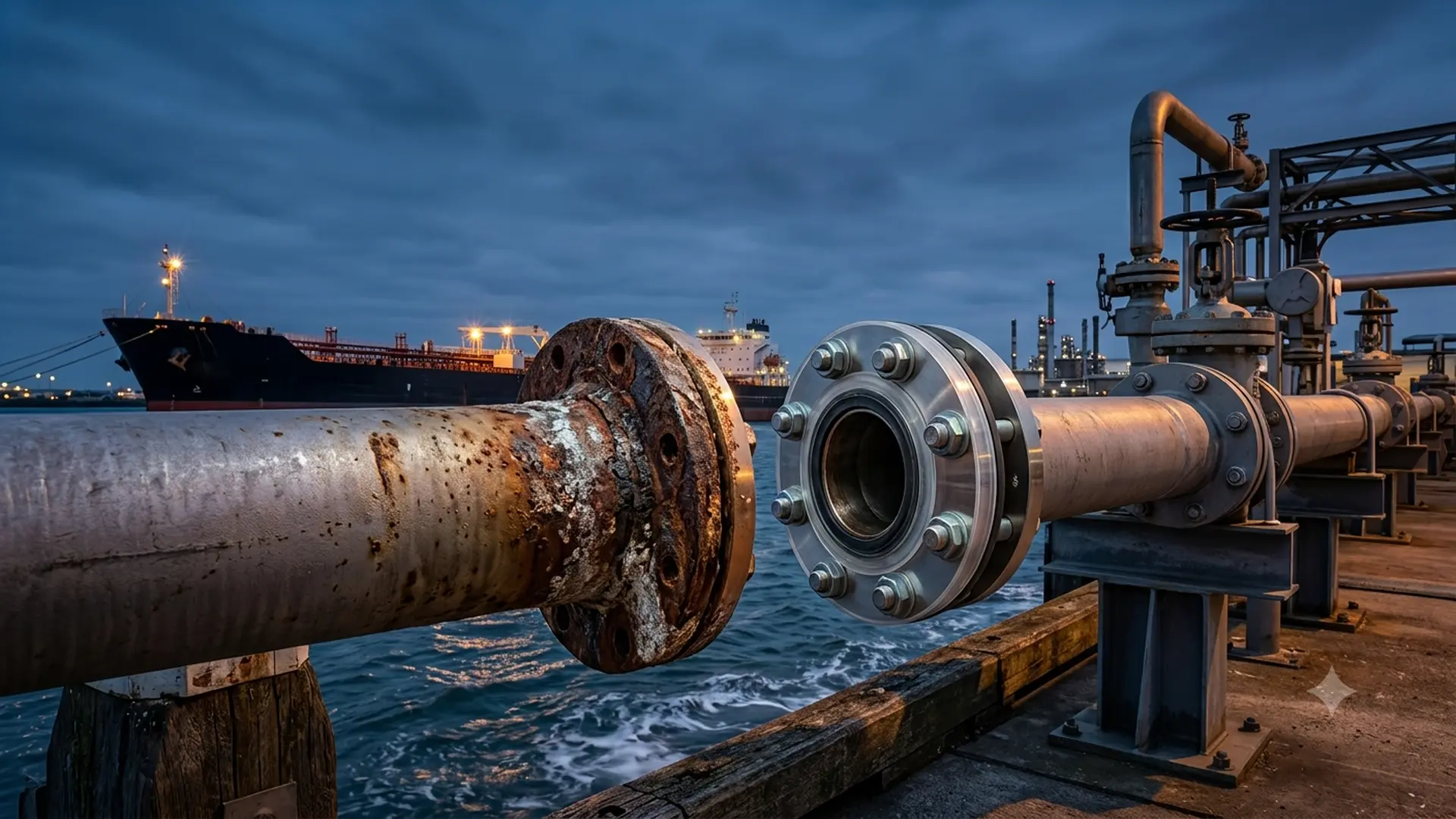
Port and industrial docks are exposed to particularly aggressive conditions: constant humidity, brackish or saline water, and the joining of metallic pipes with structures of different electrochemical potential. When two different metals come into electrical contact within an electrolyte such as seawater, a phenomenon known as galvanic corrosion is generated, capable of deteriorating flanges, bolts, and pipes in much shorter times than expected. Understanding this mechanism and applying adequate electrical isolation solutions is key to protecting the integrity of dock connections.
Galvanic corrosion in dock flanges
Galvanic corrosion represents one of the most frequent deterioration mechanisms in metallic systems where there is electrical contact between different materials exposed to an electrolyte. In port facilities and marine terminals, flanged connections located in loading, unloading, and fluid transfer lines constitute critical points due to the permanent presence of seawater, high humidity, and contaminants that favor the formation of electrochemical cells.
Dock flanges usually integrate components manufactured with different metallic alloys, such as carbon steel, stainless steels, copper alloys, or coated materials, the combination of which can generate electrochemical potential differences. When these materials are electrically connected and exposed to a conductive medium, the less noble metal acts as an anode and experiences an accelerated loss of material.
To control this phenomenon, one of the most widely used strategies in integrity engineering is the installation of electrical isolation kits for flanges, composed of isolating gaskets, bolt sleeves, dielectric washers, and complementary elements designed to interrupt the flow of galvanic current between metallic components.
In this context, specialized companies such as IOCS Italy / IOCS Srl, a Silver ally of Inspenet, offer flanges and electrical isolation kits aimed at controlling galvanic corrosion in dock connections, specialized products that respond directly to this technical problem.
In the following exclusive Inspenet interview, Davide Contino, CEO of IOCS Srl, shares the trajectory of this Italian company, which has consolidated its leadership in the design and manufacture of valves and loading and unloading systems for ships. Furthermore, he explains how the excellence of Made in Italy drives its expansion towards Latin America and offers reliable solutions for the maritime, port, and energy sectors.

Flange isolation kits for mitigation
The most effective way to break the electrical circuit between dissimilar metals is to install flange isolation kits. These assemblies include isolating gaskets, sleeves, and dielectric washers for the bolts, and steel washers that distribute the mechanical load without allowing the passage of current. The objective is simple but critical: to interrupt the electrical continuity between two pipe sections or between a pipe and a dock structure, thus preventing the galvanic cell from being established.
A well-designed flange isolation kit must consider the operating pressure, temperature, the type of fluid transported, and the required dielectric strength. The incorrect selection of materials or a poor assembly can completely nullify the protection, which is why it is recommended to work with specialized suppliers who certify their products under recognized international standards.
Isolating gaskets and electrical isolation
Isolating gaskets are the central component of any electrical isolation strategy in flanges. They are manufactured with non-conductive materials, such as reinforced phenolics, polyamide, or elastomeric compounds with dielectric layers, capable of withstanding the pressure and temperature conditions of the system without losing their insulating properties over time.
In addition to the gasket itself, complete electrical isolation requires:
- Isolating sleeves on each bolt, to prevent direct contact between the metal stud and the flange hole.
- Dielectric washers, which prevent the passage of current through the bolt head or nut.
- Backup steel washers, which distribute the mechanical load and protect the insulating material from overtightening damage.
The correct combination of these elements guarantees that the joint maintains its mechanical strength while eliminating the electrical path that gives rise to galvanic corrosion. It is essential to perform insulation resistance tests after assembly, verifying that there are no accidental electrical bridges due to contact with nearby metallic structures.
Ampp sp0286 and cathodic protection
The implementation of electrical isolation systems in flanges must consider technical criteria established by international standards. The recommended practice AMPP SP0286: Standard Practice for Electrical Isolation of Cathodically Protected Pipelines provides guidelines for the design, installation, and maintenance of electrical isolation systems associated with cathodic protection.
Electrical isolation is especially important in cathodically protected systems because it allows controlling the distribution of applied current. An unwanted electrical connection can generate current losses, interference, and a reduction in the efficiency of the protection system.
In port facilities, flange isolation kits can complement cathodic protection systems through:
- Separation of metallic segments with different protection requirements.
- Control of stray currents.
- Reduction of accelerated corrosion in metallic joints.
- Improvement of the cathodic protection system’s performance.
From an asset integrity management perspective, preventing galvanic corrosion through electrical isolation is a preventive measure that directly impacts operational reliability and safety.
The use of certified and properly selected kits reduces corrective actions, minimizes the risk of leaks, and contributes to compliance with international maintenance and inspection standards.
Application in marine infrastructure and integrity management
Industrial docks, export terminals, and marine transfer systems require specific strategies due to continuous exposure to severe environmental conditions.
Flanged connections located on loading arms, subsea pipelines, transfer lines, and auxiliary systems must be evaluated considering:
- Electrochemical compatibility of materials.
- State of coatings.
- Presence of moisture or saline contamination.
- History of corrosion failures.
- Efficiency of the cathodic protection system.
From an asset integrity management perspective, the prevention of galvanic corrosion through electrical isolation represents a preventive action with a direct impact on operational reliability and safety.
The incorporation of certified and correctly selected kits reduces corrective interventions, minimizes leakage risks, and contributes to compliance with international maintenance and inspection standards.
Conclusions
Galvanic corrosion in dock flanges constitutes a critical degradation mechanism due to the combination of different metallic materials and highly conductive marine environments. Its control requires specific strategies that reduce the electrochemical interaction between components.
Electrical isolation kits for flanges, composed of isolating gaskets, dielectric sleeves, and complementary elements, represent an effective solution for interrupting galvanic circuits and improving the reliability of industrial connections.
The application of good practices such as AMPP SP0286, together with cathodic protection systems, periodic inspection, and proper material selection, allows for the development of more efficient integrity management programs.
Specialized companies such as IOCS Italy / IOCS Srl, a Silver Partner of Inspenet, contribute to the industrial sector by supplying gaskets, flanges, and electrical insulation kits designed to control this type of corrosion in critical applications, including port infrastructure and dock connections.
References
- AMPP. (2022). AMPP SP0286: Standard Practice for Electrical Isolation of Cathodically Protected Pipelines. Association for Materials Protection and Performance.
- Baboian, R. (Ed.). (2005). Corrosion Engineer’s Reference Book (3rd ed.). NACE International.
- Jones, D. A. (1996). Principles and Prevention of Corrosion. Prentice Hall.
- Revie, R. W., & Uhlig, H. H. (2008). Corrosion and Corrosion Control: An Introduction to Corrosion Science and Engineering (4th ed.). John Wiley & Sons.
- Roberge, P. R. (2012). Handbook of Corrosion Engineering (2nd ed.). McGraw-Hill.
- IOCS Srl. (2026). Electrical insulation kits and flange isolation solutions for industrial applications. IOCS Italy.