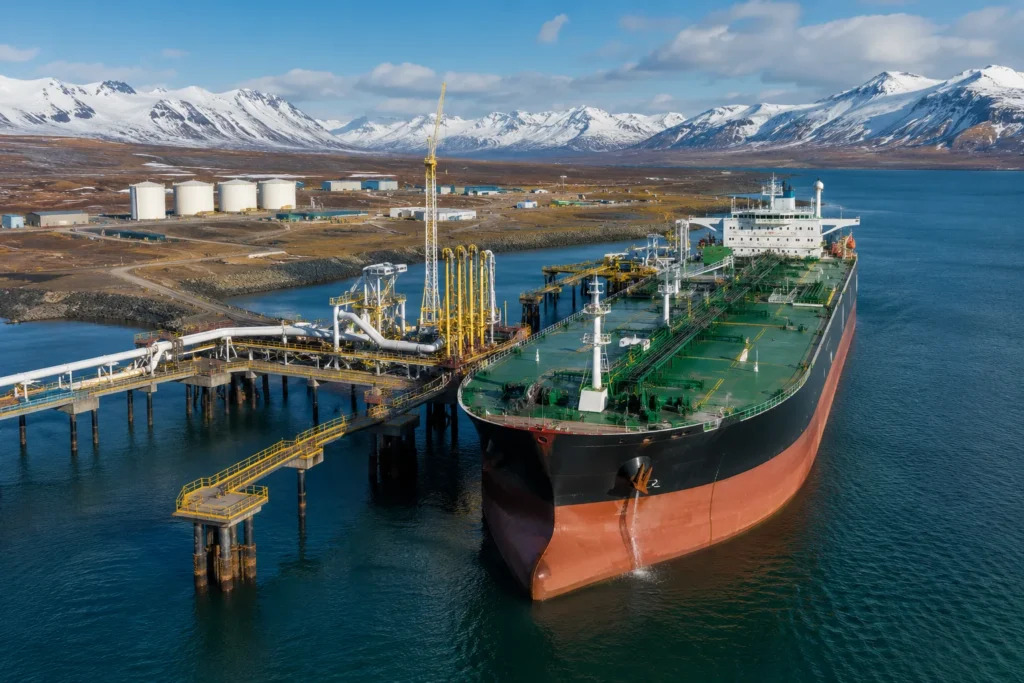
Pikka first cargo has departed Alaska with 450,000 barrels of crude oil, marking a new milestone for the development operated by Santos in partnership with Repsol on the North Slope. The volume was loaded onto the Polar Resolution tanker at the Valdez Marine Terminal and will be transported to refineries on the U.S. West Coast, according to information released on August 11.
The commercial operation comes after Pikka’s project Phase 1 achieved first oil in May 2026, ahead of the originally planned schedule. Since then, the project has begun progressively increasing its volumes as it moves toward an estimated plateau production of approximately 80,000 barrels per day (bpd).
Pikka is currently producing around 23,000 bpd, according to Santos. The development represents one of Alaska’s major new oil projects and is expected to bring approximately 400 million barrels of gross proven plus probable (2P) reserves into production.
Pikka First Cargo Opens the Project’s Commercial Phase
The shipment of the first 450,000 barrels introduces a new stage for Pikka Phase 1. After starting production, the project is now beginning to move crude oil from Alaska to the U.S. market.
The cargo was transferred to the Polar Resolution at Valdez, the outlet for the oil transportation system connecting North Slope production with Alaska’s southern coast. Its destination will be refineries on the U.S. West Coast.
The event distinguishes two milestones for the project. The first occurred in May, when Pikka began producing oil. The second is now materializing with the loading of a commercial volume for transportation to refineries.
Santos expects Phase 1 to reach plateau production during the third quarter of 2026. The target of approximately 80,000 bpd would represent more than three times the current level of 23,000 bpd as additional wells and associated facilities continue to be brought online.
Pikka Phase 1 targets production of 80,000 bpd
Pikka combines a significant resource base with infrastructure designed to develop the field progressively.
Phase 1 includes 45 wells from a single well pad. When Santos and Repsol announced first oil in May, 28 of those wells had already been drilled. The project also includes processing facilities, seawater supply and treatment systems, export infrastructure, and a remote operations center.
Repsol reported at the time that Pikka Phase 1 had started production ahead of the originally planned schedule and placed its plateau capacity at approximately 80,000 bpd. The company estimated that this volume would represent about 19% of Alaska’s oil production once the targeted level is reached.
The scale of the development is also reflected in its resources. Phase 1 is designed to bring approximately 400 million barrels of gross 2P reserves into production. Santos holds a 51% interest and serves as operator, while Repsol holds the remaining 49% stake.
Santos and Repsol prepare the potential for a second phase
The infrastructure built for Phase 1 could also become the foundation for a future expansion of Pikka.
A potential Phase 2 would make use of assets already developed during the first stage, including roads, the export pipeline, seawater supply systems, camps, and processing facilities. This strategy would make it possible to bring additional volumes into production by utilizing part of the existing infrastructure.
According to estimates disclosed by Repsol and reflected in available industry information, a second phase could add approximately 40,000 gross bpd of additional production.
However, the expansion has not yet reached a final investment decision. The companies continue to evaluate the development, and a potential FID could take place in 2027.
Therefore, the additional 40,000 bpd should be understood as the potential of a future expansion rather than currently approved capacity.
Pikka moves from execution to operations
The first cargo also represents a shift in priorities for Santos. After several years focused on construction, drilling, and commissioning, Pikka is beginning to transition into a stage in which production, costs, and operational reliability will take on greater importance.
Santos CEO Kevin Gallagher said the company is moving from project execution toward a disciplined, low-cost operating model while continuing to pursue technical improvements throughout the drilling program.The start-up of Pikka has also led Santos to set its 2026 full-year production guidance at between 99 million and 105 million boe.
For the project, the next objective will be to progressively reach the approximately 80,000 bpd targeted for Phase 1 during the third quarter. With 450,000 barrels already loaded at Valdez, Pikka has now passed another critical milestone in its development: after transforming North Slope resources into production, Santos and Repsol are now beginning to move those barrels into the U.S. market.
Source: Upstream