Australia will test AI-powered solar inspection robots to automate the diagnosis of photovoltaic modules and reduce operating costs, Autonomous robots they will begin to be incorporated into large photovoltaic plants in Australia through testing of NX Ranger, an electrical team designed to inspect solar panels with the help of artificial intelligence and thermo-optical cameras.
Technology is part of Lightspeed Solar a three-year project supported by the Australian Renewable Energy Agency (ARENA) aims to accelerate the adoption of automated systems in the construction and operation of solar farms. To develop the program, ARENA granted $25 million to Equans Solar & Storage the initiative will allow the evaluation of up to ten technologies related to civil works, mechanical and electrical work, operation and maintenance, and digital coordination.
Autonomous robots will bring solar inspection to photovoltaic parks
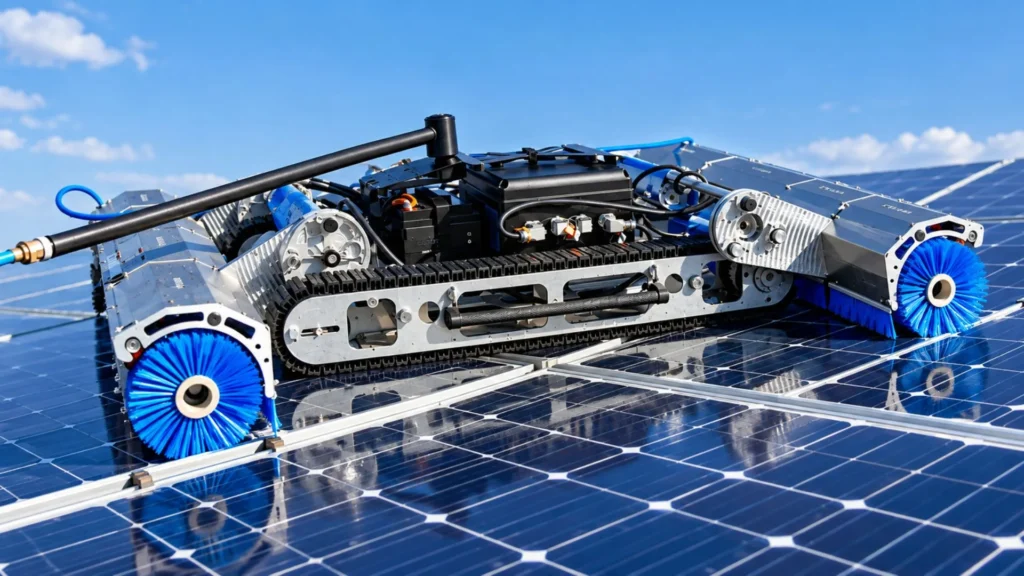
One of the technologies that will be tested is Nextpower Ranger, also known as NX Ranger, the team will conduct its first demonstration inside an Australian solar park. The robot can move autonomously between rows of modules and examine their undersides. To do this, it combines thermal and optical cameras with artificial intelligence systems capable of detecting and highlighting potential anomalies.
Its 4WD system is also designed to operate in remote terrain, where conventional inspections may require more time, travel, and specialized personnel. Another key feature is its ability to process information directly on board. This allows for results to be obtained during the journey, making it easier for operators to identify potential faults without relying solely on subsequent data loading and analysis.
Artificial intelligence enters photovoltaic maintenance
The NX Ranger joins a growing generation of autonomous robots for inspection of solar panels in Australia, the CSIRO is already testing a robot called Bear and compares its performance with inspections carried out by technical personnel. The arrival of the NX Ranger expands this type of testing to include commercial applications in large-scale photovoltaic plants.
The goal is to test under real-world conditions the extent to which robotics can reduce labor-intensive tasks and streamline operations and maintenance. However, Lightspeed Solar’s work will not be limited to inspections. The program also includes construction robots and automated piloting systems technologies aimed at improving productivity and streamlining the execution of new solar projects.
ARENA aims for even cheaper solar energy
Automation is part of a broader economic objective, ARENA works under its vision called 30-30-30, the agency, which aims to achieve photovoltaic modules with an efficiency of 30 % and an installed cost of 30 cents per watt by 2030, also aspires to bring the cost of solar electricity below $20 per megawatt-hour.
Achieving these figures does not depend solely on reducing the price of the modules, the tasks of construction, inspection, maintenance, and coordination of solar parks also offer room to decrease costs through the use of robotics and digital tools.
Darren Miller, ARENA’s CEO, explained that grouping several technologies within a single funding portfolio allows for faster and larger-scale testing in real-world environments. The model also facilitates sharing the knowledge gained during testing with the rest of the industry.
Australia expands its solar automation trials
ARENA already applies a similar strategy together with Fortescue the agency awarded $45 million to develop a testbed for up to ten technologies within the mining company’s solar portfolio in Pilbara. One of these projects allowed for the evaluation of autonomous piloting technology, Built Robotics in the Cloudbreak solar park, under the remote conditions characteristic of the region.
Now, the collaboration with Equans aims to expand this model and validate new technologies capable of changing how photovoltaic plants are designed, built, and operated. Benoit Froidurot, director of innovation and development at Equans, believes that the projected growth of renewable assets will increase the importance of combining robotics, digital systems and artificial intelligence in the sector’s operations.
The NX Ranger tests will allow this potential to be verified directly in the field and assess whether solar inspection robots can accelerate module diagnostics, reduce the need for manual tasks, and contribute to lowering the operating costs of large-scale photovoltaic plants.
Source: Renew Economy
Photo: Shutterstock