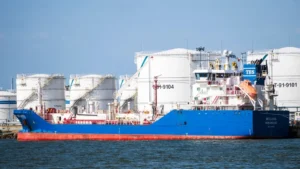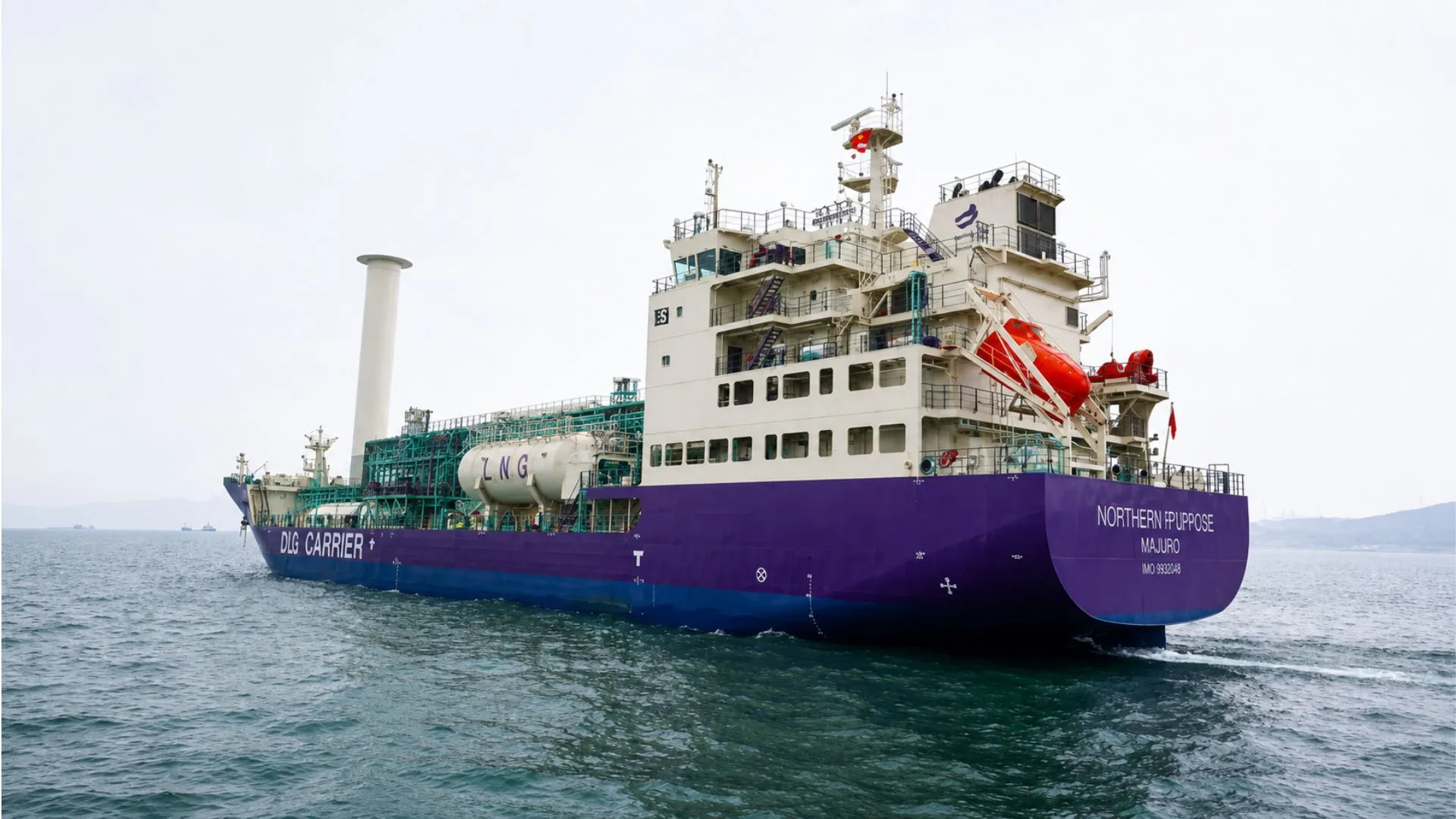
Northern Lights it completed the fleet necessary for the first phase of its operations after the arrival in Norway of the Northern Purpose, its fourth ship designed for transport liquefied carbon dioxide.
The vessel joins the Northern Pioneer, Northern Pathfinder and Northern Phoenix; the four ships will allow the collection of CO₂ captured in European industrial facilities and its transfer to the Øygarden reception terminal.
Northern Purpose completes the first phase of the fleet
The Northern Purpose was built by Dalian Shipbuilding Offshore Co. in China and christened on May 19, after its delivery, the vessel sailed from Asia to Europe to join Northern Lights’ operations.
The vessel is 130 meters long and has a cargo capacity of 7,500 cubic meters; the liquefied CO₂ is distributed in two pressurized cylindrical tanks developed to maintain the necessary conditions during maritime transport.
Likewise, the ship has a dual fuel propulsion system it can use liquefied natural gas, its design also incorporates a wind-assisted rotor sail and an air lubrication system to reduce hull drag.
These technologies aim to limit energy consumption and emissions associated with travel between European industrial ports and the west coast of Norway.
CO₂ maritime transport to Øygarden
The ships of Northern Lights they will transport carbon dioxide captured by industrial customers from Europe to the Øygarden terminal.
Once released, the CO₂ will be piped to a geological storage facility located beneath the seabed, the installation allows for the permanent storage of carbon at a depth of approximately 2,600 meters.
This model creates a cross-border chain connecting emissions plants with maritime infrastructure, land terminals, and offshore storage. In this way, companies that lack their own storage facilities can contract carbon transport and storage services.
The first phase of Northern Lights has an approximate capacity of 1.5 million tons of CO₂ per year, the company plans to increase this to more than five million tons annually during a second phase.
Northern Lights expands its carbon infrastructure
Northern Lights it is a joint venture owned equally by Equinor, Shell and TotalEnergies; its first phase is part of Longship, the carbon capture and storage program promoted by the Norwegian Government.
In August 2025, the companies injected and stored the first volumes of CO₂ from the project; this operation marked the beginning of commercial activity for an infrastructure designed to receive carbon from third parties.
For Tim Heijn, CEO of Northern Lights JV, the arrival of the Northern Purpose will allow them to offer more reliable and flexible services to European customers.
The company is also preparing to expand its maritime capacity; Northern Lights announced charter agreements with Mitsui O.S.K. Lines and with a consortium made up of Kawasaki Kisen Kaisha and MISC to incorporate four additional vessels.
Furthermore, the second phase includes larger capacity vessels starting in 2028; the expansion will respond to the expected growth in European demand for transport and permanent storage of CO₂.
With the first four vessels operational, Northern Lights now has the fleet planned to begin its regular service and connect European industrial emitters with the Norwegian geological storage infrastructure.
Source: Offshore energy
Photo: Northern Lights