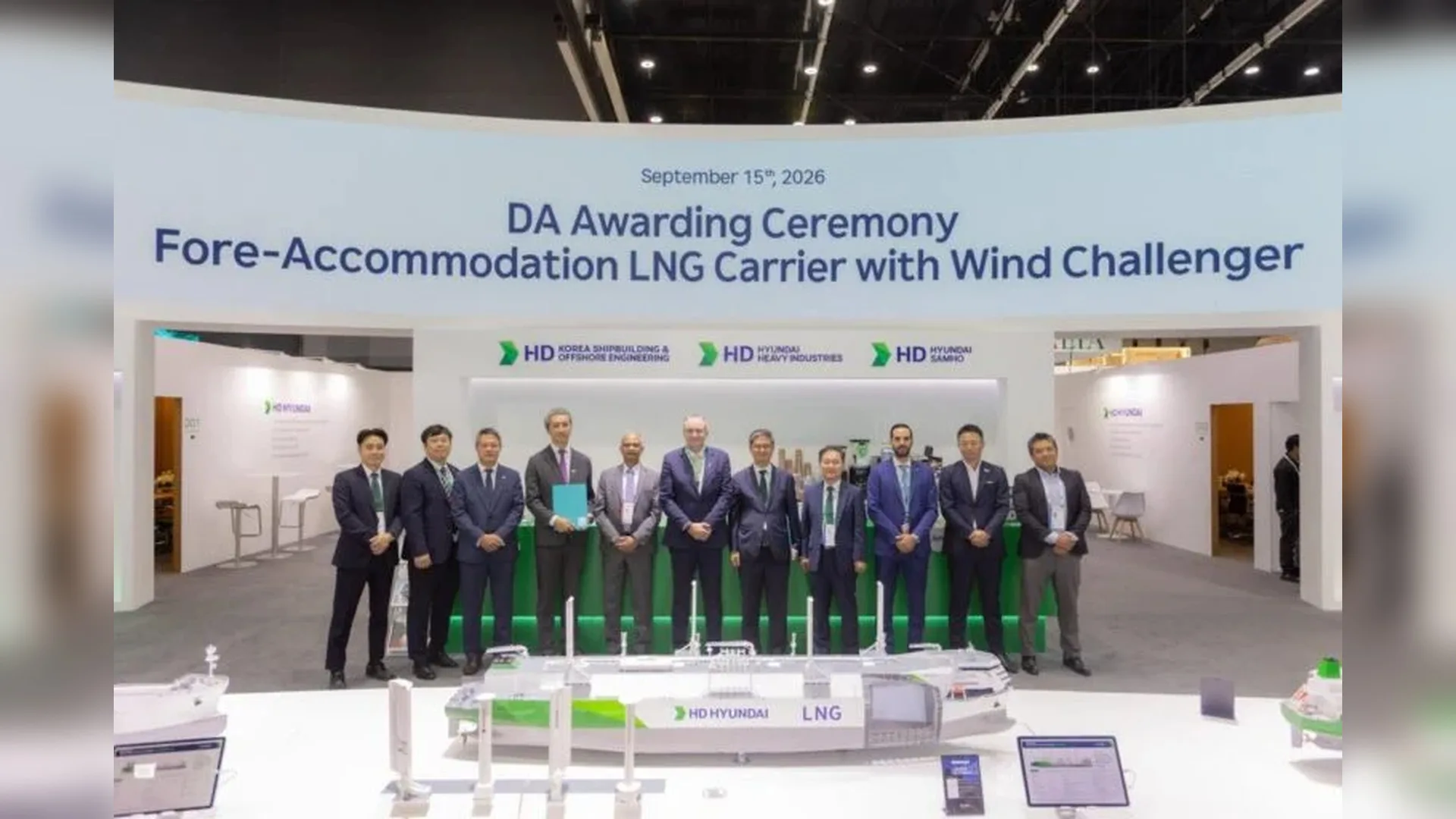
Lloyd’s Register (LR) completed the design evaluation of a new LNG carrier developed by HD Hyundai Heavy Industries (HHI), which incorporates four rigid Wind Challenger sails from Mitsui O.S.K. Lines (MOL).
The concept introduces a significant change to the usual configuration of this type of vessel, the accommodation block and navigation bridge are moved forward. This arrangement frees up a large section of deck from the midships to the stern for installing the wind-assisted propulsion system.
The assessment also confirms that the concept meets the requirements of Lloyd’s Register’s WAPS notation, intended for wind-assisted propulsion systems.
The LNG carrier moves its accommodation to the bow
The location of the accommodation is one of the central elements of the project, by moving this structure and the navigation bridge towards the bow, HHI manages to free up more deck space to integrate the velas Wind Challenger.
This configuration allows the number, size, and location of the sails to be adapted to the design requirements. This flexibility aims to make better use of available wind energy without affecting the operational, safety, and navigation requirements of the LNG carrier.
The partners present the concept as the first forward-accommodation LNG carrier designed to incorporate four Wind Challenger sails.
The project brings together HD Hyundai Heavy Industries, Mitsui O.S.K. Lines, Lloyd’s Register, and the Maritime Administration of the Republic of the Marshall Islands. Its development had already received Approval in Principle (AiP) from Lloyd’s Register during Gastech 2025.
Four Wind Challenger sails to support propulsion
Wind Challenger is the rigid sail system developed by MOL to harness wind energy to support conventional ship propulsion.
In this design, four units can be installed on the deck freed up after the accommodation and bridge are moved forward. The proposal aims to incorporate wind power into the operation of a vessel intended for the maritime transport of liquefied natural gas.
The arrangement also addresses one of the main challenges of installing wind propulsion systems on large vessels: having enough space on deck without interfering with the necessary operations of the ship.
According to MOL, the concept demonstrates that it is possible to integrate four Wind Challenger sails while maintaining safety, operational efficiency and regulatory compliance criteria.
Lloyd’s Register assessed the integration of the WAPS system
The technical review was not limited to checking the location of the sails, the partners analyzed various aspects related to the integration of a WAPS system on a methane carrier.
Factors evaluated included the visibility required for navigation, hull stability, and structural loads generated by rigid sails. The integration of emergency stop systems (ESD) was also reviewed.
The process also included a HAZID study to identify potential hazards, as well as risk assessments carried out in accordance with Lloyd’s Register’s risk-based certification process.
These analyses are especially relevant because the incorporation of large structures on deck modifies the stability, visibility and resistance conditions that must be considered during the design of the ship.
After completing the review, LR determined that the concept satisfies the requirements of its WAPS notation for the safe and effective application of wind-assisted propulsion systems.
HHI and MOL bring the concept closer to a commercial application
HD Hyundai Heavy Industries believes that the evaluation reflects the level of technical maturity achieved by the design and allows progress towards a possible commercial application.
The combination of forward accommodation with Wind Challenger sails offers HHI the possibility of studying a different architecture for future LNG carriers, integrating wind assistance technologies without abandoning class requirements or the conditions necessary to operate an LNG carrier.
MOL, for its part, frames the project within its efforts to bring wind-assisted propulsion to larger-scale vessels. For the Japanese shipping company, the design demonstrates that four sails can be incorporated into an LNG carrier while maintaining the safety, operational, and regulatory compliance criteria considered during its development.
Wind-assisted propulsion for LNG transport
The project seeks to harness wind as a complementary energy source to reduce dependence on conventional propulsion under certain navigation conditions.
MOL believes that the application of wind-assisted propulsion at this scale could contribute to reducing greenhouse gas emissions associated with LNG shipping.
The Marshall Islands Maritime Administration is also involved in the project and has highlighted the importance of having strong regulatory frameworks for the introduction of new naval configurations.
With the design evaluation now complete, HHI, MOL and their partners have a more advanced technical basis to continue developing the four-sail LNG carrier Wind Challenger and study its future incorporation into commercial LNG transport.
Source: Offshore Energy
Photo: Lloyd’s Register