Table of Contents
- What should be defined in the offshore mooring analysis prior to FEED?
- Metocean analysis and design load cases
- Mooring loads and vessel offset
- Mooring system design: variables governing system response
- From static equilibrium to dynamic mooring analysis
- Technical definition of the configuration before FEED
- Conclusions
- References
- Frequently Asked Questions (FAQs)
A mooring arrangement defined at an early stage must keep the floating unit within an excursion envelope compatible with mooring line strength, anchor capacity and the motion limits imposed by subsea interfaces. Offshore mooring analysis establishes this response before the geometry that will progress into the next engineering phase is fixed.
Before FEED (Front-End Engineering Design), the technical criteria, interfaces and design conditions governing the system need to be sufficiently defined. If governing line tensions, vessel offsets or anchor loads fall outside the applicable criteria, pretension, mooring radius, line azimuths, line composition or anchor locations can still be revised before detailed engineering begins.
What should be defined in the offshore mooring analysis prior to FEED?
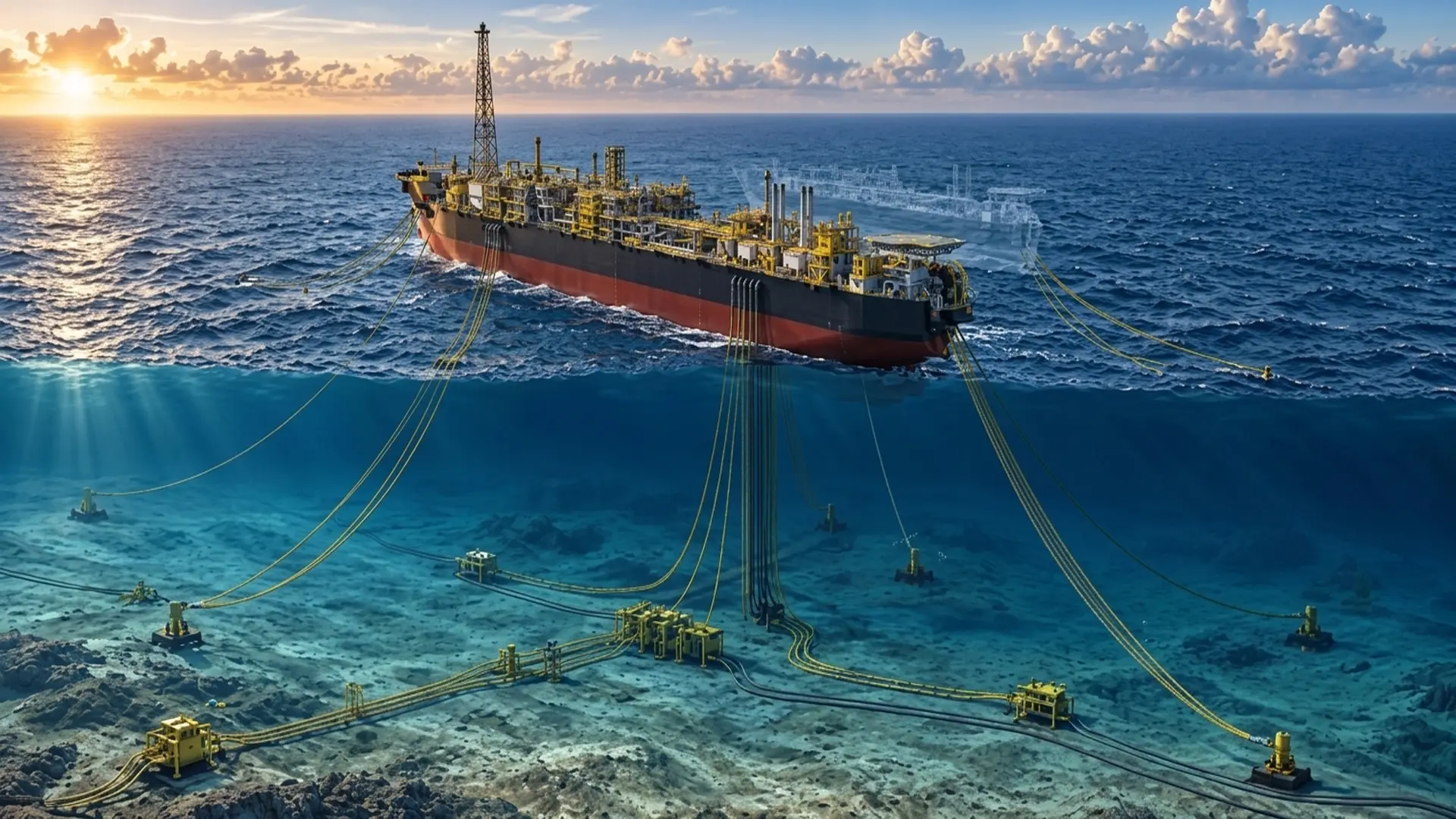
The mooring system must provide sufficient restoring stiffness to limit the horizontal excursion of the floating unit under wind, current and wave loading. Its response depends on the mooring arrangement, water depth, axial properties of the lines, pretension, fairlead positions, anchor characteristics and the hydrodynamic behaviour of the vessel.
The analysis must identify extreme line tensions, maximum vessel offsets, anchor loads and clearances to risers, umbilicals, flowlines and nearby subsea structures. The governing condition may be determined by line strength, anchor capacity, an offset limit or the available subsea clearance.
Design and analysis criteria
ISO 19901-7:2026, the third edition published in July 2026, specifies methodologies for the design, analysis and evaluation of stationkeeping systems for floating offshore structures and for the site-specific assessment of mobile offshore units.
Its scope covers system configuration and performance, selection and design of components, installation and assessment of the as-installed condition. The 2026 edition replaced ISO 19901-7:2013 and extends these requirements across the different stages of the mooring system life cycle.
API RP 2SK, Fourth Edition, February 2024, provides recommended practices for the design and analysis of mooring-based stationkeeping systems, with or without thruster assistance. It distinguishes requirements applicable to permanent and mobile mooring systems and addresses conditions ranging from normal operation to survival environments.
The methodology relates the design environment to system responses such as mooring line tensions, vessel offsets and anchor loads. These results are then assessed against the applicable line strength, excursion and anchoring capacity limits.
Metocean analysis and design load cases
Metocean analysis provides the environmental inputs used in the model. Wave height and period, wave spectrum and direction, current velocity and profile, together with wind speed and direction, determine the environmental loading acting on the floating unit.
The resulting response includes a mean component associated with sustained environmental forces, wave-frequency motions associated primarily with first-order wave excitation, and a low-frequency component driven mainly by second-order wave drift forces.
For large floating units, low-frequency behaviour can have a significant influence on vessel excursion and maximum mooring line tensions. Environmental directionality also changes the distribution of loads across the mooring system and can shift the governing condition from one group of lines to another.
DNV-RP-C205, Edition 2025-04, amended in March 2026, provides criteria and guidance for characterising wind, waves and currents and for determining the environmental loads applied in the analysis of marine structures.
Mooring loads and vessel offset
Mooring loads depend on the instantaneous position of the floating unit. In a catenary mooring system, the length of line resting on the seabed decreases as vessel excursion increases, changing the touchdown point, line geometry and horizontal tension component.
In taut or semi-taut mooring configurations, axial stiffness makes a greater contribution to the restoring force. Material, line length, submerged weight and elongation characteristics determine the relationship between vessel displacement and line tension.
Pretension directly affects this relationship. Increasing pretension can restrict certain vessel motions, but it also increases initial line tension and the loads transferred to mooring lines, connectors, fairleads and anchors.
Vessel offset, defined as the excursion of the floating unit from its reference position, may be constrained by risers, umbilicals, transfer hoses, exclusion zones or nearby subsea infrastructure.
A configuration may therefore satisfy mooring line strength criteria and still be governed by an offset or clearance limitation. The assessment must consider line tension, system stiffness, anchor capacity and field geometry together.
Mooring system design: variables governing system response
Mooring system design requires comparison of alternative line counts, azimuths, mooring radii, line lengths, materials, diameters, pretensions, fairlead positions and anchoring concepts. Each variable changes the global stiffness of the system and the distribution of loads.
Sensitivity analysis can be used to identify which parameters have the greatest influence on system response. A change in environmental direction can alter the governing mooring line, a variation in stiffness can change vessel offset, and a subsea constraint may require changes to the mooring radius or line azimuths.
Anchor capacity must also be assessed as part of the global system response. Increasing system stiffness to reduce vessel excursion can increase the loads transferred to the anchoring system and consequently affect its geotechnical requirements.
The intact and damaged conditions required by the applicable design criteria produce different system responses. Loss of a mooring line redistributes tensions and changes the equilibrium position of the floating unit, potentially making vessel offset or subsea clearance the new governing criterion.
For floating assets, offshore station keeping depends on the restoring stiffness of the mooring arrangement, anchor capacity and the excursion limits established for the field interfaces.
From static equilibrium to dynamic mooring analysis
The appropriate analysis method depends on the project phase, system characteristics and sensitivity of the response. The three main levels can be summarised as follows:
| Method | Primary application |
| Static | Equilibrium position, pretensions and load-displacement relationship. |
| Quasi-dynamic | Efficient comparison of configurations using simplified assumptions. |
| Dynamic | Mooring tensions and vessel offsets considering the time-dependent response of the system. |
In quasi-dynamic analysis, mooring lines can be represented using analytical catenary formulations while the degrees of freedom of the vessel are calculated. This simplification reduces computational effort when its underlying assumptions are appropriate for the system being assessed.
Dynamic analysis incorporates mass, damping, stiffness, loading and changing system geometry throughout the simulation. OrcaFlex provides frequency-domain and time-domain dynamic analysis capabilities, as well as quasi-dynamic analysis for mooring applications.
In time-domain analysis, the system geometry evolves throughout the integration process, allowing nonlinear system behaviour to be represented. The choice between analytical methods should therefore be based on the physical phenomena that need to be resolved and the level of accuracy required for the governing load cases.
Technical definition of the configuration before FEED
The configuration progressing into FEED should be supported by a defined metocean basis, vessel loading conditions, bathymetry, field constraints, preliminary mooring geometry, representative line properties, pretensions and anchoring concepts.
The analysis results identify the cases governing line tensions, vessel offsets and anchor loads. Constraints imposed by risers, umbilicals, subsea structures and exclusion zones should also be clearly established.
Within this scope, Axiom Offshore provides Mooring & Station Keeping services covering mooring analysis, design and positioning studies for floating assets. Its Hydrodynamics & Motions capabilities complement these studies through vessel motions, seakeeping and hydrodynamic analysis used to assess performance, operability and environmental loading.
The company also performs static and dynamic analyses for assets using spread mooring arrangements and single-point mooring (SPM) systems, including applications at marine terminals and single-point moorings, together with fatigue assessments and extreme environmental condition evaluations.
In a recent project, Axiom Offshore completed a Preliminary Mooring Analysis using OrcaFlex that included modelling the vessel at the project site, assessing mooring system performance and configuration, evaluating global behaviour under site-specific metocean conditions, reviewing vessel offsets and anchor loads, and identifying opportunities for optimisation.
For projects where the mooring configuration, anchor loads or vessel offset limits need to be established before FEED, the technical scope can be discussed directly with Axiom Offshore through Inspenet Corporate Connect.
Conclusions
A mooring configuration progressing into FEED must demonstrate compatibility between mooring line tensions, vessel excursion, anchor capacity and the clearances available within the field. Maximum line tension, maximum vessel offset and peak anchor load may occur under different environmental combinations.
Offshore mooring analysis must identify these governing cases and the variables to which system response is most sensitive before the reference configuration is fixed. This definition allows FEED to proceed with a mooring system whose global behaviour has already been assessed against the applicable technical limits and project interfaces.
References
- API RP 2SK. Design and Analysis of Stationkeeping Systems for Floating Offshore Structures. Fourth Edition, 2024.
- Axiom Offshore. Mooring & Station Keeping; Hydrodynamics & Motions.
- DNV-RP-C205. Environmental conditions and environmental loads. Edition 2025-04, amended 2026-03.
- ISO 19901-7:2026. Specific requirements for offshore structures, Part 7: Stationkeeping systems for floating offshore structures and mobile offshore units.
- Orcina. OrcaFlex Documentation, Dynamic and Quasi-dynamic Analysis.
Frequently Asked Questions (FAQs)
What does offshore mooring analysis evaluate?
It determines mooring line tensions, vessel offsets, anchor loads and subsea clearances under the environmental conditions defined for the project site.
What is vessel offset?
It is the excursion of the floating unit from its reference position. Its allowable limit may be governed by risers, umbilicals, transfer systems or nearby subsea infrastructure.
What does metocean analysis contribute to mooring design?
It defines the combinations of wind, waves and current used to calculate the environmental loads governing line tensions, vessel motions and demands on the anchoring system.
When is dynamic mooring analysis required?
It is required when the time-dependent response of the vessel and mooring lines has a significant influence on extreme tensions, vessel offsets, fatigue or loads transferred to the anchoring system.