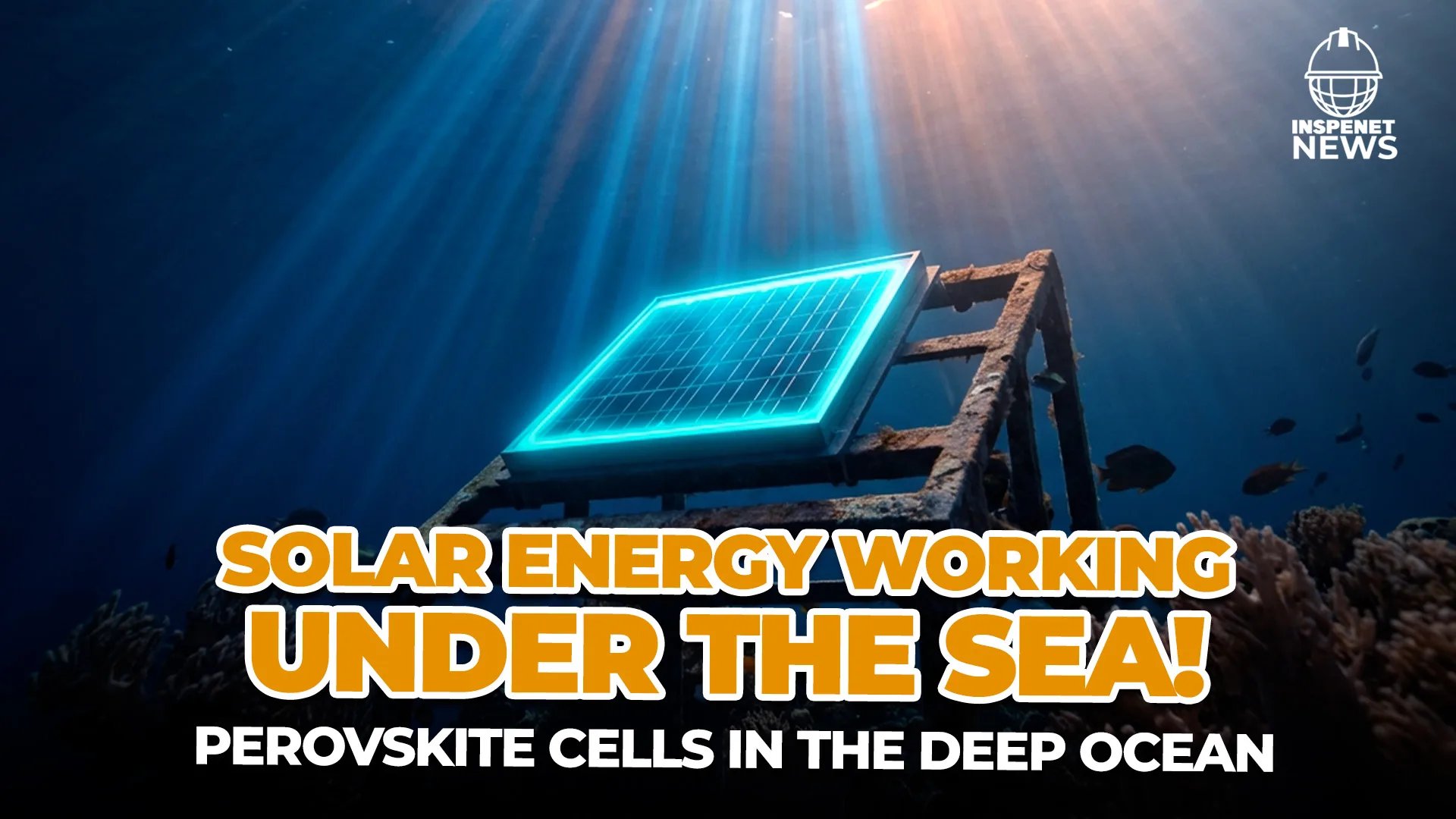
Underwater solar cells generate electricity at 10 meters
A team of scientists has demonstrated that underwater solar cells can generate electricity at a depth of 10 meters. The tests, conducted in the South China Sea, show a potential way to power equipment operating far from land.
The study, published in the scientific journal Joule , involved researchers from China and Switzerland. The work focused on perovskite solar cells designed to harness the light spectrum available underwater.
Until now, most experimental studies on this type of underwater photovoltaic energy had focused on depths of two meters or less. The new work extended the testing to 10 meters and subsequently verified the system's performance under real-world conditions.
Underwater solar cells reach depths of 10 meters
The researchers had to face one of the main problems in producing electricity using underwater solar panels: the loss of solar radiation as depth increases.
Water absorbs certain parts of the light spectrum; consequently, the radiation available several meters below the surface is different from that received by a solar cell installed on land.
To overcome this limitation, the team used lead halide perovskites with a band gap of around 1.96 eV. Their absorption capacity was matched to the spectrum that remains available between 5 and 10 meters deep, dominated mainly by wavelengths between 400 and 600 nanometers.
Thus, the photovoltaic cells were able to make better use of the light that manages to penetrate to those areas.
Perovskite cells harness the light available underwater
Furthermore, the researchers developed a laboratory system with specific optical filters. The goal was to reproduce the lighting conditions that cells would encounter at different depths.
Tests showed a conversion efficiency of 34.71% under a simulated spectrum corresponding to a depth of 10 meters. Under standard AM 1.5G sunlight conditions , the cells achieved a maximum efficiency of 17.08%.
This difference does not mean that the cells produce more energy at the bottom of the sea than under conventional sunlight. Efficiency is calculated based on the light energy that actually reaches the device. At 10 meters, there is less radiation available, and its spectral composition also changes.
The design seeks precisely to make the most of that limited light through a material adapted to underwater conditions.
Solar cells withstand more than 1,000 hours in tests
In addition, stability was another aspect studied before transferring the cells to the sea.
After being stored for 300 days at room temperature in a nitrogen chamber, the devices retained about 96% of their initial efficiency.
Subsequently, the cells were subjected to 1,160 hours of continuous operation under conditions simulating the lighting present at 10 meters. The researchers did not observe significant degradation during that period.
Accelerated testing allowed for an estimated T80 lifetime of 48,094 hours at 25°C under simulated conditions. This equates to approximately 5.49 years until performance drops to 80% of the initial level.
However, that figure comes from an estimate based on accelerated trials. Therefore, it will still be necessary to verify the behavior of the cells over extended periods under real marine conditions.
The experiment moves from the laboratory to the South China Sea
After the controlled trials, the team took the technology to the environment for which it had been designed.
Scientists fabricated larger perovskite modules and integrated them into underwater robots. They then conducted tests off the Weizhou Islands in the South China Sea.
The modules were tested at depths of 2, 6, and 10 meters. At the greatest depth, an active surface of 115 square centimeters produced 324 mWh of electricity during two hours of exposure to underwater sunlight.
The energy obtained allowed for the charging of lithium-ion batteries and subsequently the powering of LED lights. In this way, the experiment demonstrated that underwater solar cells could be scaled from small laboratory units to modules capable of performing a practical task at sea.
At shallower depths, production was higher. The modules charged the batteries with 1,416 mWh at 2 meters and 752 mWh at 6 meters during the tests described by the researchers.
Sensors and cameras could use underwater photovoltaic energy
Based on these results, one of the main implications lies in the power supply of autonomous devices installed underwater.
Sensors used to monitor ocean conditions, underwater cameras, and communication equipment need electricity to operate. In areas far from land, providing them with power for extended periods may require batteries or external power systems.
Underwater photovoltaic energy presents another possibility: producing some of that electricity directly at the location where the devices operate.
Monitoring aquaculture facilities is among the potential applications. Autonomous marine observation and communication systems could also benefit.
In this scenario, solar panels designed for underwater environments would have different requirements than terrestrial photovoltaic systems. The amount of available light, the wavelengths that penetrate water, and the operating depth all influence the cell design.
They will test underwater solar cells at greater depths
Finally, the experiment at 10 meters opens a new question: how far can this system go.
The team led by Wen-Hua Zhang intends to conduct tests at greater depths to determine the operating limit of perovskite solar cells. They also aim to develop standardized protocols for evaluating and comparing future photovoltaic systems designed to operate underwater.
Depth will be one of the main obstacles; as it increases, the amount of available solar radiation decreases and changes the spectrum that a photovoltaic cell can harness.
For now, research shows that underwater solar cells can produce electricity under real-world conditions at a depth of 10 meters. The next step will be to determine how long they can maintain that performance in the ocean and at what depth it is practical to use this technology.
News of additional interest
Saipem sells five platforms to ADES for $987 million
Saipem has completed the sale of its Saudi Arabian shallow-water drilling business to ADES Saudi Limited Company. The transaction includes five high-end jack-up rigs and outstanding contracts worth approximately 3.7 billion Saudi riyals, equivalent to $987 million. Following the necessary approvals, the Italian firm transferred its entire stake in Saudi Arabian Saipem.
With this acquisition, ADES increases its global fleet to 128 units and strengthens its operations in Saudi Arabia. It also enters the Mexican market through an agreement that will allow Saipem to continue operating the Perro Negro 10 platform in that country. Meanwhile, Saipem is advancing its strategy of focusing on deepwater and harsh environment drilling, segments of greater technical complexity and value.
Wind and solar power hit a financial wall
Financing new wind and solar projects is facing significant challenges in Australia, particularly in New South Wales. Rising interest rates and construction costs have made developing these plants more expensive. According to the analysis, each additional percentage point in bond yields can increase the levelized cost of energy in that state by approximately AU$10 per MWh.
The problem also lies in how these projects are financed. Australian pension funds have billions of dollars to invest in infrastructure, but wind and solar farms exposed to volatile prices are less attractive. Long-term PPAs with buyers of high credit quality could reduce that risk. For wind power, the analysis estimates costs of between AU$120 and AU$140 per MWh and calculates that long-term contracts could cut costs by around AU$20 per MWh in New South Wales.
MODEC brings fuel cells closer to FPSOs
MODEC and Eld Energy are making progress in developing a system to generate electricity with lower emissions from FPSO units. The companies have completed the feasibility and verification of concept phase of the ABS qualification process for their solid oxide fuel cell (SOFC) technology. The system aims to utilize the gas produced at these facilities to generate energy more efficiently.
The project involves installing a 40 kW Eld Energy module on an operational FPSO for testing with real gas under marine conditions. Before proceeding, it must pass the next phase of validation and ABS engineering reviews. The companies estimate the complete system could achieve an efficiency of around 70%. Following testing, the plan is to move to a 120 kW module compatible with carbon capture and subsequently develop multi-megawatt systems.
Petrobras will test TCP pipelines at 1,500 meters
Petrobras has contracted Strohm and its Brazilian subsidiary to supply and test thermoplastic composite pipes (TCPs) in deep waters off Brazil. The technology will be evaluated at depths of up to 1,500 meters for water injection and gas lift operations in post-salt fields. The agreement also includes engineering, qualification testing, and support during offshore installation.
The pipelines will be subjected to real operating conditions and will be installed from vessels regularly used by Petrobras. Manufactured with carbon fiber or glass fiber reinforced materials, the TCP pipelines are lighter than conventional flexible and rigid pipelines. They can also be coiled and are corrosion-resistant, features designed to facilitate installation and reduce maintenance needs throughout their service life.