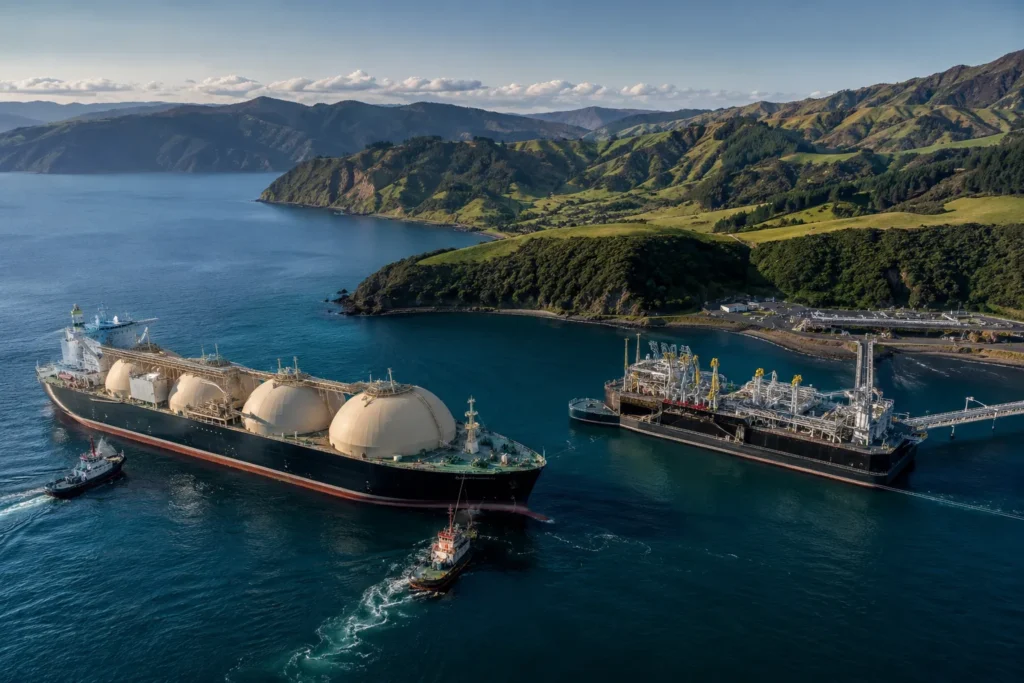
The LNG terminal planned by New Zealand has become a strategic component to strengthen the country’s energy security amid the progressive decline of domestic gas production. The initiative advances toward a new bidding phase and seeks to guarantee backup supply to the electrical system during periods of high demand and low hydroelectric availability.
In this context, the New Zealand government has advanced in the development process of a liquefied natural gas (LNG) import terminal, an infrastructure that could transform the way the country manages energy security in the coming years. The initiative has already entered a new bidding phase with two finalist suppliers selected to submit final proposals.
Declining Gas Production Redefines the Energy Landscape
New Zealand has historically built an electrical matrix supported by renewable resources, especially hydropower and geothermal energy. However, natural gas has played a fundamental role as a backup source to compensate for seasonal generation variations.
The progressive reduction in production from mature fields has generated concern among electrical operators, large industrial consumers, and energy policy officials. As domestic gas availability decreases, risks associated with system reliability increase, especially during dry winters, when hydroelectric reservoirs register levels below normal.
Faced with this scenario, LNG import emerges as an alternative to complement local supply and provide a flexible fuel source for electrical generation.
The LNG Terminal Seeks to Strengthen Electrical System Resilience
The project contemplates the incorporation of infrastructure capable of receiving international LNG shipments and making them available to power plants when market conditions require it.
Beyond increasing energy supply, the terminal aims to act as a risk management tool for a system increasingly dependent on variable renewable sources. LNG availability would enable faster response to drops in hydroelectric generation, reductions in wind production, or unexpected increases in demand.
Authorities estimate that the project could enter operation in 2028, becoming one of the country’s most significant energy developments during the next decade.
Rising Energy Costs Drive New Solutions
The evolution of electricity prices has become a topic of growing concern for households and industries. The increase in energy costs has impacted the competitiveness of some productive sectors and has added pressure on the national economy.
For the government, expanding supply options is part of a strategy aimed at reducing electrical market volatility. Having access to imported LNG could offer greater response capacity to extreme weather events or interruptions in local production.
The initiative also seeks to avoid shortage situations that may lead to abrupt increases in wholesale energy prices, a phenomenon observed in several markets facing supply constraints.
LNG and Energy Security in the Energy Transition
The project’s advancement reflects a reality repeated in different countries: the transition toward energy systems with greater renewable participation does not eliminate the need for reliable backup sources.
In the Asia-Pacific region, several governments are incorporating LNG infrastructure as a mechanism to strengthen the stability of their electrical systems while continuing to expand renewable generation capacity.
For New Zealand, the future terminal represents much more than an import facility. It is a strategic tool to guarantee energy security, improve operational resilience, and adapt to a scenario in which domestic gas production no longer offers the same level of backup as in previous decades.
Sources