Table of Contents
A plug of hydrates in subsea flowlines can reduce the flow rate in hours and turn a routine shutdown into a costly subsea intervention. An effective response does not begin by pumping chemicals; it begins by confirming the blockage, controlling the trapped pressure, and selecting the correct access. This practical guide summarizes how to address hydrate remediation to recover production using Flow Assurance criteria, from initial diagnosis to Production Recovery, including when an HRS or a Flowline Remediation System can provide intervention capability.
Hydrates in subsea flowlines and loss of production
In deepwater, the external seabed temperature is low while the internal pressure of the line can remain high. If gas and free water are present, the fluid can enter the hydrate stability zone during a shutdown, prolonged cooling, or a significant reduction in flow rate. In Subsea flowlines, the risk increases when thermal insulation loses effectiveness, water cut increases, or inhibitor dosing fails. Hence the importance of the design, manufacture, and inspection of the pipelines.
For the operator, the important thing is not to demonstrate all the thermodynamics first, but to recognize operational signs. Subsea blockages usually manifest as an increase in upstream pressure, a drop in flow rate, slow or no downstream response, unusual thermal differences, and loss of hydraulic communication between ends. These symptoms must be contrasted with valve failures, wax, asphaltenes, sand, or mechanical restrictions.
What to check before intervening
- Pressure and temperature history before, during, and after the shutdown.
- Gas, liquid, and produced water flow rates, as well as recent composition changes.
- Status and actual consumption of methanol, MEG, or other inhibitor used.
- Cooling time and exact shutdown and restart sequence.
- Available accesses: hubs, valves, jumpers, service connections, or points suitable for hot tapping.
- Estimated pressure on both sides of the restriction and volume of trapped fluid.
This first reading reduces the risk of initiating Hydrate remediation on a misidentified problem. It also allows estimating whether the plug is localized or if there are multiple restriction points, a difference that completely changes the intervention strategy and the expected time for Production recovery.
Flow assurance in subsea blockages
Flow assurance must translate into concrete operational decisions. Before mobilizing subsea equipment, the production team must define what outcome is needed: dissociating the hydrate by pressure change, circulating inhibitor, displacing fluids, recovering hydraulic communication, or combining several mechanisms. The strategy must respect the pressure limits and integrity of the subsea pipelines.
Practical decision matrix
- If partial communication exists and the pressure differential is controllable, evaluate circulation or chemical injection from existing accesses.
- If no communication exists, first model the trapped pressure and avoid maneuvers that could accelerate a plug as a projectile.
- If the affected volume is small and localized access is available, consider a compact solution operated by ROV.
- If the line has a large inventory or requires sustained pumping and separation, evaluate a higher-capacity system.
- If no suitable intervention point exists, study a temporary subsea connection or hot tap with specific engineering.
In Subsea blockages, a sudden drop in pressure should not automatically be interpreted as success. It may indicate dissociation, plug movement, or opening of a new communication path. Therefore, the operational plan must establish pressure limits, maximum pumping rates, expected temperature response, and abort criteria before starting.
Minimum controls during operation
- Upstream pressure, downstream pressure, and injection line pressure.
- Volume and rate of inhibitor pumped.
- Fluid returns and evidence of released gas.
- Temperature at available points and trend over time.
- Emergency disconnect capability and barrier status.
- Hourly log of decisions, configuration changes, and system response.
This discipline turns hydrate intervention into a controlled operation rather than a sequence of trial and error. For Hydrates in subsea lines: remediation to recover production, response speed matters, but the priority is to remove the restriction without creating an overpressure event or loss of containment.
Hydrate remediation with FRS and HRS systems
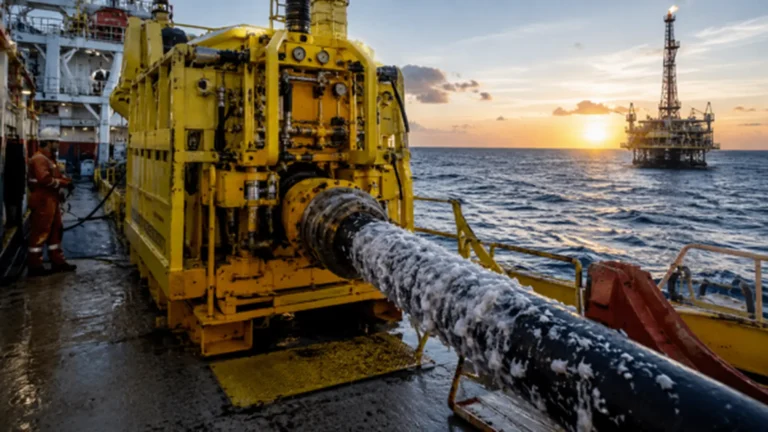
Oceaneering International integrates two solutions that fit different scenarios. Their Hydrate Remediation Skid (HRS) is geared toward lower-volume interventions and can be deployed with a work-class ROV. It is useful when Hydrate remediation requires localized access at jumpers, chemical lines, umbilicals, or connections near subsea equipment.
For larger-volume critical lines, Oceaneering offers the Flowline Remediation System (FRS). The system can be deployed from a multi-service vessel and combines pumping capacity, subsea separation, pressure monitoring, and two-way inhibitor injection. This is relevant when Subsea blockages affect a significant inventory and the intervention requires continuous control.
When to consider HRS
- Relatively small volume of trapped fluid.
- Clear access point close to the probable blockage.
- Intervention compatible with ROV and limited subsea campaign.
- Need for localized injection or circulation with compact equipment.
When to consider FRS
- Subsea flowlines of larger volume or length.
- Need for sustained pumping and returns management.
- Requirement to monitor multiple pressures during intervention.
- Need for bidirectional injection or subsea separation.
- High economic impact for each day without production recovery.
A case study published by Oceaneering in the Gulf of Mexico illustrates the approach. The line had five hydrate locations and lacked adequate intervention points. The company developed clamps and sealing saddles to execute hot tapping, created new accesses, and used HRS and FRS to remove the restrictions and restore communication between the subsea asset and the platform. The practical takeaway is straightforward: access can be as important as the power of the pumping equipment.
The selection of the FRS system should not be based solely on availability. Inventory, depth, pressure, chemical compatibility, accessibility, vessel capacity, ROV interfaces, mobilization time, and deferred production value must be compared. That analysis helps to technically justify the method and prioritize the return of production.
Practical sequence to recover the line
- Confirm the scenario
- Verify that pressure, temperature, and flow rate are compatible with hydrates.
- Rule out closed valves, instrumentation failures, and other solids.
- Estimate the probable position and extent of the restriction.
- Stabilize the system
- Define the pressure on both sides of the plug.
- Avoid rapid changes that could mobilize it uncontrollably.
- Confirm MAOP, operating limits, and available barriers.
- Choose the removal mechanism
- Controlled depressurization when technically safe.
- Methanol or MEG injection when adequate access exists.
- Circulation or displacement of fluids when the configuration allows.
- HRS intervention or Flowline Remediation System when topside is not sufficient.
- Execute and observe
- Pump at previously approved rates.
- Compare pressures and returns with expected behavior.
- Stop operation upon unexplained deviations.
- Document every change to be able to reconstruct the event.
- Verify recovery
- Confirm sustained hydraulic communication.
- Restore flow rate gradually.
- Monitor temperature, pressure, and multiphase stability during restart or production resumption.
- Do not declare Production recovery until stability and absence of a new restriction are verified.
This sequence focuses Hydrate remediation on actions that can be prepared prior to an emergency. A pre-approved procedure, with defined personnel, limits, and equipment, reduces decision times when Hydrates in subsea lines: remediation to recover production goes from being a design risk to a real event.
How to prevent the blockage from recurring
Once flow is recovered, the work continues. Flow Assurance must review the root cause and update the operating philosophy. If the event occurred after a shutdown, it is advisable to check whether the actual cooling time exceeded the predicted duration. If it appeared during production, insulation, chemical dosing, water cut, flow regime, and instrumentation must be reviewed.
Recommended follow-up actions
- Update cooling curves and restart windows with real data.
- Review capacity, redundancy, and alarms of the chemical injection system.
- Define minimum inventory of methanol or MEG for contingencies.
- Incorporate future intervention points if access was a limitation.
- Review contracts, ROV availability, and remediation equipment.
- Record lessons learned within the flow management plan.
DNV-ST-F101, DNV-RP-F116, and API RP 17A provide general criteria for subsea integrity, operation, and intervention that should be considered alongside operator-specific procedures. ISO 20815:2026 complements the approach from production assurance and reliability perspectives. These references help ensure that Production recovery does not compromise the integrity of Subsea flowlines or the future availability of the system.
Conclusions
An effective response to hydrates must be simple to execute and rigorous in its limits: confirm the blockage, know the trapped pressure, select the correct access, remove the solid in a controlled manner, and validate the restart. HRS and FRS expand the options when surface intervention is insufficient.
Production recovery in subsea lines affected by hydrates requires a comprehensive strategy combining hydrate remediation, mechanical integrity, and flow assurance. This approach allows restoring operational capacity without transferring the risks associated with hydrate formation and asset degradation to subsequent operational stages. Likewise, documentation and technical traceability of executed actions constitute fundamental elements to support future inspection, maintenance, and intervention decisions.
References
- American Petroleum Institute. (2022). API RP 17A: Design and operation of subsea production systems, General requirements and recommendations.
- DNV. (2021). DNV-ST-F101: Submarine pipeline systems.
- DNV. (2021). DNV-RP-F116: Integrity management of submarine pipeline systems.
- International Organization for Standardization. (2026). ISO 20815:2026, Production assurance and reliability management.
- Oceaneering International, Inc. Restore Field Operability with Remediation Solutions. Source.
- Oceaneering International, Inc. Subsea flowline pressure-containing clamp case study. Source.
Frequently Asked Questions (FAQs)
How to know if the blockage is really a hydrate?
Compare pressure, temperature, flow rate, shutdown history, water cut, and inhibitor consumption. If the trend matches the formation window, model the event and rule out valves, wax, sand, or mechanical failures before initiating Hydrate remediation.
What is the main risk during removal?
A high pressure differential can suddenly mobilize the plug. In Subsea blockages, intervention must limit rapid pressure changes, maintain barriers, and have clear shutdown criteria.
Do HRS and FRS do the same job?
No. HRS is geared toward compact, localized interventions with ROV. The FRS Flowline Remediation System provides greater capacity for large-volume lines, sustained pumping, separation, and pressure monitoring.
When can production be restarted?
When stable hydraulic communication exists, pressure responds predictably, and restart can be executed within the Flow Assurance window. Production recovery must be gradual and monitored.