Table of Contents
- Natural Gas in Andaman: What Did Oil India Confirm at Vijayapuram-3?
- Why Does Natural Gas in Andaman Matter for Indian Energy Security?
- Implications of Natural Gas in Andaman for Operators
- Natural Gas in Andaman: Next Steps in Block AN-OSHP-2018/1
- What Happened
- Magnitude of Natural Gas in Andaman
- Why It Matters for the Energy Industry
- Implications for Operators
- Market Context
- Frequently Asked Questions
India’s energy exploration adds a new deepwater milestone. Oil India confirmed the presence of natural gas in Andaman following initial tests at the Vijayapuram-3 well, a result that strengthens the offshore potential of the Andaman Islands and expands the country’s gas development prospects.
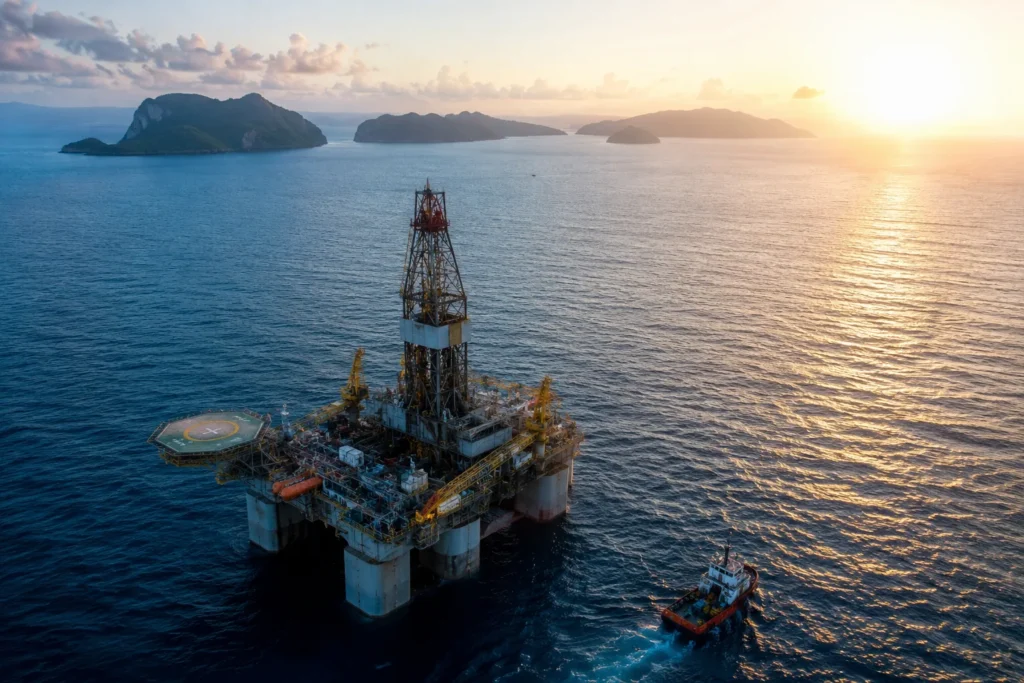
Oil India confirmed the presence of natural gas in Andaman following initial tests at the Vijayapuram-3 well, its third exploratory well within the offshore block AN-OSHP-2018/1, located approximately 15 km off the eastern coast of the Andaman Islands, in 355 meters of water depth, with confirmed production intervals at more than 1,900 meters depth in the Eocene formation.
Natural Gas in Andaman: What Did Oil India Confirm at Vijayapuram-3?
Oil India Limited announced the discovery of natural gas in Andaman through a regulatory filing cited by Indian media, including Economic Times and Times of India. The Sri Vijayapuram-3 well, drilled in the Offshore Andaman block AN-OSHP-2018/1 awarded under the Open Acreage Licensing Policy (OALP), recorded continuous flaring and immediate pressure buildup after drilling, the two standard technical indicators confirming active gaseous hydrocarbon presence.
Vijayapuram-3 is the second well with hydrocarbons in the block. The first was Vijayapuram-2, which reported natural gas in Andaman in September 2025 and triggered the ongoing evaluation program: reprocessing of 2D seismic, acquisition of 600 km² of 3D seismic, and integrated processing of new and existing data before selecting appraisal wells.
Why Does Natural Gas in Andaman Matter for Indian Energy Security?
India imports a majority proportion of the crude oil and gas it consumes. National energy policy has made reducing that dependence a strategic objective, and offshore exploration in underdeveloped basins—including Andaman—one of its priority vectors through the Samudra Manthan mission, focused on deepwater and ultra-deepwater drilling in the Indian maritime arc.
A commercial gas system in Andaman would not alter that import equation in the short term. Development decisions depend on appraisal, extended flow tests, recoverable reserve estimates, and offshore logistical feasibility, a process that in comparable basins takes between five and ten years from exploratory discovery to first production.
What the discovery of natural gas in Andaman does change is geological uncertainty: with two positive wells in the same block, the basin shifts from speculative to an active prospect with a proven petroleum system. The pattern is comparable to ExxonMobil’s Stabroek block in Guyana, where the sequence of exploratory discoveries validated the basin before committing development capital.
Oil India characterized the Vijayapuram-3 result as “a leading indicator” for planning future exploratory programs in the area, by reducing geological uncertainty in the Andaman basin.
Implications of Natural Gas in Andaman for Operators
For operators with positioning in Asian offshore exploration, the discovery of natural gas in Andaman opens a demand cycle for high-resolution seismic, exploratory drilling, and appraisal services in a basin that until now had limited activity. The confirmation of hydrocarbons in two successive wells increases the probability that third-party operators will seek participation in the block or in adjacent blocks.
In infrastructure, any development would require gas evacuation solutions from offshore waters in a region with limited connectivity to existing networks: floating regasification terminals, subsea pipelines, or LNG export are the standard technical options for basins at this stage. The global market adds demand context: with LNG flows from the United States at 2026 lows, any new source of gas supply in Asia gains strategic value for regional importers.
Natural Gas in Andaman: Next Steps in Block AN-OSHP-2018/1
Oil India has not declared commercial reserves nor issued a development decision. The confirmed program includes additional seismic processing, gas sampling, isotopic analysis to determine hydrocarbon origin and quality, and the design of appraisal wells to estimate recoverable volumes with greater precision. The regulatory appraisal timeline under the OALP framework will determine the pace of progress before any FID.
For the service industry and offshore providers, the immediate horizon lies in 3D seismic contracts—600 km² already authorized—and in the design of the appraisal program. For Oil India investors, the value of the announcement lies in the confirmation of an active gas system in Andaman, not in a production projection or accountable reserve.
- The Vijayapuram-3 well is approximately 15 km off the eastern coast of the Andaman Islands.
- Drilling was conducted in 355 meters of water depth, with productive tests at more than 1,900 meters.
- Two of the three exploratory wells drilled by Oil India in the block have already reported hydrocarbons.
What Happened
Oil India Limited reported the presence of natural gas at Vijayapuram-3, also identified as Sri Vijayapuram-3 in official reports, within the Offshore Andaman block AN-OSHP-2018/1 awarded under the Open Acreage Licensing Policy.
The company reported the discovery through a regulatory communication cited by Indian media. The well, located off the eastern coast of Andaman, confirmed gas during initial tests through continuous flaring and immediate pressure buildup after drilling.
Magnitude of Natural Gas in Andaman
The technical magnitude lies in exploratory repetition. Vijayapuram-3 is the third well drilled by Oil India in the current campaign and the second with hydrocarbon presence. The first gas indication was reported at Vijayapuram-2 in September 2025.
Oil India initiated an evaluation program following the previous discovery. That work includes reprocessing of 2D seismic, additional acquisition of 600 km² of 3D seismic, and processing of new and existing data before defining appraisal wells.
Why It Matters for the Energy Industry
India imports a large portion of the crude oil it consumes and seeks to increase domestic production in offshore basins. A commercial gas system in Andaman would not immediately change that dependence, but it could open a new frontier for natural gas, offshore services, and advanced seismic evaluation in an underexplored basin. The pattern is comparable to other recent offshore discoveries, such as ExxonMobil’s Haimara well in Guyana, where exploratory confirmation precedes years of appraisal before any development decision.
The discovery also strengthens the Samudra Manthan mission, focused on deepwater and ultra-deepwater drilling in Indian maritime basins. The technical reading still requires caution: Oil India confirmed gas presence, not certified reserves or a development decision. The global gas market also adds pressure: with LNG flows from the United States at 2026 lows, any new source of supply in Asia gains strategic relevance.
Implications for Operators
- Exploration: the block requires evaluation wells before estimating recoverable commercial reserves.
- Integrity: upcoming tests must confirm reservoir pressure, composition, and stability.
- Logistics: any development will require maritime support, gas evacuation, and treatment facilities.
- CAPEX: decisions will depend on productivity, connectivity, and distance to existing infrastructure.
- Supply chain: seismic, drilling, subsea services, and offshore support may gain demand if appraisal confirms commercial scale.
Market Context
The Indian government has compared Andaman’s potential to high-impact new exploratory provinces. That comparison must be validated with reservoir data, extended tests, and recoverable estimates consistent with the national deepwater exploration program.
For now, the value of the announcement lies in reducing geological uncertainty, demonstrating an active petroleum system in Andaman, and justifying further exploratory and seismic investment before discussing commercial projects or FID.
Frequently Asked Questions
Did Oil India Confirm Reserves?
No. It confirmed the presence of natural gas in initial tests, not certified commercial reserves or an approved development plan.
Where Is Vijayapuram-3?
The well is approximately 15 km off the eastern coast of Andaman, in 355 meters of water depth, with production tests at more than 1,900 meters in the Eocene formation.
What’s Next for the Block?
Additional seismic processing, gas sampling, isotopic studies, and drilling of appraisal wells to define the commercial potential of the discovery.
Vijayapuram-3 strengthens the exploratory case for Andaman, but the industrial decision will come after appraisal and confirmation of continuity, productivity, and logistical feasibility of the gas system. For operators and providers, the immediate focus is on reservoir data, seismic results, and design of an offshore chain capable of monetizing a potential development in the Andaman Sea.
Source: Yahoo Finance