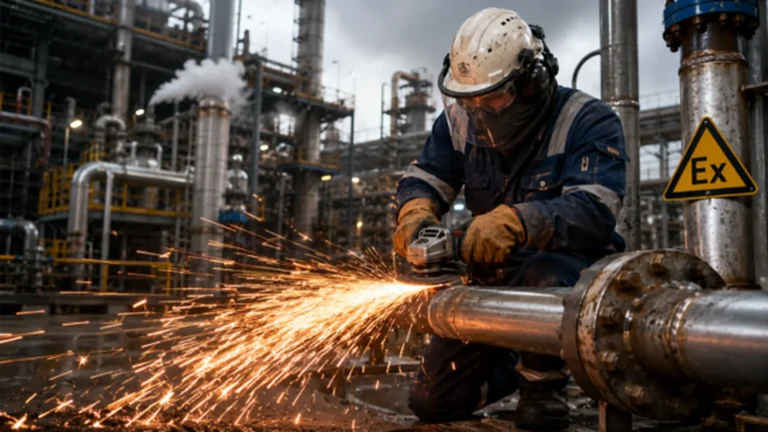
When in a construction workshop, a spark may seem like a minor detail, but in an area with flammable gases, vapors, or dusts, it becomes a real explosion risk. Therefore, in classified areas, safety and maintenance must be flawless, as traditional steel tools can be a source of ignition nobody wants to see. In order to avoid any undesired event, the recommendation to use non sparking tools, especially beryllium-copper, is not a luxury. It is, definitely a technical control measure to reduce risk in explosive atmospheres and maintain safe work under standards such as NFPA 70 (National Fire Protection Association).
Risks in classified areas
To be prepared, it is necessary to recognize classified areas. But what are these areas, and how are they classified? They are spaces where an explosive atmosphere can form in such quantities that special precautions are required to protect worker health and safety. Regulations classify them into zones according to the frequency and duration of the presence of flammable gases, vapors, or mists—such as Zones 0, 1, and 2—or combustible dusts—such as Zones 20, 21, and 22 (INSST, n.d.; EGA Master, 2020).
And how can I recognize the risk level in each zone? In Zone 0, the explosive atmosphere is present continuously or for long periods; in Zone 1, it is occasional under normal conditions; in Zone 2, it is infrequent or of short duration. This classification defines the risk level and, therefore, the measures to be taken for necessary technical and organizational solutions.
The main danger in these zones is the ignition of the flammable mixture by sources such as direct flames, hot surfaces, electrical or mechanical sparks, electrostatic discharges, and frictional overheating, considering that steel tools, when striking or rubbing surfaces, can generate sparks with enough energy to ignite gases or dusts, especially in more dangerous groups such as IIC (hydrogen, acetylene) (EGA Master, 2020; INSST, n.d.). Therefore, the first line of defense is to prevent the appearance of an explosive atmosphere; the second is to avoid any source of ignition; and the third is to mitigate the effects of a possible explosion.
How do the tools work?
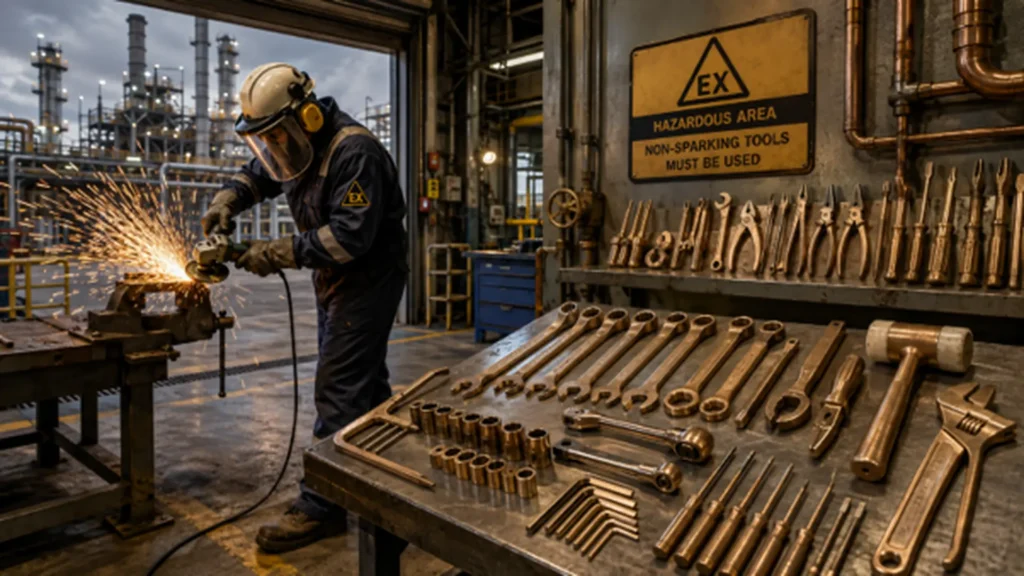
Non-sparking tools are designed to generate low-energy sparks, always below the ignition limit of the hazardous substances present in the environment. They are manufactured with non-ferrous alloys, mainly copper-beryllium (CuBe) and aluminum-bronze (AlBr), which, upon impacting other surfaces, produce “cold” sparks incapable of initiating combustion (Hommer Tools, 2025). The physical key lies in the fact that these alloys keep the friction or impact energy well below the minimum ignition energy (MIE), typically under 0.05 mJ, making them safe even in environments with sensitive gases (DeepLinkChain, 2026).
Unlike steel, non-ferrous alloys do not oxidize in the same way nor do they generate violent exothermic reactions upon impact, which drastically reduces the heat released and the temperature of the spark. In addition, many of these tools are non-magnetic and corrosion-resistant, making them useful in marine, medical, or firefighting applications as well (Alyco Tools, n.d.).
Standard EN 1127, for instance, prohibits the use of steel tools in Zones 0 and 20, and restricts their use in Zones 1 and 2 if Group IIC gases are present, reinforcing the need for certified non-sparking equipment.
Safe maintenance with copper-beryllium tools
Safe maintenance in classified areas requires selecting tools appropriate for the zone and the type of atmosphere. An example is copper-beryllium tools, which stand out for their high hardness (280–365 HB), tensile strength (1110–1325 N/mm²), and compatibility with all ATEX zones, including the most critical ones like Zone 0 and 20 (Acha, n.d.; CS Unitec, 2026).
However, copper-beryllium is not universal: it reacts with acetylene to form highly explosive acetylides, so it must not be used in the presence of this gas. In addition, beryllium is toxic in dust or vapor form, so its handling requires exposure control and proper cleaning procedures (Prolians, n.d.). For less critical applications or budget constraints, aluminum-bronze offers a more economical alternative, albeit with lower hardness and limitations in gas groups such as IIC. The choice must be based on risk analysis, classified zone, and chemical compatibility.
Alloy compatibility matrix
The correct selection of non-sparking tools depends on a compatibility matrix relating the alloy to the gas or dust group, the ATEX zone, and specific restrictions. According to manufacturers and BAM/ATEX certifications, copper-beryllium tools are compatible with all explosion groups (I, IIA, IIB, and IIC), except in atmospheres containing acetylene, where they are prohibited, as noted by EGA Master, 2020; Inpratex, n.d.; and BSK Tools, 2025. These tools can be used in Zones 0, 1, and 2 (gas/vapor) and Zones 20, 21, and 22 (dust), as well as in mining (M1 and M2), provided the maximum surface temperature is respected.
On the other hand, aluminum-bronze tools are compatible with groups I, IIA, and IIB, but not with IIC, excluding them from atmospheres with hydrogen or acetylene. Their use is authorized in Zones 1, 2, 21, and 22, but not in Zone 0 or 20, making them a limited option for extreme risk areas. The following table summarizes this compatibility matrix:
| Alloy | Compatible groups | Gas zones | Dust zones | Restrictions |
|---|---|---|---|---|
| Copper-beryllium (CuBe) | I, IIA, IIB, IIC | 0, 1, 2 | 20, 21, 22 | Do not use with acetylene (IIC) |
| Aluminum-bronze (AlBr) | I, IIA, IIB | 1, 2 | 21, 22 | Do not use in Zone 0/20 or with IIC |
This matrix is essential for safe maintenance, as it avoids selection errors that could turn a “non-sparking” tool into a source of ignition (INSST, n.d.; EGA Master, 2020).
NFPA 70 and selection of non-sparking tools
NFPA 70, also known as the National Electrical Code (NEC), establishes requirements for electrical installations in classified areas, including the selection of equipment and tools that do not represent ignition sources. Although the standard focuses on electrical equipment, its logic extends to hand tools: in Divisions 1 and 2 (equivalent to Zones 0/1 and 2 in the ATEX system), any tool capable of generating sparks must be evaluated to prevent ignition of explosive atmospheres. NFPA 70 requires equipment in these areas to be approved for the risk type (Class I, II, or III; Division 1 or 2; Group A–G), a principle that also applies to non-sparking tools (NFPA, 2023).
The selection of non-sparking tools must follow clear criteria: compatibility with the zone (0, 1, 2 or 20, 21, 22), gas or dust group (I, IIA, IIB, IIC), maximum surface temperature, and mechanical resistance. Tools certified under standards such as ATEX, IECEx, or EN 1127 offer guarantees that they were tested not to generate dangerous sparks under specified conditions (EGA Master, 2020; CS Unitec, 2026). NFPA 70, along with guides from INSST and manufacturers, reinforces the need to integrate tool selection into the plant’s safety program, including training, inspection, and documentary traceability.
In this scenario of high technical demands, SKS Group is also a key company in the industry for supplying certified non-sparking tools, ensuring strict compliance with international standards such as ATEX, IECEx, and NFPA 70 guidelines. Beyond equipment distribution, SKS Group also advises industrial plants on risk analysis and precise material selection based on zoning and the present gas group.
Conclusion
The hazard of explosion in classified areas is not theoretical: an uncontrolled spark can have catastrophic consequences. Non-sparking tools, especially copper-beryllium ones, are an essential technical barrier for safe maintenance in explosive atmospheres, provided they are properly selected and used. Standards like NFPA 70 and technical guides such as those from INSST provide the framework to integrate these tools into a coherent risk management system, where ignition prevention is just as important as preventing the flammable mixture itself. For the specialized engineer, the key is not only having the right tool, but understanding why it is the right one.
References
- Acha. (n.d.). Copper-beryllium non-sparking scissors. https://www.acha.com/es/productos/herramienta-antichispa/tijeras-antichispa-de-cobre-berilio/tijera-antichispa
- Alyco Tools. (n.d.). Non-sparking Cu-Be firefighter axe. https://www.alycotools.com/es/hacha-de-bombero-antichispa-cu-be-alyco/v-10251/
- BSK Tools. (2025). Tools for ATEX zones. https://www.bsktools.com/es/herramientas-zonas-atex/
- CS Unitec. (2026). Non-sparking tool materials: aluminum-bronze vs copper-beryllium. https://csunitec.com/es/materiales-de-las-herramientas-antichispas-herramientas-de-aluminio-bronce-vs-herramientas-de-cobre-berilio/
- DeepLinkChain. (2026). How do non-sparking tools prevent explosion risks? https://www.deeplinkchain.com/es/blog/how-do-non-sparking-tools-prevent-explosion-risks
- EGA Master. (2020). Non-sparking tools. https://www.egamaster.com/es/ega-wiki/2020/11/3/las-herramientas-antichispa
- Grupos ICCIS. (n.d.). ATEX lighting catalog. https://gruposiccis.com/catalogos/CATALOGO-HERRAMIENTAS-ATEX.pdf
- Hommer Tools. (2025). What are non-sparking tools and why are they essential for industries? https://hommertools.com/2025/07/22/que-son-las-herramientas-antichispas-y-por-que-son-esenciales-para-las-industrias/
- Inpratex. (n.d.). 8 pcs non-sparking safety kit. https://www.inpratex.com/PDF-Es/KIT-Herramientas-Antichispa-8-pcs.pdf
- INSST. (n.d.). Explosive atmospheres. National Institute for Safety and Health at Work. https://www.insst.es/materias/riesgos/seguridad-en-el-trabajo/atmosferas-explosivas
- NFPA. (2023). NFPA 70: National Electrical Code. National Fire Protection Association.
- Prolians. (n.d.). Non-sparking tools. Metalco Prolians. https://prolians.es/catalogos/herramienta-atex/herramienta-atex.pdf

