Karoon Energy expands its oil production with Who Dat East
Oil production plans in the United States following approval for the development of the Who Dat East field . The joint venture responsible for the asset made the final investment decision to execute a subsea project that will require between $155 and $165 million in net capital for Karoon.
According to current planning, the first production will arrive during the second half of 2028. The development will allow new volumes of oil and gas to be incorporated into the infrastructure already operating in Who Dat, reducing the need to build a separate processing system.
Who Dat East is moving towards its development phase
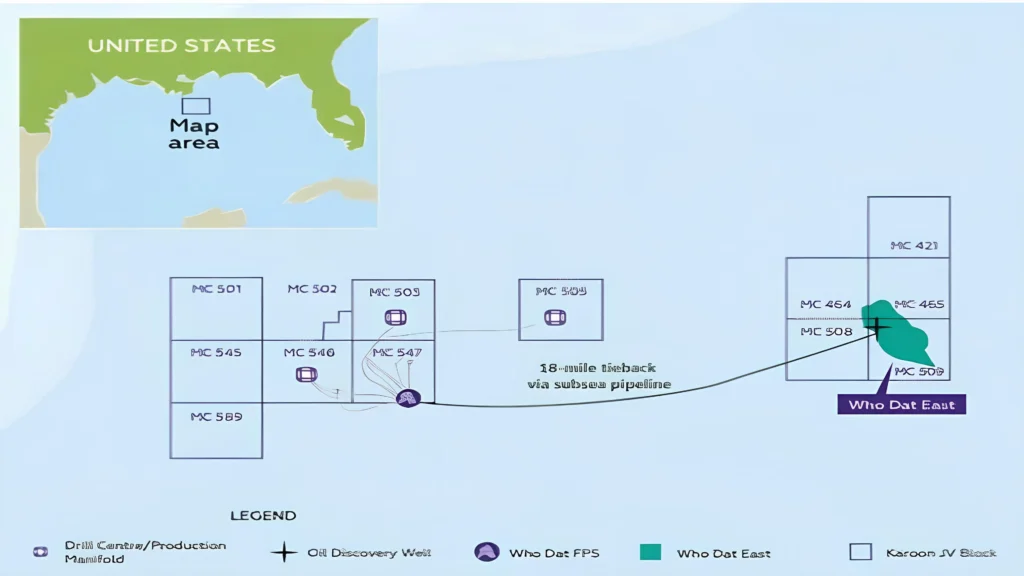
Specifically, Who Dat East is located in block MC 509-1 at a depth of approximately 1,300 meters. LLOG operates the joint venture and holds a 40% working interest, Karoon USA controls another 40%, while Westlawn Americas Offshore holds the remaining 20%.
In addition, the project includes an initial development of a single well; the work includes completing the discovery well drilled in 2024 and installing the necessary subsea controls to bring it into production.
The plan also requires constructing a pipeline approximately 29 kilometers long to connect the well to the Who Dat floating production system. Minor adjustments will also be made to these facilities to accommodate the increased production volumes.
This strategy leverages existing operational assets; the oil and gas extracted from Who Dat East will be combined with Who Dat's production and then transported and processed using its existing infrastructure.
Oil production will begin in 2028
Furthermore, the commissioning is planned for the second half of 2028. In its initial phase, Who Dat East aims for a gross production of approximately 6,500 barrels per day of liquids and 50 million standard cubic feet of gas per day.
For Karoon, these figures would initially represent about 2,600 barrels per day of liquids and 20 million standard cubic feet per day of gas based on its net interest on revenue.
By converting both components to a combined measure, Karoon estimates an initial production of approximately 5,900 net barrels of oil equivalent per day. Roughly 45% would be liquids and 55% gas.
Karoon will allocate up to $165 million
In terms of investment, Karoon estimates that its participation in the development will require between $155 million and $165 million. Of that amount, between $15 million and $20 million are planned for the second half of 2026.
The company also estimates that the initial development phase could achieve an internal rate of return exceeding 20% under the average scenario used to evaluate the project. This estimate depends on several factors, including adherence to the schedule and budget, regulatory approvals, contractor performance, and energy market conditions.
The use of existing infrastructure plays a key role in this approach. Instead of developing separate processing facilities for the new field , Who Dat East will be directly connected to the Who Dat production system.
Who Dat East expands Karoon's presence in the United States
Meanwhile, the project represents another step in Karoon's expansion of its offshore operations in the United States. The company entered the WhoDat market in late 2023 by acquiring stakes in production and exploration assets from LLOG.
Subsequently, drilling at Who Dat East allowed for progress in the commercial evaluation of the discovery. In October 2024, Karoon raised its net 2C contingent resource estimate for the asset by 191% to 15.7 million barrels of oil equivalent.
As of year-end 2025, those contingent 2C resources included 7 million barrels of oil and condensate and 52.2 billion cubic feet of net natural gas for Karoon. Following project approval, the company expects to review its Who Dat East resources as part of its 2026 reserves and resources assessment.
Who Dat's infrastructure will support the new supply
Finally, the development model will allow the new volumes to follow the same commercial routes used by existing production. This integrates Who Dat East into an already established operation and concentrates investment in the well, the subsea connection, and the necessary adaptations to the floating system.
Carri Lockhart, CEO and managing director of Karoon Energy, emphasized when announcing the decision that the company expects to achieve low-cost, high-margin production once the project begins operations. She also noted the collaboration of LLOG and Westlawn Americas Offshore in bringing the development to the construction phase.
Thus, the final investment decision transforms Who Dat East from a discovery evaluated over the past few years into a project with a clear timeline. If the program progresses as planned, the field will begin producing oil and gas during the second half of 2028.
News of additional interest
China is looking to the Arctic to transport its cargo to Europe
Threats against ships in the Red Sea are pushing China to seek alternative routes to connect Asia with Europe. The Chinese shipping company Sea Legend will launch a weekly container service through Arctic waters this summer. The route between Ningbo and Felixstowe could cut travel time by nearly half compared to traditional routes.
The route skirts Russia along the Northern Sea Route and is easier to use during the months of greatest ice melt. However, major Western shipping companies such as Maersk, MSC, and Hapag-Lloyd avoid making this route a regular service. Their concerns include Russian control of the route, potential environmental damage, and difficulties in responding to accidents. Allianz recorded 531 incidents in Arctic waters during the decade leading up to 2023, 261 of which were related to machinery damage or failure.
Texas is preparing a new green ammonia plant
First Ammonia has selected Topsoe to supply the synthesis technology for its future green ammonia plant in Victoria, Texas. The facility will produce ammonia from hydrogen generated through electrolysis and renewable electricity. The company expects to close financing in 2026 and begin commercial operations in 2029.
Topsoe's technology will allow the plant's production to be adjusted according to energy availability. The system will be able to go from 10% to 100% of its capacity in about 30 minutes and also reduce it at a similar rate. This flexibility aims to maintain stable production despite the variations inherent in renewable sources such as solar and wind power. The ammonia produced will be destined for both the United States and international markets.
Western Gateway will move fuel for 2,092 km
Phillips 66, Kinder Morgan, and HF Sinclair have given the green light to Western Gateway , a pipeline system to transport refined fuels from St. Louis and the Gulf Coast to Arizona and California. The network will span approximately 2,092 kilometers and have the capacity to move 230,000 barrels per day. The project combines nearly 1,448 kilometers of new pipeline with existing infrastructure in the western United States.
The project has an enterprise value of approximately US$5 billion and will be primarily supported by 10-year contracts with committed payments. Phillips 66 will hold 49.9% of the system, Kinder Morgan 35.1%, and HF Sinclair 15%. Some existing pipelines will have their flow direction reversed to connect the different regions. Commissioning is planned for 2029, subject to obtaining the necessary permits and regulatory approvals.
Shearwater guarantees 15 months of work in India
Shearwater GeoServices has been awarded two contracts by the state-owned oil company ONGC to conduct 3D seismic surveys off the coast of India. The work will take approximately 15 vessel-months: nine months on the west coast and six on the east coast. The Norwegian company expects to begin both projects in early Q4 2026.
The agreements still need to be finalized into definitive contracts, a process expected in the third quarter. For Shearwater, the new orders expand its order book and ensure increased activity for its fleet through 2027. The company is also strengthening its relationship with ONGC, which has been supported by a continuous presence in India since 2016.