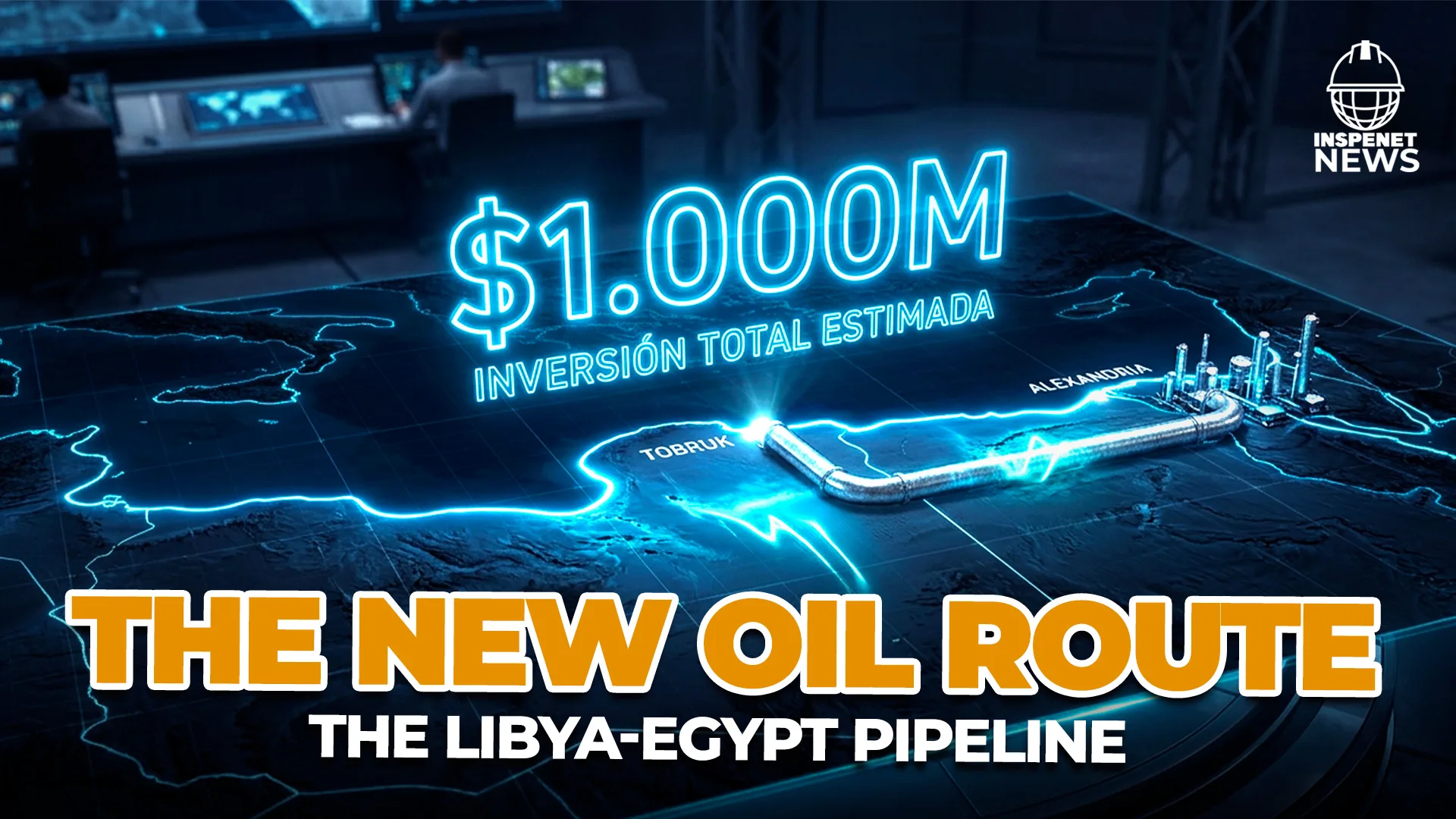
Egypt and Libya negotiate oil pipeline worth over $1 billion
Egypt and Libya are close to reaching an agreement to study the construction of an oil pipeline connecting Tobruk to Alexandria. The pipeline would be approximately 800 kilometers long and would require an investment of over $1 billion.
Currently, both countries are analyzing how to finance and implement the project; they also need to determine how much oil it will be able to transport. This capacity will depend on the volume of crude oil Libya has available for export and the processing capacity of Egyptian refineries.
The Egypt-Libya pipeline would allow oil to be sent directly to Egypt's Mediterranean coast. The proposal is particularly important as Cairo attempts to replace some of the supplies affected by disruptions to the routes connecting the country to producers in the Persian Gulf.
Egypt seeks new route to receive oil
For its part, Egypt needs to secure new supplies in light of the consequences of the conflict with Iran and the problems in the Strait of Hormuz. Disruptions to oil traffic have affected the routes the country used to obtain supplies from the Gulf.
In response to this situation, the Egyptian government is seeking to import at least one million barrels of Libyan oil per month. This volume would help offset the suspension of supplies from Kuwait.
Furthermore, a land connection between Tobruk and Alexandria would reduce the need to transport the oil by tanker. The crude could then flow directly from Libyan territory to the Egyptian refining system on the Mediterranean coast.
The new pipeline would thus offer an additional route at a time of high exposure of the region's maritime supplies.
How much oil could the pipeline transport?
However, there is still no definitive capacity for the pipeline project ; Egypt and Libya will have to determine it during the next stages of evaluation.
One of the factors will be the amount of oil that Libya can allocate to exports, the second will be the capacity of Egyptian refineries to receive and process that volume continuously.
Therefore, the negotiation is not limited to building the approximately 800 kilometers of pipelines; the two countries also need to define a financing model and the technical conditions necessary to operate the infrastructure.
The projected cost exceeds $1 billion, making financing one of the main issues that must be resolved before the initiative can move forward with its implementation.
Libya's oil production drives the project
Meanwhile, Libya comes into these talks with oil production at its highest level in more than a decade.
The country produces approximately 1.43 million barrels of crude oil per day. This is supplemented by about 49,000 barrels of condensate per day. Thus, total liquid production is approximately 1.48 million barrels per day.
Masoud Suleman, president of Libya's National Oil Corporation, has indicated that the country is aiming to reach a production of 1.5 million barrels per day.
This growth explains some of Libya's interest in having another outlet for its oil. A direct connection with Egypt would open an additional market for some of the barrels produced in Libyan territory.
What would Libya gain from the oil pipeline to Egypt?
In turn, the oil agreement would offer Libya an alternative for placing its production outside the country. The oil could be shipped from Tobruk directly to Egyptian processing facilities.
The relationship could also work in reverse. Some of the crude oil sent to Egypt could be returned to Libya as refined products for domestic consumption.
In this way, Libya would gain a new way to market oil while taking advantage of the refining infrastructure available in Egypt.
For Cairo, the operation would mean having additional raw materials for its Mediterranean refineries without depending exclusively on the maritime routes used to transport supplies from other producers.
Egypt and Libya expand their energy cooperation
The project also comes after talks between Egyptian Prime Minister Mostafa Madbouly and Libya's Government of National Accord Prime Minister Abdul Hamid Dbeibeh.
Both governments have discussed expanding their cooperation in sectors such as oil refining, natural gas, and electricity. The pipeline between Tobruk and Alexandria would further this relationship by providing physical infrastructure for transporting crude oil.
However, the agreement still needs to pass several stages. Financing, implementation, and transport capacity are still under review. The Libyan National Oil Corporation has also declined to comment on the reports related to the project.
The Egypt-Libya oil pipeline would reduce dependence on the Gulf.
Ultimately, the importance of the proposal extends beyond the planned 800 kilometers. Egypt is attempting to diversify the origin and routes of its oil as regional tensions disrupt some of its traditional supplies.
A connection with Libya would allow for the receipt of crude oil from the west and directly via North Africa. At the same time, Libya would have stable access to the Egyptian market for a portion of its growing production.
The future of the Egypt-Libya oil pipeline now depends on both countries agreeing on its financing, capacity, and implementation terms. If the project moves forward, Tobruk and Alexandria would be connected by a new land route for transporting oil between the two countries.
News of additional interest
US gas prices soar amid heat wave
US natural gas futures surged as much as 5.2% to $2,801 per million BTU for September delivery, their biggest intraday gain in more than two months. The move came after forecasts predicted warmer temperatures in the central and southern parts of the country. Warmer weather typically increases air conditioning use and, consequently, the demand for gas to generate electricity.
This pressure was compounded by increased activity at LNG export terminals on the Gulf Coast, where flows reached their highest level in over a month. The turnaround caught funds holding significant short positions on gas by surprise. Faced with rising prices, several managers began closing those positions by buying futures, further fueling the advance.
Kosmos strengthens the logistics of its submarine umbilicals
Subsea Cable Assets (SCA) has secured its first contract with Kosmos Energy to design and manufacture a land-based carousel capable of storing up to 1,000 tons of submarine umbilical cables. The equipment will be used for operations related to a project in Mobile, Alabama, and is scheduled for delivery in the fourth quarter of 2026. SCA will also oversee the on-site assembly of the system.
The carousel will allow for the storage and handling of large lengths of umbilical cable before its transport and deployment at sea. These systems integrate electrical, hydraulic, and communication components that connect surface installations with underwater equipment. Therefore, their handling requires careful control of factors such as tension and bending radius to prevent internal damage during storage.
Delfin LNG prepares the ground for its offshore project
Delfin LNG has contracted TDI-Brooks to conduct geophysical and geotechnical studies off the coast of Louisiana, where it plans to develop its deepwater port for exporting liquefied natural gas. Work will begin in late August 2026 with the survey vessel R/V Brooks McCall and will continue in September with the geotechnical assessment in conjunction with Tolunay-Wong Engineers.
The studies will allow researchers to understand the conditions of the seabed and subsoil before proceeding with the infrastructure. Delfin plans to install up to three floating LNG storage units with a combined capacity of approximately 13.2 million tons per year. The first unit would have a capacity of about 4.4 million tons per year. The project will utilize existing infrastructure in the Gulf of Mexico to reduce some of the development costs.
Jackdaw is nearing a final decision in the UK
The Jackdaw gas project has advanced in its regulatory process in the UK after its public consultation concluded on August 10. The environmental regulator OPRED will now analyze the responses received before submitting the development for a ministerial decision. The project is located in the North Sea and is part of Adura's major energy plans for the region.
Jackdaw is progressing alongside Rosebank, another oil and gas development located west of the Shetland Islands, whose consultation remains open until August 17. Adura estimates that both projects represent a combined investment of £10.8 billion. The company maintains that these developments can support British energy supply and sustain jobs and business for local suppliers.