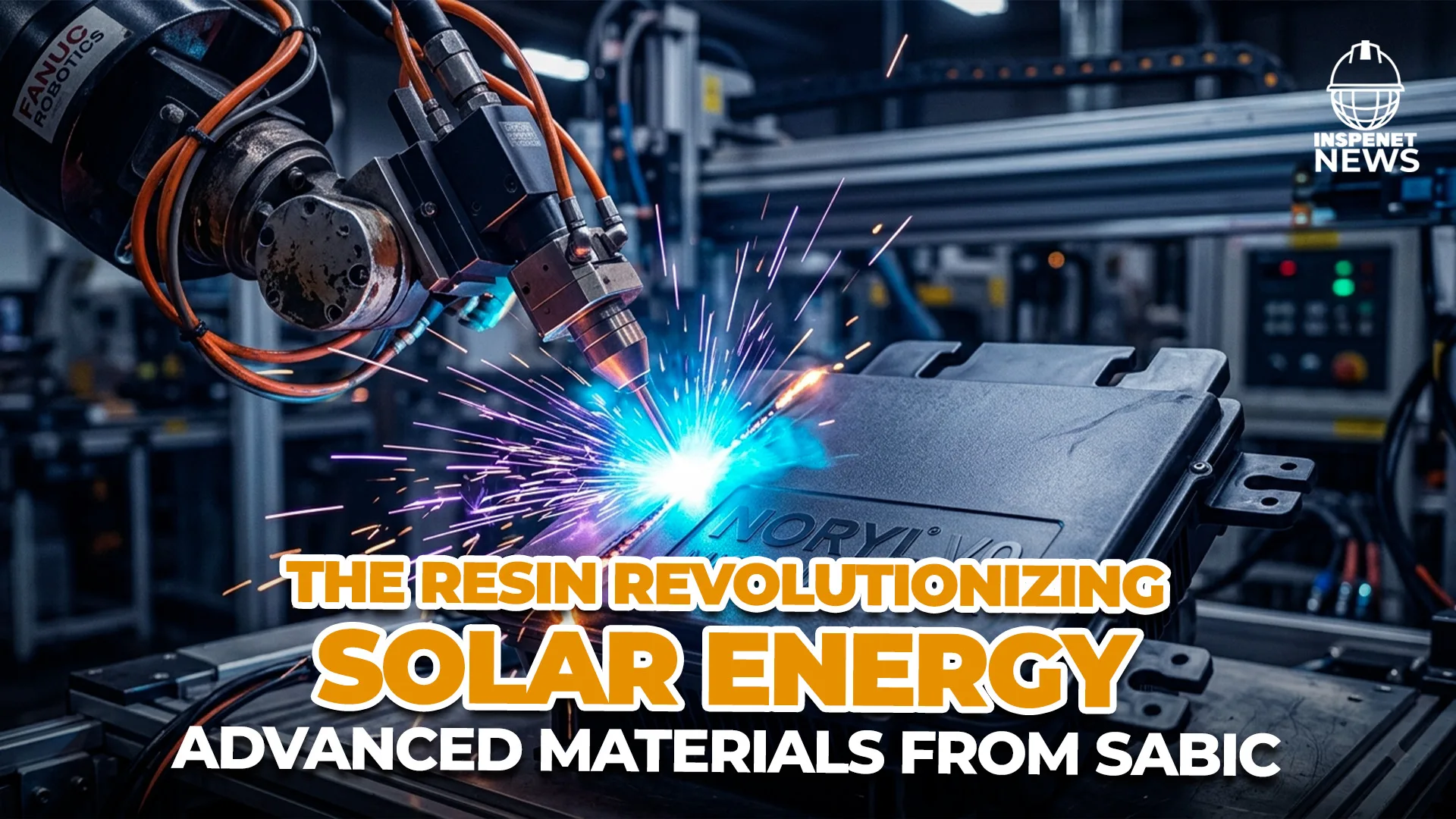
SABIC receives an R&D 100 Award for NORYL V0 for solar energy
SABIC has received an R&D 100 Award for NORYL V0, its range of laser -weldable resins for solar energy applications. The award, given in the Materials Science category, marks the sixth consecutive year the company has received this prestigious accolade.
photovoltaic component manufacturing . The properties of these solar energy materials allow for cleaner and faster component production processes, according to information provided by the company.
Why did NORYL V0 receive the R&D 100 Award?
The NORYL V0 range consists of the V0150TW and V0150IR2 resins ; the former functions as an absorbent material, while the latter has transmissive properties that allow both to be used during the laser welding process .
Furthermore, the resins combine fire resistance, weather protection, and sealing capabilities. These characteristics are ideal for components that need to maintain their performance during prolonged outdoor exposure.
The R&D 100 Award specifically recognizes this development within the Materials Science category. The award also adds to the list of accolades SABIC has received in recent years.
NORYL V0 improves microinverter laser welding
Furthermore, one of the main uses of NORYL V0 is in photovoltaic microinverters . These devices are part of solar power systems and require enclosures capable of protecting their components from external conditions.
The complementary properties of V0150TW and V0150IR2 allow for laser welding during their manufacturing. This enables SABIC to create a faster and cleaner production process for certain parts intended for these devices.
In turn, the sealing achieved through this procedure aims to enhance the reliability and durability of the components. This feature is especially important in solar energy applications that remain exposed for extended periods.
Less waste and energy consumption during manufacturing
The potential advantages of resins go beyond the behavior of the finished product; SABIC maintains that their application can reduce energy consumption during manufacturing and decrease material waste.
The company also points to a possible reduction in production costs; these factors may be relevant for manufacturers seeking to increase the production volume of photovoltaic components while keeping their resources under control.
Therefore, NORYL V0's proposal connects materials science with one of the challenges of the solar industry: manufacturing resistant components through processes that require less energy and generate less waste.
Materials for solar energy withstand extreme conditions
Meanwhile, weather resistance is another aspect considered in the development. Photovoltaic microinverters operate in outdoor installations where their components may be continuously exposed to varying environmental conditions.
NORYL V0 resins offer enhanced weather resistance along with flame-retardant properties . They also provide the necessary sealing to protect the components housed within.
In this way, SABIC aims to ensure that these materials for solar energy contribute both to the manufacturing process and to the subsequent performance of the equipment. The combination of these characteristics can lead to greater reliability during the operation of photovoltaic systems.
SABIC expands its track record at the R&D 100 Awards
Finally, this recognition adds to other awards received by SABIC in the field of materials science. Since 2021, the company has won seven R&D 100 Awards and has been selected as a finalist three times.
The V0150TW and V0150IR2 resins also received an Edison Award this year in the Materials Science category.
Faisal Alfaqeer, CEO and member of the Executive Board of SABIC, linked the recognition to the company's work in addressing industry challenges through its technological expertise and the development of customer-oriented solutions.
With the new R&D 100 Award, NORYL V0 is gaining visibility as a solution for manufacturing photovoltaic microinverters. Its suitability for laser welding and its resistance to outdoor conditions position the material as a key component in developments aimed at improving the production of solar energy products.
News of additional interest
Falcon 9 debris crashes into the Moon
Debris from a SpaceX Falcon 9 rocket crashed into the Moon on August 5 at approximately 8,700 km/h, after having been in space since January 2025. The object, about 12 meters long, was pulled under the Moon's gravity and landed near the terminator, the line separating the sunlit and shadowed portions of the lunar surface. No spacecraft orbiting the Moon managed to obtain direct images of the impact.
The Very Large Telescope, located in Chile, did detect signals related to the impact. Its instruments recorded sodium and lithium in the gas cloud ejected by the collision, which remained visible for five to ten minutes. Scientists believe this data could provide information about the material ejected from the lunar surface, although it is still in the initial stages of analysis. Experts also noted that the event did not pose a danger to people.
Morocco gains ground in the battle for the ports
Morocco has invested approximately €14.3 billion in port development in the north of the country, with Tangier Med as the main driver of its logistics growth. The port complex handled 11 million TEUs in 2025, an 8.4% increase over the previous year and more than double the nearly 5.3 million TEUs recorded by Algeciras. The availability of land for future expansion also gives Tangier Med room to continue increasing its capacity compared to the Spanish port, which has greater physical limitations.
The next major project is Nador West Med, located near Melilla and backed by an investment of around €900 million. Its terminal will initially be able to handle 5 million TEUs per year and will have the capacity to expand to 12 million. In addition to containers, the port will handle oil, energy products, liquid bulk cargo, and industrial cargo. Morocco is also allocating resources to Nador City and the transformation of the port of Tangier to accommodate cruise ships.
JCB takes hydrogen to speeds of up to 581.5 km/h
The JCB Hydromax achieved an average speed of 581.5 km/h during Bonneville Speed Week in the United States. The experimental vehicle, equipped with two hydrogen combustion engines delivering 1,600 hp, surpassed the previous record of 560.5 km/h in its category, which had stood since 2010. During the test, it reached a top speed of 585.5 km/h, with British driver Andy Green at the wheel.
The prototype measures 9.75 meters and has undergone 44 tests as part of its development program. After achieving this milestone, JCB will remain at the Bonneville Salt Flats to pursue an FIA-sanctioned world record and progressively increase the vehicle's power. The company already has experience in this area: in 2006 it reached 563.5 km/h with the Dieselmax, and in 2019 it pushed one of its Fastrac tractors to 217.5 km/h.
Petrobras produces more and surpasses its goals once again
Petrobras closed the second quarter of 2026 with a significant improvement in its results, driven by record oil and natural gas production. The Brazilian oil company nearly doubled its profits and achieved its highest recurring quarterly net profit ever measured in dollars. Its CEO, Magda Chambriard, highlighted that the company continues its streak of exceeding internal forecasts.
Production also exceeded expectations. Petrobras extracted approximately 200,000 barrels of oil per day more than anticipated during the quarter, thanks to improved operational efficiency and the early delivery of projects. These include the P-78 and P-79 floating production units, destined for the Búzios field in Brazil's pre-salt zone.