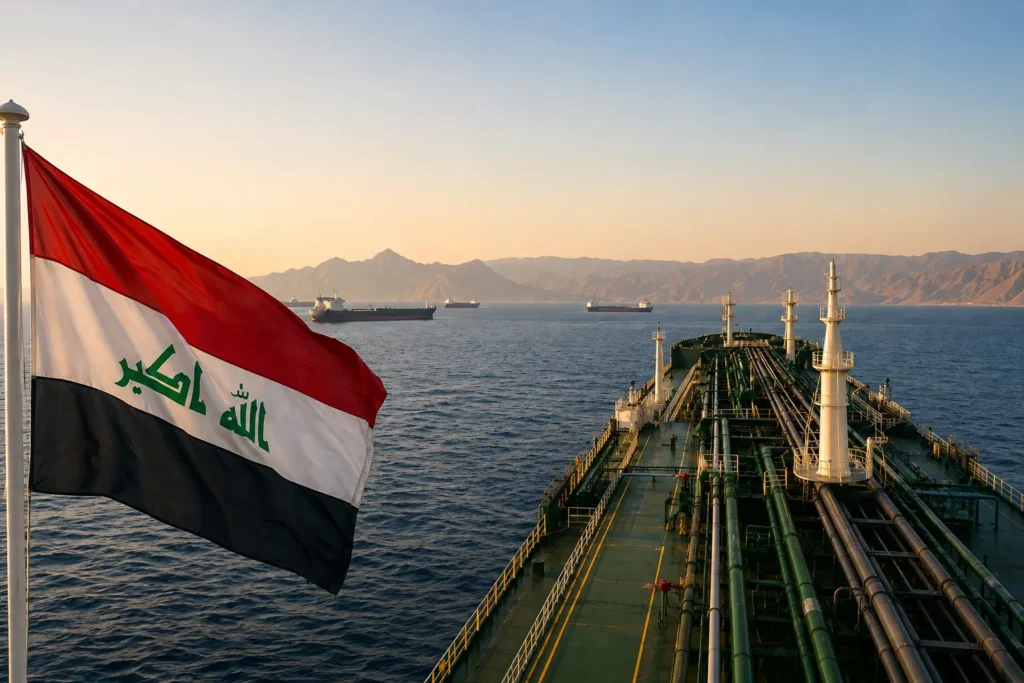
Iraqi crude outside Hormuz is beginning to acquire a different value in a market shaped by maritime risk. Totsa, the trading arm of TotalEnergies, is offering Basrah Medium for loading outside the strait, while numerous buyers continue to avoid sending vessels to Iraqi terminals in the Gulf due to fears of attacks.
The offer carries a premium of nearly US$10 per barrel over Dubai quotes, according to traders cited by Reuters on August 13. The move introduces a new variable into the Iraqi oil trade: it is no longer only about the price of the barrel, but also about where the buyer can receive it and what level of risk must be assumed to reach it.
The situation contrasts with recent efforts by Iraq’s state oil marketer SOMO. In early August, Iraq offered substantial discounts to encourage buyers to lift cargoes from Basrah, but deteriorating navigation conditions have made it difficult to translate those competitive prices into normal maritime operations.
Iraqi crude outside Hormuz changes the logistics equation
Basrah is the main maritime outlet for Iraqi oil destined for international markets. The current problem emerges after loading: a vessel picking up oil at terminals in southern Iraq must pass through the Strait of Hormuz to exit the Gulf.
Disruptions stemming from the regional conflict have turned that transit into a risk decision for shipowners, operators, and buyers. SOMO invited its term customers to lift their August volumes of Basrah Medium and Basrah Heavy from Iraqi terminals. However, the availability of oil has not been enough to normalize loadings because numerous buyers continue to face difficulties securing vessels willing to enter the area.
In this environment, having a cargo that can be received outside Hormuz changes part of the equation. The buyer no longer faces directly the same voyage required to collect the oil inside the Gulf. However, the available information does not identify the exact location where Totsa is offering the cargo or specify the logistics mechanism being used to position it outside the strait.
Therefore, there is insufficient basis to attribute the operation to a particular terminal or to a specific ship-to-ship transfer.
Why would someone pay more for the same Iraqi crude?
This is probably the most interesting question behind the operation.
In early August, SOMO offered discounts ranging from US$25 to US$27 per barrel for Basrah Medium, depending on the loading window, for volumes lifted from facilities inside Hormuz. Basrah Heavy received even larger discounts.
Totsa is now offering Basrah Medium outside the strait at a premium of nearly US$10 over Dubai. The difference should not automatically be interpreted as the exact price of avoiding Hormuz. Commercial terms, dates, transportation costs, and the specific characteristics of each cargo can affect its valuation.
However, the comparison does reveal an important transformation: the physical location of the oil is gaining extraordinary weight in how it is traded. A barrel available at an attractive price inside an area that few vessels are willing to enter may ultimately be less commercially accessible than another barrel positioned beyond the main maritime bottleneck.
Maritime shipping drives up the cost of moving oil out of Basrah
Recent developments in the freight market illustrate the scale of the problem.
Reliance Industries recently chartered a supertanker to transport 2 million barrels of Iraqi crude. The freight cost was estimated at between US$23 million and US$25 million, approximately twelve times a previous benchmark cited for that type of voyage.
The operation demonstrates that securing cheap oil at the point of origin does not necessarily mean obtaining cheap oil at its destination.
Vessel security, tonnage availability, insurance, sailing times, and exposure to conflict zones can substantially alter the final cost of an operation.
Shipping traffic also illustrates the magnitude of the disruption. Between Monday and Thursday of last week, Reuters counted 33 vessels transiting Hormuz, compared with 50 during the same period a week earlier. Before the conflict, weekly traffic stood at around 130 to 140 vessels.
The decline is particularly significant for Iraq because its main southern export terminals are located inside the Gulf.
TotalEnergies turns logistics into a commercial advantage
Totsa’s operation shows how major trading companies can play an additional role when traditional routes cease to function normally.
Their capabilities extend beyond simply buying and selling barrels. Access to vessels, storage, cargo scheduling, risk management, and the ability to reposition oil can change the conditions under which a product reaches the next buyer.
In this case, the distinguishing feature of the offer is not a new crude grade. It remains Basrah Medium. What changes is its position relative to the logistics bottleneck.
The same phenomenon is also emerging among other Gulf producers. ADNOC, for example, has turned to new transportation arrangements and greater commercial flexibility to keep crude moving during regional disruptions.
This suggests that the market is beginning to respond to risk not only through pricing, but also through new logistics and commercial configurations.
Hormuz redefines the value of Basrah oil
Totsa’s offer does not solve Iraq’s structural problem. The country remains heavily dependent on its southern export infrastructure, and as long as navigation remains disrupted, getting those barrels to market will continue to represent a challenge.
There is also insufficient information to determine whether the offer outside Hormuz will be a one-off operation or a mechanism that could be repeated with larger volumes.
But the episode sends an important signal. Under normal conditions, the market compares quality, price, availability, and distance. In an environment of elevated geopolitical risk, an additional variable emerges: the actual ability to physically access the barrel.
That is why the nearly US$10 premium on Totsa’s offer should be viewed within the context of a market where SOMO has had to apply steep discounts to encourage loadings inside the Gulf and where transporting a VLCC from Basrah can reach extraordinary costs.
As long as transit through the Strait of Hormuz remains restricted, the Iraqi oil trade will have to continue adapting. And if positioning crude beyond the strait reduces part of the buyer’s maritime exposure, logistics may cease to be simply a cost and instead become one of the attributes that determine the barrel’s commercial value.
Source: Reuters.