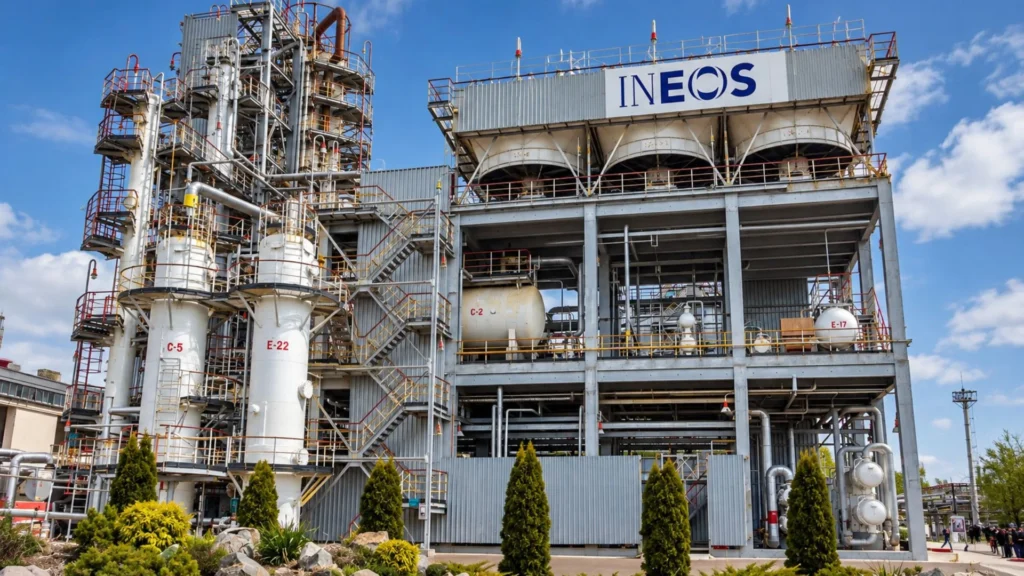
Ineos will suspend operations at three chemical plants in Hull, UK, due to high gas prices in Europe and their impact on production costs, the company attributed the decision to the increasing energy pressure facing the European chemical industry. This sector requires large amounts of energy to maintain its processes and competes with producers located in markets where gas and electricity are considerably cheaper.
Ineos faces pressure from high gas prices
According to data cited by Reuters, British gas contracts nearing expiration are trading around $ 23.51 per million British thermal units (MMBtu). In contrast, the US benchmark Henry Hub gas is around $ 2.84 per MMBtu. This difference represents significant pressure for industrial facilities that rely on gas both as an energy source and a raw material.
Jim Ratcliffe, president of the company, asserted that gas prices are currently 12 times higher than in the United States and eight times higher than in China. In his view, this gap reduces the ability of European manufacturing to compete in international markets. Ratcliffe also questioned the combined impact of high energy costs and carbon taxes on the continent’s industry.
European regulators must recognize that the combination of high energy costs and the added burden of unsustainable carbon taxes is destroying our European manufacturing base.
Ratcliffe
Three chemical plants in Hull will be shut down
The three affected facilities are located in Hull and employ almost 4,000 people in total, these plants manufacture chemical products used in various industrial chains, with applications in medicines, clothing, cosmetics, detergents, construction materials and explosives. The suspension of their operations demonstrates how rising energy costs can impact an industry located at the beginning of numerous supply chains.
The European chemical industry faces higher costs
European manufacturers have been operating under more demanding energy conditions than some of their competitors in the United States and China for several years, the energy crisis following Russia’s invasion of Ukraine disrupted both gas supply and prices in Europe, later, tensions in the Middle East added further pressure and uncertainty to the international energy market.
As a result, energy-intensive European industries face higher gas and electricity costs than some of their international competitors, this difference is particularly relevant for the chemical sector, where gas is used both to power industrial processes and in certain production chains.
Ineos aims for European industrial competitiveness
Ineos’ decision once again places the competitiveness of European industry at the heart of the energy price debate. For energy-intensive companies, the price of gas can have a direct impact on the profitability of a facility. When the gap with other regions widens, producing certain chemicals in Europe can become significantly more expensive.
The shutdown of the Hull plants reflects this problem on an industrial scale, Ineos it argues that the combination of expensive energy and carbon-related burdens is increasing pressure on European manufacturing, while producers in the United States and China operate with lower energy costs. The evolution of the gas market will therefore be a key factor for Ineos’s facilities as well as for other European chemical plants exposed to high energy consumption.
Source: Reuters
Photo: Shutterstock