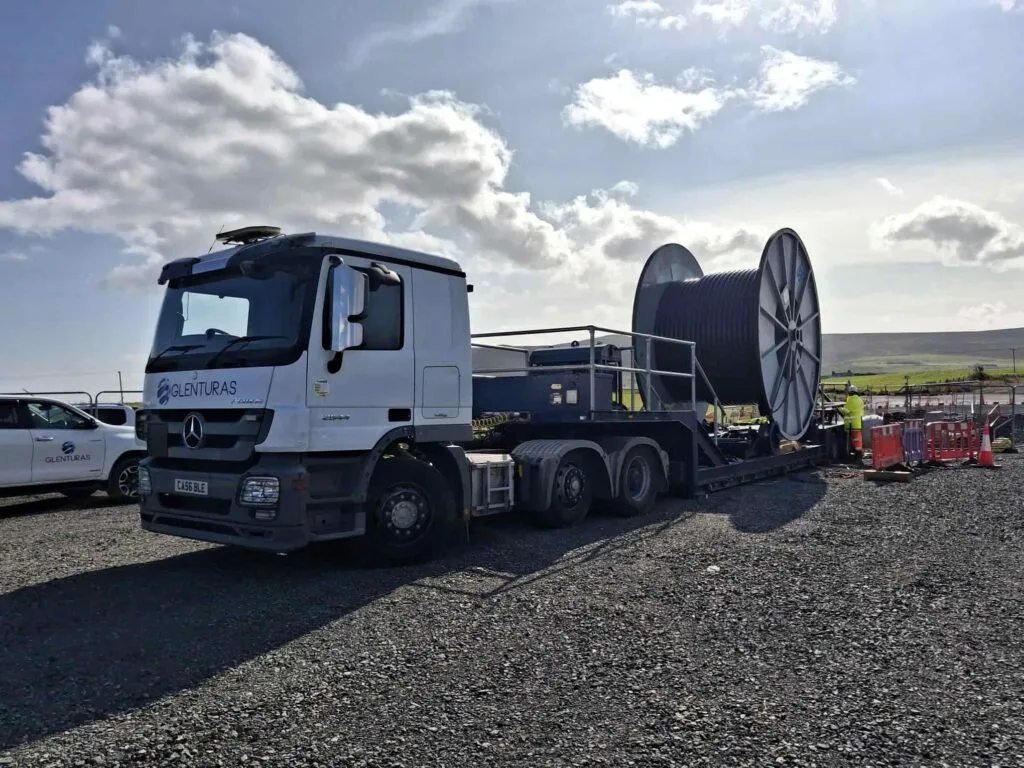
Construction of the Orkney Link has entered a new phase with the start of the installation of the underground power cable that will connect the Orkney Islands to Great Britain’s electricity transmission network for the first time. SSEN Transmission is developing the project, while Nexans is executing the manufacturing and installation of the cable system linking Finstown in Orkney with Dounreay on the Caithness coast.
The project includes a new substation at Finstown, approximately 14 kilometers of underground HVAC cable to Warebeth, and another 53 kilometers of subsea cable across the Pentland Firth to Caithness. There, it will connect to a new substation at Dounreay before joining the British transmission network. The system is designed to carry up to 220 MW and allow for two-way power flow.
Over the coming months, Nexans and SSEN Transmission teams will install 27 cable drums at various points along the route between Finstown and Warebeth. From there, the cable will be pulled through previously constructed ducts along the route using specialized pulling equipment. Subsequently, the necessary jointing will be performed to convert the different sections into a continuous circuit.
Orkney Link: The cable is only one part of the system
The installation of the conductor represents one of the visible steps of a much larger transmission project. In Finstown, the new substation will function as a connection point between local generation and the transmission system, transforming the voltage to 220 kV to transport electricity to the mainland. The land end will feature equivalent infrastructure at Dounreay to facilitate the connection to the existing grid.
The link will utilize high-voltage alternating current (HVAC) technology. Nexans confirmed that the system is designed to exchange up to 220 MW between Orkney and the mainland and that the total route length reaches approximately 69 kilometers, including land and subsea sections.
While cable installation progresses, electrical infrastructure is also advancing. Structural and cladding work on the buildings at the Finstown substation has already been completed, allowing the installation of electrical equipment to begin. Siemens Energy and BAM form the joint venture responsible for the construction of the project’s substations.
A grid to export energy from the islands
The energy significance of the Orkney Link is related to a particular characteristic of the Orkney Islands: there is significant renewable generation potential, but available transmission capacity has historically limited how much of that energy can be integrated into the power system.
The new connection will allow for the transport of up to 220 MW between the islands and the mainland, creating an export route for new renewable generation. SSEN Transmission notes that the project will enable the utilization of resources from existing and future wind installations, as well as emerging technologies linked to ocean energy harvesting.
However, flow can also occur in the opposite direction. The bidirectional architecture of the Orkney Link will allow Orkney to receive electricity from the mainland grid when necessary, adding a second function to the link: in addition to facilitating the export of local generation, it contributes to strengthening the security and resilience of the islands’ electricity supply.
The project thus becomes a piece of infrastructure that connects generation, transmission, and security of supply. It is not just about installing new renewable capacity, but about building the grid capable of transporting that electricity to demand centers.
Subsea infrastructure defines the project
The 53-kilometer subsea section constitutes one of the most technically demanding elements of the link. The solution combines subsea cable, a transition at the Warebeth landfall, land cable, and high-voltage substations, making the interfaces between systems a critical aspect of execution.
Nexans was contracted to manufacture and install the cable system. The company indicated that the offshore section cables would be manufactured at its plant in Halden, Norway, while the land sections would be produced in Charleroi, Belgium, and the accessories in Cortaillod, Switzerland.
The project also required specialized work before reaching this phase. At Warebeth, horizontal directional drilling was completed to establish the cable path to the landfall point, a solution that reduces surface intervention in an area particularly sensitive for the installation of the link.
Current planning maintains 2028 as the target for the energization of the link. When it enters operation, Orkney will be connected to the national transmission grid for the first time through infrastructure capable of exchanging up to 220 MW of electricity.
SOURCE AND PHOTO: https://www.offshore-energy.biz/