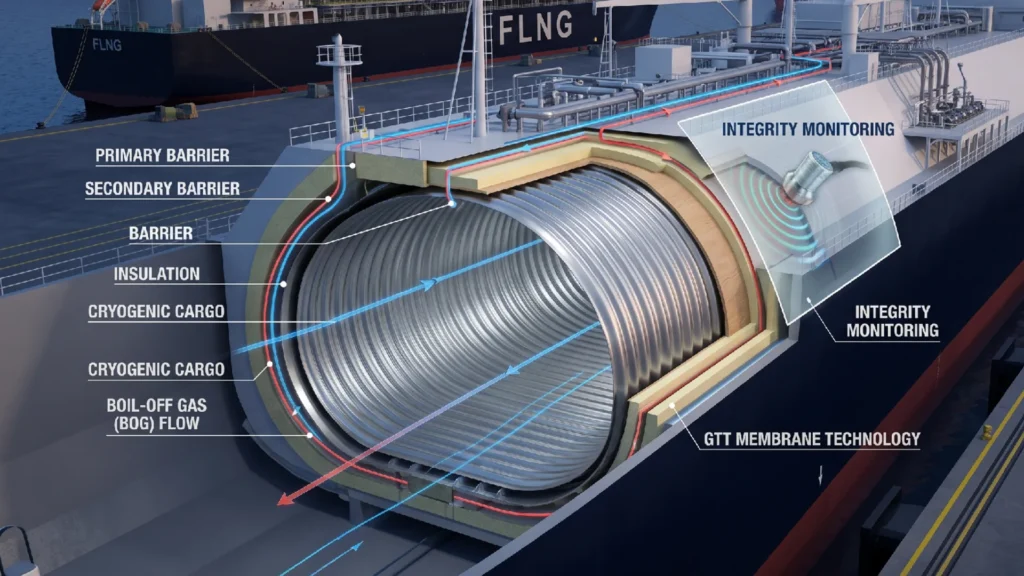
Gaztransport & Technigaz (GTT) announced the award of new orders for the design of cryogenic tanks for an FLNG unit and six LNG carriers to be built in South Korea and China. The contracts cover a floating LNG production facility and six large-capacity vessels, all equipped with the Mark III Flex membrane containment system.
The project portfolio comprises two 174,000 m³ vessels, four 175,000 m³ vessels, and the Delfin FLNG 1 unit, which will have 180,000 m³ of LNG storage capacity. This expansion reflects growing investment in infrastructure for liquefaction, storage, and maritime transport of liquefied natural gas.
Delfin FLNG will mark a milestone for LNG in the United States
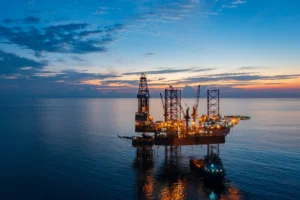
One of the most significant contracts corresponds to Delfin FLNG 1, whose cryogenic tank engineering was commissioned by Samsung Heavy Industries for the Delfin LNG project, located off the coast of Louisiana.
According to GTT, the facility will be the first floating liquefaction unit (FLNG) to enter operation in the United States and the largest in the world by planned production capacity, with 4.4 million tons of LNG per year (MTPA). Delivery is scheduled for mid-2030.
The unit will feature eight cryogenic tanks, arranged in two rows, with a total capacity of 180,000 m³ of LNG storage, all equipped with the Mark III Flex system.
Six new vessels will expand LNG transport capacity
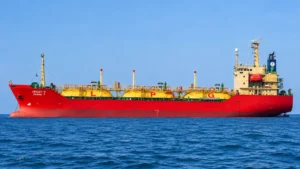
In addition to the FLNG project, GTT will design the containment systems for two new 174,000 m³ LNG carriers, built by HD Hyundai Heavy Industries following an order placed by HD Korea Shipbuilding & Offshore Engineering (HD KSOE). The vessels will incorporate Mark III Flex technology and their delivery is scheduled for the first quarter of 2029.
These are joined by four new 175,000 m³ LNG carriers to be built by Jiangnan Shipyard for COSCO Shipping Energy. Deliveries are scheduled between the third quarter of 2029 and the third quarter of 2030.
Cryogenic technology will be critical for reliability
Cryogenic containment systems represent one of the most critical components of LNG infrastructure. Their function is to maintain liquefied natural gas at temperatures close to -163°C, minimizing heat transfer and ensuring leak-tightness throughout the asset’s operational life.
In the case of Delfin FLNG 1, GTT emphasized that the Mark III Flex system was developed to respond to demanding maritime and offshore conditions, including operations in regions exposed to hurricanes. These characteristics enable improved reliability and safety of facilities subjected to high mechanical and environmental loads.
From a mechanical integrity perspective, these systems will require strict inspection programs, fabrication control, structural monitoring, and maintenance to preserve the performance of membranes, thermal insulation, and joints during decades of operation.
LNG infrastructure continues to expand
The new contracts obtained by GTT demonstrate the sustained growth of global infrastructure for liquefied natural gas. The incorporation of new FLNG units and LNG carriers will expand the production and transport capacity needed to supply markets with constantly increasing energy demand.
For the offshore industry, these projects also represent new opportunities for manufacturers, shipyards, inspection companies, non-destructive testing providers, and asset integrity specialists who will participate in the life cycle of these strategic facilities.
Source: Offshore Energy