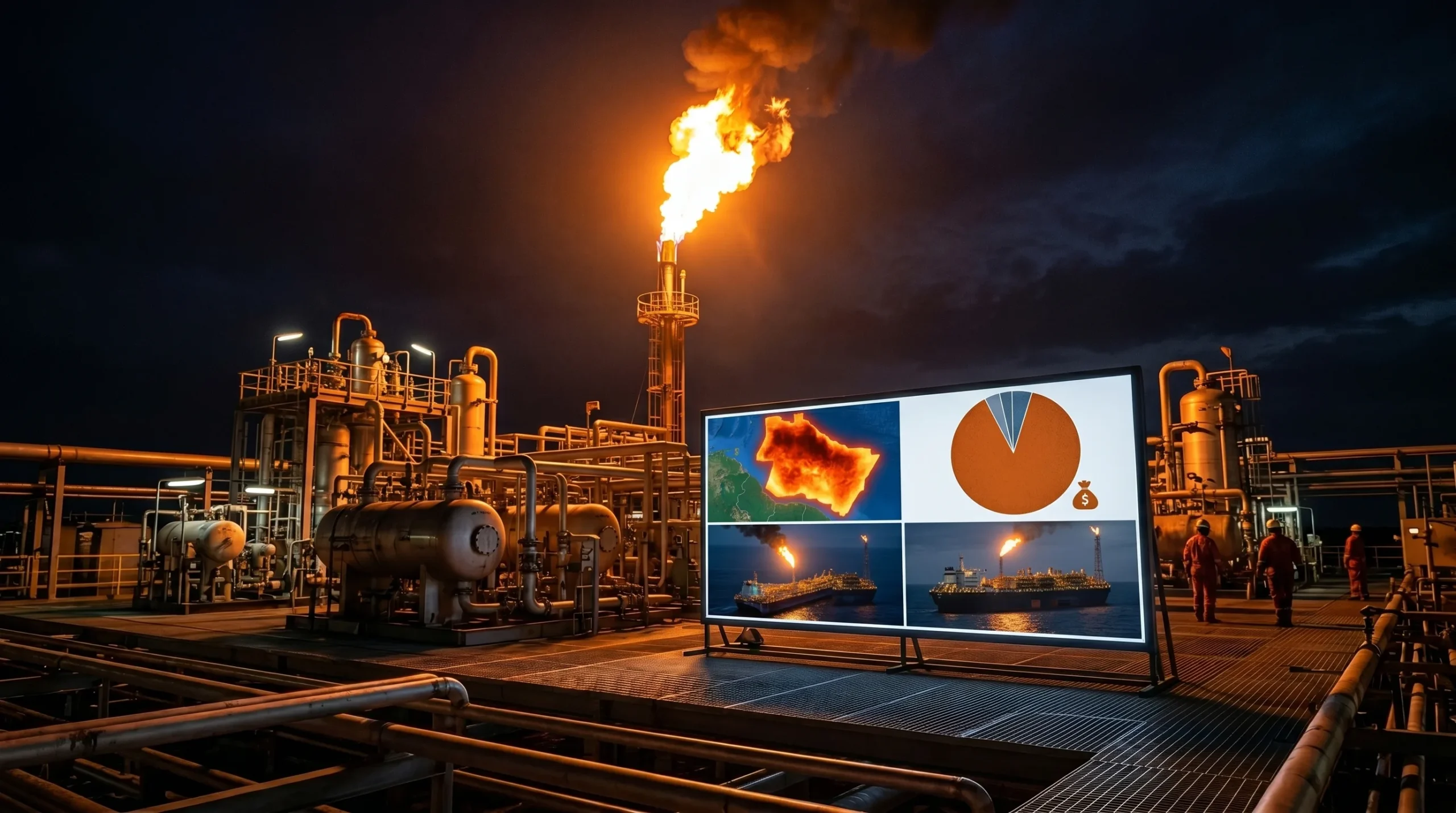
Global gas flaring reached 167 billion cubic meters (bcm) in 2025, the highest level in six years and the third consecutive increase, according to the World Bank. The flared volume is equivalent to US$54,000 million in destroyed energy value and more than 400 million tonnes of CO₂ equivalent emitted.
Russia, Iran, and Iraq account for nearly half of the global total. In Russia, Vedomosti reported 25.1 bcm flared in 2025, up 6.8% from 2024. Nine countries—Russia, Iran, Venezuela, Mexico, Algeria, Nigeria, Iraq, Libya, and the U.S.—accounted for more than 80% of global flaring while producing half of the world’s oil.
Why did global gas flaring increase again?
Demetrios Papathanasiou, the World Bank’s Global Director for Energy, noted that “the economic consequences of continued flaring are simply too substantial.” Zubin Bamji, Manager of the World Bank’s Flaring and Methane Alliance, added: “The technologies to capture associated gas are well established. What is missing in too many regions is the leadership, prioritization, and governance essential to implement these solutions.”
The cost to eliminate routine flaring ranges between US$70,000 and US$100,000 million, less than twice the value of the gas currently wasted each year. The World Bank’s Zero Routine Flaring by 2030 initiative is facing an adverse trajectory with three consecutive years of increases.
For capturing and monetizing associated gas, the World Bank report confirms that the gap is not technological but infrastructural: gathering, compression, and transport systems not planned in parallel with producing wells.
Energy waste exceeds US$54,000 million
Libya, Algeria, and Nigeria flared more than 25 bcm in 2025. Nigeria recorded between 6.08 and 6.6 bcm depending on the source—NUPRC versus the World Bank’s satellite estimate, a difference attributed to distinct measurement methodologies. The Nigerian regulator reaffirmed its commitment to eliminate routine flaring by 2030.
The divergence between in situ measurement and satellite data reflects shortcomings in methane emissions monitoring systems at upstream facilities. Without accurate measurement, reduction commitments lack a verifiable technical basis.
Beyond the economic impact, routine gas flaring represents a missed opportunity to strengthen global energy security. Much of that associated gas could be used for power generation, industrial supply, liquefied natural gas (LNG) production, or as feedstock for petrochemical processes. However, in many producing regions, infrastructure constraints, processing capacity, and market access limitations persist, forcing operators to dispose of the surplus through combustion instead of integrating it into the value chain.
Reducing gas flaring will be key to the energy transition
The World Bank report on Gas Flaring 2026 points to structural demand in compression, gas gathering systems, processing plants, and midstream asset digitalization. The three-year consecutive increase expands the opportunity for EPCs, turbomachinery suppliers, and asset integrity companies in Africa, the Middle East, and Latin America. Coverage can also be expanded with Reuters data on progress in Russia and Iran.
For the oil and gas industry, reducing gas flaring has become a key indicator of environmental and operational performance. Companies are increasing investments in gas recovery systems, compression, digital monitoring, and emissions detection technologies to meet decarbonization targets and respond to regulatory and investor demands. These measures not only reduce emissions, but also enable the recovery of an energy resource with commercial value.
Source: World Bank Group /Reuters