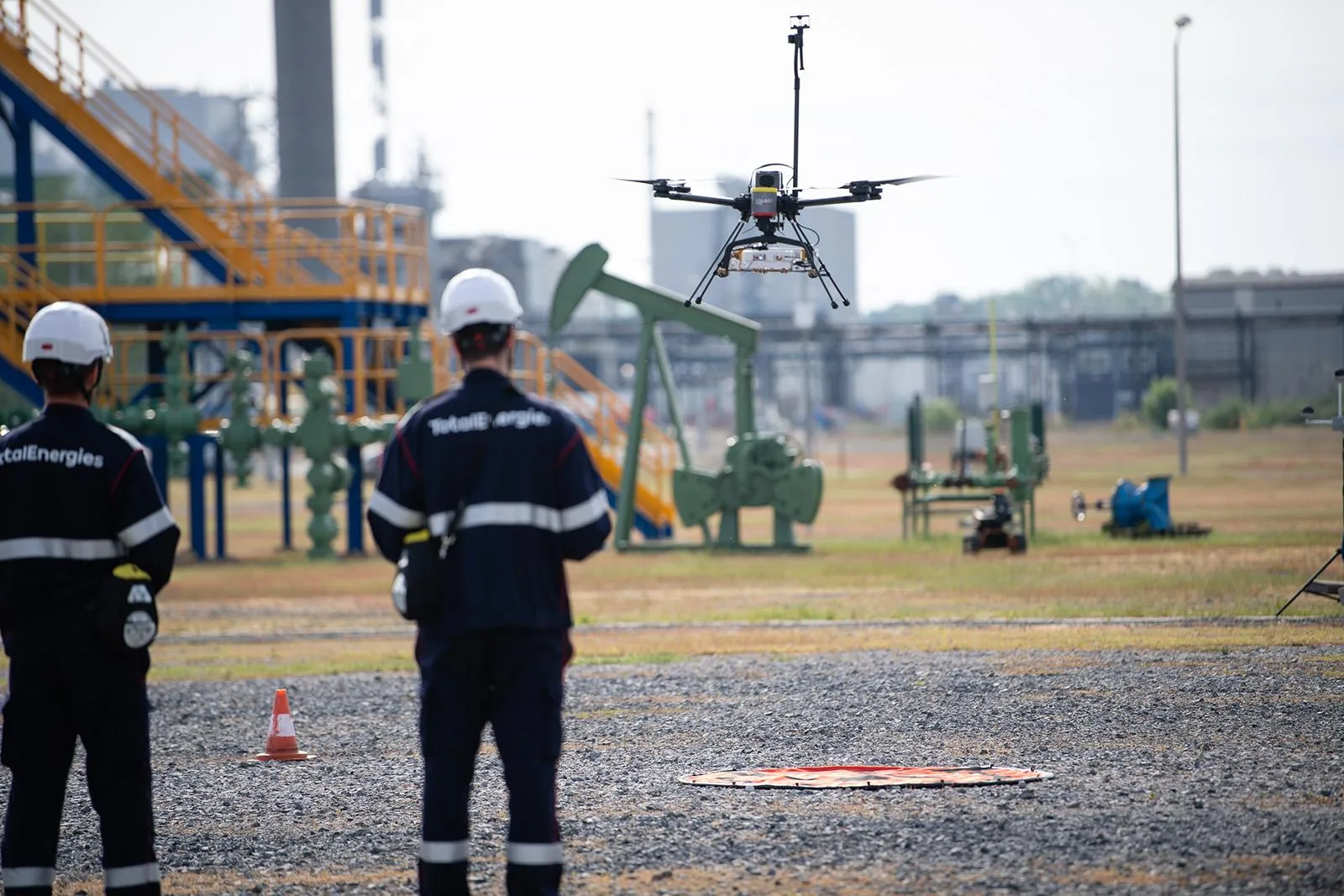
TotalEnergies announced the implementation of a global continuous monitoring system in real time to detect methane emissions across all its operational exploration and production facilities.
The initiative is part of the company’s strategy to achieve “near-zero” methane emissions in its upstream assets by 2030.
TotalEnergies Exceeds Methane Reduction Targets
The company reported that it achieved a 65% reduction in its methane emissions in 2025 compared to 2020 levels, thus exceeding its initial reduction target of 60%.
TotalEnergies is now targeting a 70% reduction in 2026 and confirmed it is on track toward its goal of an 80% reduction by or during 2030.
In terms of methane intensity associated with operated oil and gas production, the company reached a level of 0.07% in 2025, exceeding ahead of schedule its target of remaining below 0.1% by 2030.
System Incorporates 13,000 Sensors in Upstream Assets
The new continuous monitoring system is based on a network of approximately 13,000 sensors deployed across operational exploration and production assets.
The infrastructure combines technologies such as: wireless IoT sensors, OGI infrared cameras, pyrometers and laser optical sensors, predictive emissions monitoring systems (PEMS), acoustic and meteorological sensors.
According to TotalEnergies, these tools enable the identification of leaks and anomalous emissions in real time to execute immediate corrective actions.
AUSEA Drones and Satellites Strengthen Detection
The monitoring strategy also includes annual leak detection and repair (LDAR) campaigns at all operated facilities.
Additionally, TotalEnergies uses drones equipped with AUSEA (Airborne Ultralight Spectrometer for Environmental Applications) technology, capable of simultaneously detecting methane and CO₂ emissions with high precision.
The company noted that AUSEA technology has already been shared with companies such as Petrobras, Sonangol, ONGC, and Veolia.
The monitoring is complemented by satellite analysis associated with the MARS program of the International Methane Emissions Observatory (IMEO) of the United Nations Environment Programme.
MethaneLive and STORM Centralize Global Monitoring
In 2025, TotalEnergies also launched MethaneLive, a digital center installed in Pau, France, responsible for centralizing information from multiple detection systems.
The platform uses digital tools and specialized analysis to alert operators and coordinate responses to potential emissions.
The company is also developing the digital solution STORM, designed to integrate data from IoT sensors, infrared cameras, drones, satellites, and meteorological systems through 2D and 3D visualization.
Currently, STORM is in the pilot phase at the Tempa Rossa plant in Italy.
TADI Platform Validates Detection Technologies
TotalEnergies also highlighted the role of its testing platform TADI (TotalEnergies Anomalies Detection Initiatives), located in Lacq, France.
The facility enables the replication of controlled leak scenarios to validate detection and quantification technologies before their industrial deployment.
In April 2025, TADI and the U.S. center METEC jointly published an international protocol for the evaluation of methane detection technologies, seeking to harmonize global monitoring standards.
Source and photo: https://totalenergies.com/