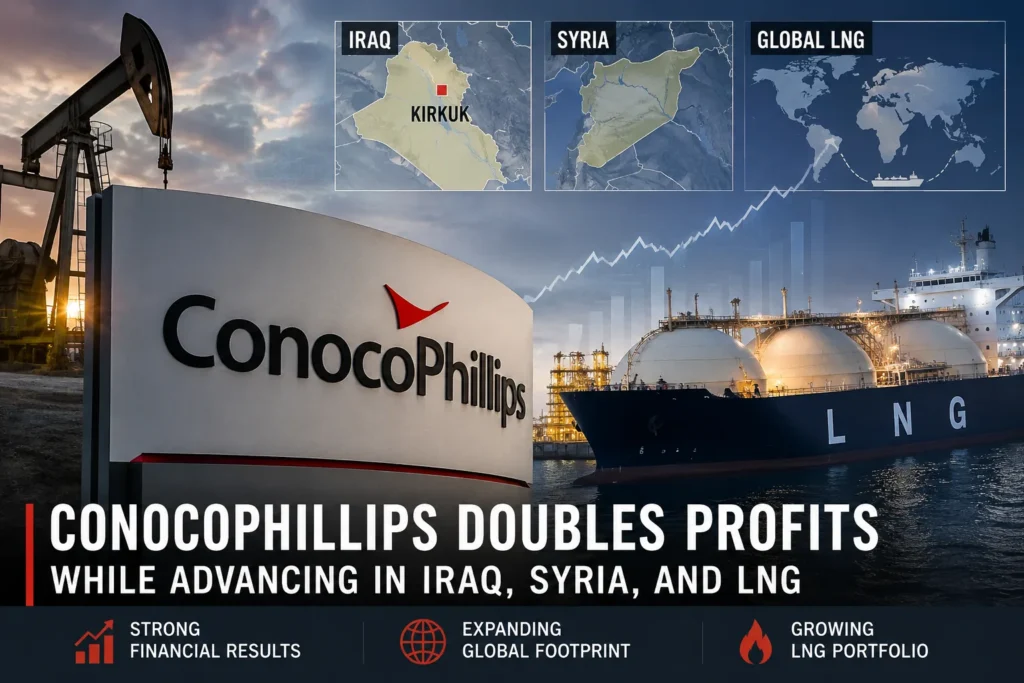
ConocoPhillips closed the second quarter of 2026 with a strong improvement in its financial results while accelerating an expansion strategy that combines record production in the Permian, new oil opportunities in Iraq, a return to Syria, and a growing presence in the global liquefied natural gas (LNG) market.
The company reported earnings of $3.9 billion, equivalent to $3.23 per share, nearly double the $2.0 billion recorded during the same period in 2025. Excluding special items, adjusted earnings reached $4.0 billion, compared with $1.8 billion a year earlier.
The financial performance was accompanied by strong cash generation. ConocoPhillips generated $7.4 billion from operating activities and $7.2 billion in cash from operations (CFO), providing resources to fund investments, dividends, and an acceleration of share repurchases. During the quarter, distributions to shareholders reached $3.0 billion.
However, behind the quarterly figures lies a broader story: ConocoPhillips is using its financial strength to reposition its portfolio toward long-life assets and opportunities capable of strengthening its international presence.
ConocoPhillips strengthens its Permian position despite lower global production
Total production reached 2.248 million barrels of oil equivalent per day (boe/d) during the second quarter. Although this represents a decrease of 143,000 boe/d compared with the same period in 2025, U.S. operations continued to play a central role.
The Lower 48 produced 1.479 million boe/d, including 720,000 boe/d from the Delaware Basin, 202,000 from the Midland Basin, 363,000 from the Eagle Ford, and 189,000 from the Bakken. The year-over-year decline in consolidated production was primarily related to the impact of the conflict in the Middle East on Qatar operations and higher royalties at Surmont. In contrast, organic growth in the Lower 48 helped partially offset those effects.
Prices also supported the results. The company’s average realized price reached $62.33 per boe, a 36% increase from the $45.77 per boe recorded a year earlier. This improvement directly contributed to the increase in quarterly earnings.
For the third quarter, ConocoPhillips expects production of between 2.29 million and 2.32 million boe/d and maintained its full-year 2026 guidance unchanged.
Iraq and Syria open a new phase of expansion
One of the most significant moves in the company’s international strategy is taking place in Kirkuk, northern Iraq. ConocoPhillips agreed to acquire a 42% interest in BP Energy Company of Kirkuk Limited from bp, gaining access to a group of producing oil fields with significant rehabilitation and redevelopment opportunities.
The agreement covers the Baba and Avanah domes of the Kirkuk field, as well as the Bai Hassan, Jambur, and Khabbaz fields. The area initially contains more than 3 billion barrels of oil equivalent in gross recoverable resources, in addition to further exploration potential. The transaction is expected to be completed before the end of 2026, subject to the relevant approvals.
For ConocoPhillips, the appeal lies in gaining access to an existing production base without initially taking on a disproportionate capital program. The company itself stated that the transaction is not expected to require significant capital contributions and that compensation will be proportionally linked to incremental production and costs.
At the same time, ConocoPhillips is returning to Syria, a market from which it had been absent for decades. In June, the company, together with NovaTerra, reached an agreement with the Syrian Petroleum Company aimed at restoring and increasing gas production using existing infrastructure. CEO Ryan Lance confirmed at the time that the company expected to increase gas production and eventually expand its presence in the country.
Both moves reflect a similar strategy: pursuing opportunities where known resources and existing infrastructure can provide a pathway for growth rather than relying exclusively on developing new projects from the ground up.
LNG gains weight within the global strategy
The third component of the expansion lies in liquefied natural gas. During the quarter, ConocoPhillips added 2 million tonnes per annum (Mtpa) through new offtake agreements, increasing its commercial LNG portfolio to 12 Mtpa.
This expansion complements the company’s positions in LNG projects in Qatar, Australia, and the United States. On the U.S. Gulf Coast, ConocoPhillips also holds a direct 30% interest in Phase 1 of Port Arthur LNG, which is expected to begin operations in 2027.
The strategy allows the company to build exposure across different points of the value chain: gas production, participation in liquefaction facilities, and commercial supply agreements.
Qatar remains particularly relevant. ConocoPhillips said this week that potential delays associated with recent disruptions in the country would likely be limited to a few months and are not expected to affect its free cash flow target.
ConocoPhillips combines financial discipline with upstream growth
The international expansion comes as the company continues to reshape its portfolio. ConocoPhillips achieved its $5 billion divestment target ahead of schedule, after agreeing to sell $1.7 billion in non-core Lower 48 assets, with the transactions closing in July.
At the same time, the company doubled its quarterly share repurchases to $2 billion and distributed another $1 billion through dividends. ConocoPhillips maintains its target of returning approximately 45% of CFO to shareholders during 2026 and continues to target a $7 billion free cash flow inflection by 2029.
The second-quarter results therefore show more than a recovery in earnings. ConocoPhillips is combining cash generation, divestments of non-core assets, and new international positions to reshape its portfolio.
The Permian continues to provide a solid production base, while Kirkuk opens a long-term oil growth opportunity, Syria represents a return to a market with infrastructure that needs to restore production, and LNG expands the company’s exposure to international gas trade.
The execution of these initiatives will determine whether the strong financial performance achieved in 2026 can translate into sustainable growth over the coming years.
Sources: ConocoPhillips