Table of Contents
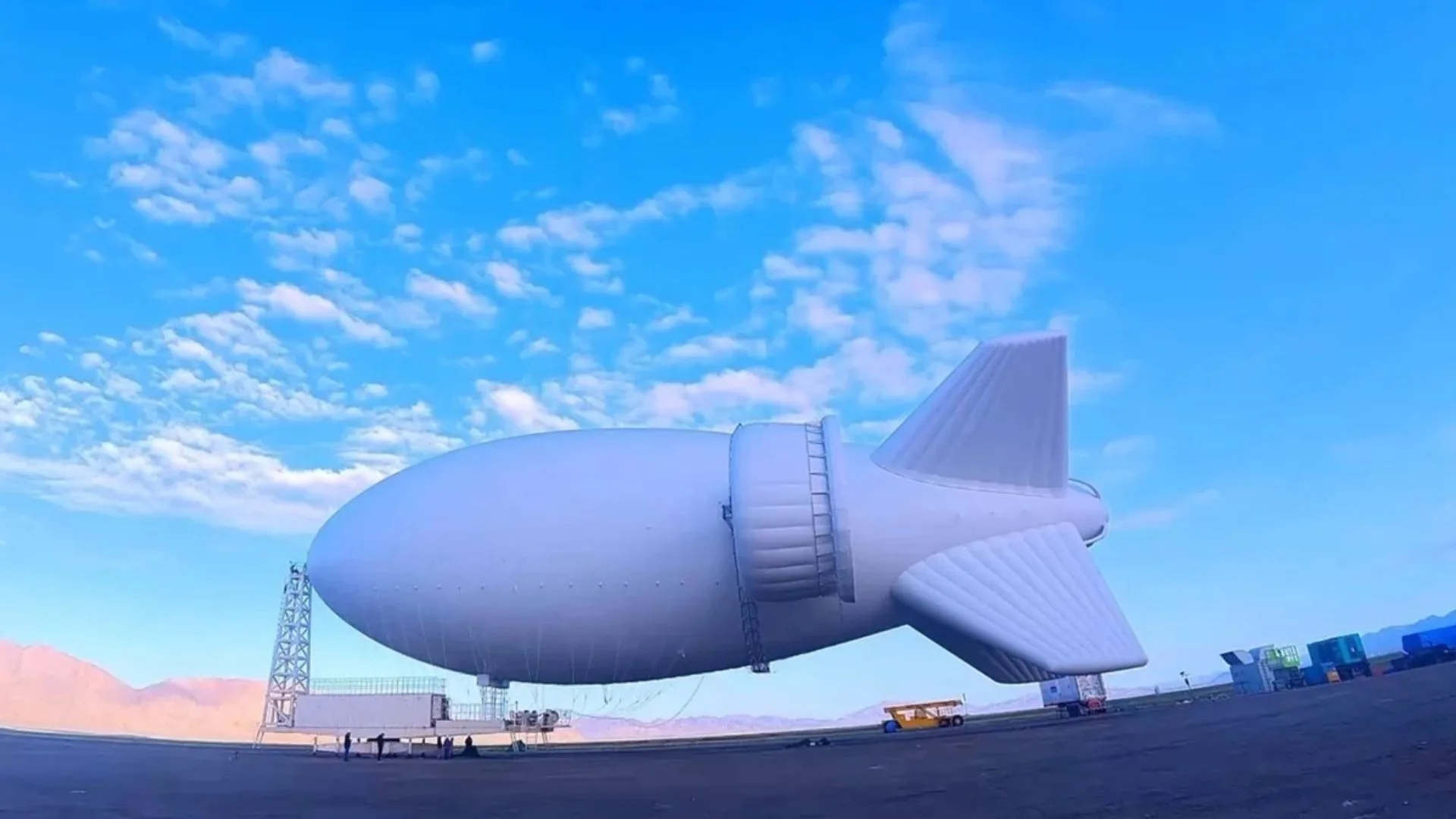
China he took the S4000, a turbine-powered aircraft designed to harness high-altitude winds and generate electricity, to an altitude of 4,000 meters.
The high-altitude wind energy it took a new step in China with the testing of the S4000, a large aircraft equipped with turbines that can rise to about 4,000 meters to take advantage of stronger and more constant wind currents.
According to information released by the state broadcaster CCTV the prototype completed an operational cycle that included ascent, position holding, power generation, and subsequent recovery. The test was conducted at a facility in northwest China and allowed for the evaluation of the platform’s overall performance.
The system was developed by the company Sawes Energy Technology along with the Tsinghua University and the Aerospace Information Research Institute of the Chinese Academy of Sciences.
How does the S4000 generate electricity?
Unlike a conventional wind turbine installed on a tower, the S4000 takes the turbines directly to the air currents located at a higher altitude.
The platform has a configuration similar to that of an airship and uses helium to stay aloft, its size is approximately the length of a Boeing 747, and its structure carries lightweight turbines responsible for transforming wind energy into electricity.
While in flight, a cable connects the aircraft to the ground, this element allows the transmission of the generated electricity and keeps the system secure during operation.
Thus, technology seeks to overcome one of the physical limitations of wind energy conventional, the height of the towers. Placing the generator directly towards the air currents allows access to wind resources that are beyond the reach of onshore wind turbines.
High-altitude winds offer greater stability
Several kilometers above the surface, air currents can be more intense and constant than near the ground, this characteristic explains the interest in developing systems for airborne wind energy.
Furthermore, an aerial platform eliminates the need to construct large towers to reach greater heights, the challenge lies in keeping the aircraft stable, controlling its position, and safely transmitting electricity to the ground.
The S4000 seeks to demonstrate that these operations can be integrated within the same system, the recent test covered precisely the stages of ascent, stationary operation, generation, and recovery.
Sawes progresses from the S1500 to the S6000
Furthermore, the S4000 is part of a family of platforms developed by Sawes Energy Technology the company, founded in 2023, uses the expected operating altitude to name its different models.
In September 2025, the company flew the S1500, a platform that reached a power output of 1 megawatt, subsequently, in January 2026, it tested the S2000 at an altitude of approximately 2,000 meters.
By March, both systems had accumulated orders close to 500 million yuan, equivalent to about $74.3 million, according to figures released by the company.
Sawes is now also working on the S6000, a model designed to exceed 6,000 meters in altitude and expected to carry out its first operations during 2026.
A power source for remote areas
Furthermore, mobility is one of the potential advantages of these platforms compared to fixed wind turbines. The system can be moved between different locations, a feature that opens up possibilities for supplying electricity to areas far from conventional power grids.
Its potential applications include deserts, islands, mountainous regions, and disaster-stricken areas, in these scenarios, an airborne platform could serve as a temporary or supplemental source of electricity without requiring large wind turbines.
This flexibility also allows for the development of generation systems capable of changing location according to energy needs or wind conditions.
China is studying the cost of generating electricity from the sky
The economic factor will be decisive in determining whether the high-altitude wind energy it can compete with already established renewable technologies.
Developers estimate that generating electricity at around 3,000 meters could achieve costs similar to those of conventional onshore wind power.
The forecasts are even more ambitious for altitudes close to 9,000 meters, according to estimates released about these systems, a platform could operate for more than 8,000 hours a year and reach an approximate cost of 0.03 yuan per kilowatt-hour. These figures are projections and will need to be validated through prolonged operations and larger-scale projects.
China incorporates high-altitude wind power into its energy plans
Finally, interest in this technology goes beyond the Sawes Energy Technology project, China’s 15th Five-Year Plan for renewable energy includes exploration and research activities related to high-altitude wind power and other wind-powered generation technologies.
China is also developing systems in which the generator remains on the ground while an aerial device captures energy from atmospheric currents.
In September 2025, a 5,000 square meter wind-capturing structure was moved from Beijing for a program run by China Energy Engineering Corporation power generation tests are scheduled for the end of 2026.
The S4000 represents another avenue within that strategy of bringing the turbines towards the air currents and producing electricity while the platform remains suspended several kilometers high.
Source: South China Morning Post
Photo: CCTV