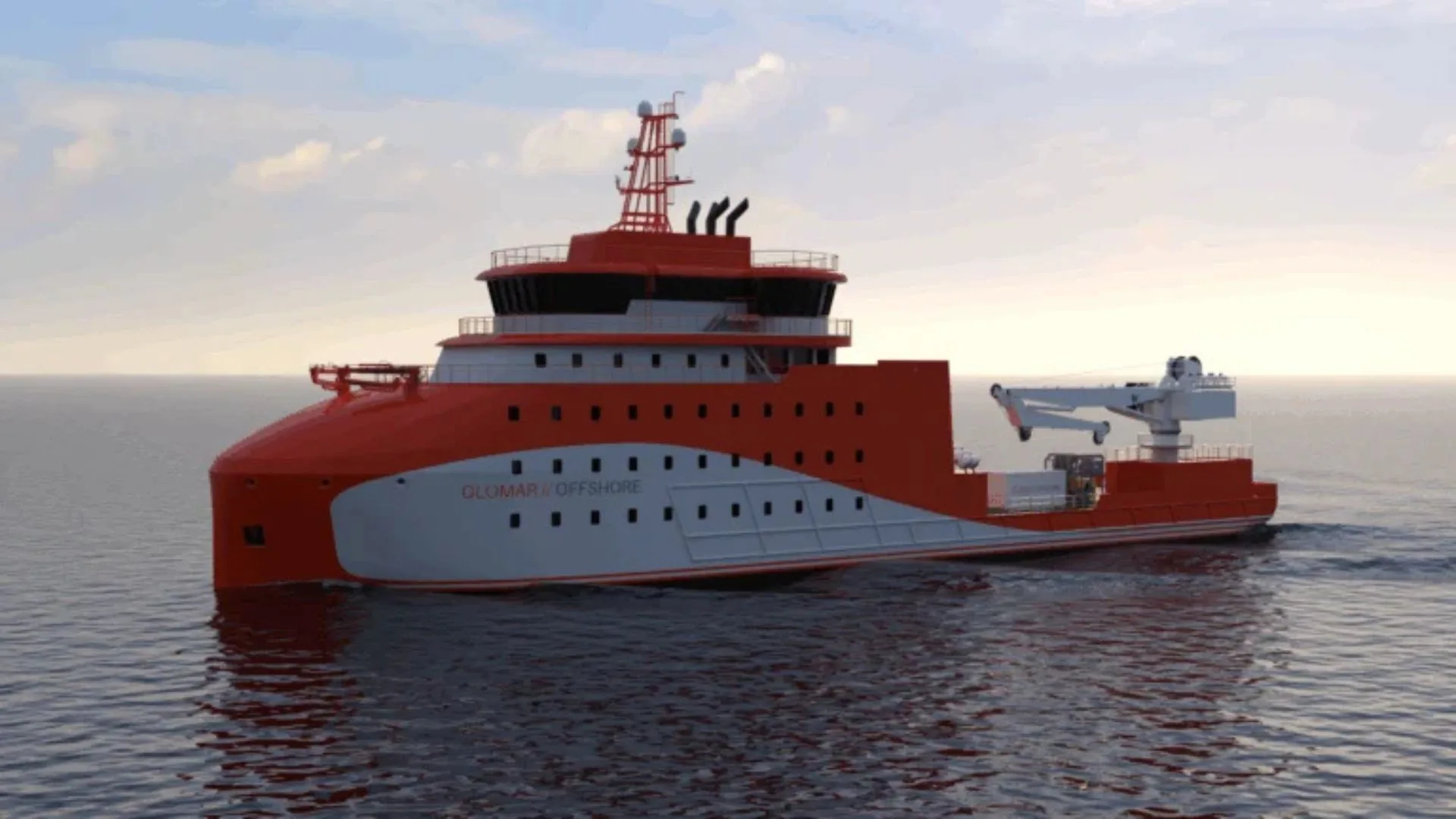
C-Job Naval Architects and Glomar Offshore unveiled the design for a new offshore support vessel (OSV) designed to handle different underwater operations from a single platform, the project’s versatility led its developers to compare it to a Swiss Army knife for offshore work.
The concept aims to reduce the need for multiple specialized vessels to complete an offshore campaign, to achieve this, the future OSV will be able to participate in underwater inspections, remotely operated vehicle (ROV) work, and trenching operations related to submarine cables.
An 80-meter OSV prepared for different operations
Specifically, the vessel will have 80 meters in length and it will be the first vessel of its kind built specifically for Glomar. Its configuration will allow the platform to be adapted to different offshore operations without depending on a single operational profile.
Its facilities will include a hangar for ROVs and a moon pool, an opening integrated into the hull that facilitates the deployment of equipment into the water. It will also incorporate a deck area dedicated to trenching equipment for underwater operations.
The design also includes accommodation for 60 people, a capacity that will allow both the crew and the technical staff required for the different campaigns to be embarked.
C-Job bets on methanol and batteries for propulsion
One of the central aspects of the new support vessel offshore its energy configuration will determine the OSV’s availability, dual-fuel engines capable of running on methanol and marine gas oil (MGO) along with integrated methanol tanks.
This configuration will be complemented by a hybrid system with batteries, the combination will allow the use of energy to be adapted to the operational needs of the vessel and is part of the approach adopted by C-Job and Glomar to prepare the vessel for future sustainability requirements.
This project reflects C-Job’s commitment to delivering innovative and future-proof ship designs.
Job Volwater
According to the executive, the joint work with Glomar made it possible to develop a flexible and high-performance vessel designed to meet current operational demands and future sustainability standards.
DP2 positioning and ability to operate in ice
Furthermore, the OSV will be equipped with a DP2 dynamic positioning system this technology allows the vessel to maintain a specific position using its own propulsion systems, a capability that is especially relevant during underwater interventions and ROV operations.
The design also takes into account Ice Class, expanding the range of conditions under which the vessel can operate.
This combination of systems reinforces the multipurpose nature of the project, subsea inspections, ROV operations, and cable-related work can all be carried out using the same platform configured for different equipment and missions.
Glomar is betting on a flexible offshore platform
For Glomar Offshore, the project aligns with its strategy of using solutions tailored to the needs of each operation. Melvin Weij, the company’s operations director, highlighted the flexibility and sustainable approach incorporated into the design.
At Glomar, tailor-made solutions are part of our DNA
Melvin Weij
With this configuration, the new offshore support vessel it is designed as a platform capable of concentrating functions that would normally require different specialized vessels. Its combination of subsea capability, ROV systems, trenching, DP2, methanol, and battery storage will be the basis of this operational versatility.
Source: Offshore Energy
Photo: C-Job/Glomar