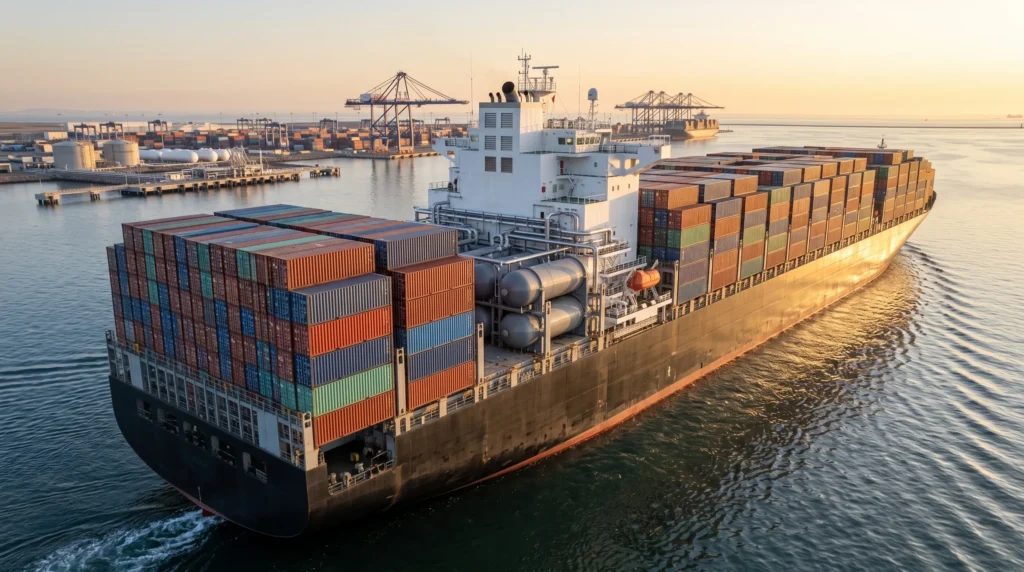
The LNG dual-fuel vessel represents a new advance for maritime transport by incorporating more efficient and lower-emission propulsion technologies. These vessels, capable of operating with both liquefied natural gas (LNG) and conventional fuels, reflect the transformation the shipping industry is undergoing in the face of decarbonization challenges and international environmental regulations. Their growing adoption strengthens the competitiveness of commercial fleets and consolidates LNG as one of the most important transition fuels for more sustainable maritime transport.
LNG Dual-Fuel Vessel Accelerates Maritime Transition
The maritime industry is undergoing a period of profound modernization driven by international emission reduction targets established by the International Maritime Organization (IMO). In this context, LNG dual-fuel vessels have become one of the most viable alternatives to reduce the carbon footprint without compromising operational efficiency.
Unlike conventional vessels, these ships can alternate between liquefied natural gas and traditional marine fuels, providing greater operational flexibility in terms of fuel availability and market conditions. In addition to significantly reducing sulfur oxide emissions (SOx), nitrogen oxides (NOx), and particulate matter, the use of LNG also contributes to decreasing carbon dioxide (CO₂) emissions compared to heavy fuels.
The New Generation of Container Ships Aims for Greater Efficiency
The development of new container ships equipped with dual propulsion systems responds to the growth of maritime trade and the need to operate more sustainable fleets. Leading shipyards and shipping companies continue to incorporate state-of-the-art engines, high-capacity cryogenic tanks, and intelligent energy management systems to optimize fuel consumption during operations.
These vessels also integrate digital technologies that allow for monitoring engine performance, analyzing energy consumption in real-time, and optimizing navigation routes through advanced fleet management platforms. The combination of digitalization and alternative fuels is redefining the operational efficiency of global maritime transport.
Bunkering Infrastructure Accelerates LNG Adoption
The growth of LNG dual-fuel vessels is also driving investments in port infrastructure. More and more terminals are incorporating specialized facilities for supplying liquefied natural gas through bunkering operations, expanding the availability of this fuel on the world’s main trade routes.
The expansion of this infrastructure strengthens the confidence of maritime operators to incorporate new dual-fuel vessels, while facilitating compliance with current and future environmental regulations. In parallel, the experience gained with LNG will serve as a basis for the future incorporation of lower-carbon intensity fuels, such as bio-LNG, e-methane, and eventually, hydrogen or ammonia.
Maritime Transport Moves Towards Gradual Decarbonization
The incorporation of LNG dual-fuel vessels demonstrates that the maritime sector’s energy transition does not depend on a single technology, but on a progressive strategy based on innovation, operational efficiency, and energy flexibility. While new propulsion alternatives continue to be developed, LNG maintains a relevant role as a transition fuel capable of reducing emissions and improving the environmental performance of commercial fleets.
The evolution of the shipping industry will be marked by the integration of cleaner fuels, digital optimization systems, and an increasingly prepared infrastructure to respond to the demands of sustainable maritime trade. In this scenario, dual-fuel vessels represent a significant step towards more efficient, competitive, and globally aligned maritime transport with decarbonization goals.
Source: Marine & Offshore