Table of Contents
- Advanced Corrosion-Resistant Coatings Enter AMPP’s Agenda
- Can Graphene Change Corrosion Protection?
- Hydrogen, CO₂, and Ammonia Raise Material Performance Requirements
- A Critical Gap Exists Between the Laboratory and an Industrial Asset
- The Agreement Could Bring Research, Industry, and Standards Closer Together
Advanced corrosion-resistant coatings are entering a new stage of industrial research through the alliance between the Association for Materials Protection and Performance (AMPP) and the Advanced Carbons Council (ACC). The two organizations have established a three-year collaboration agreement whose initial focus will be the use of advanced carbon materials in surface protection technologies.
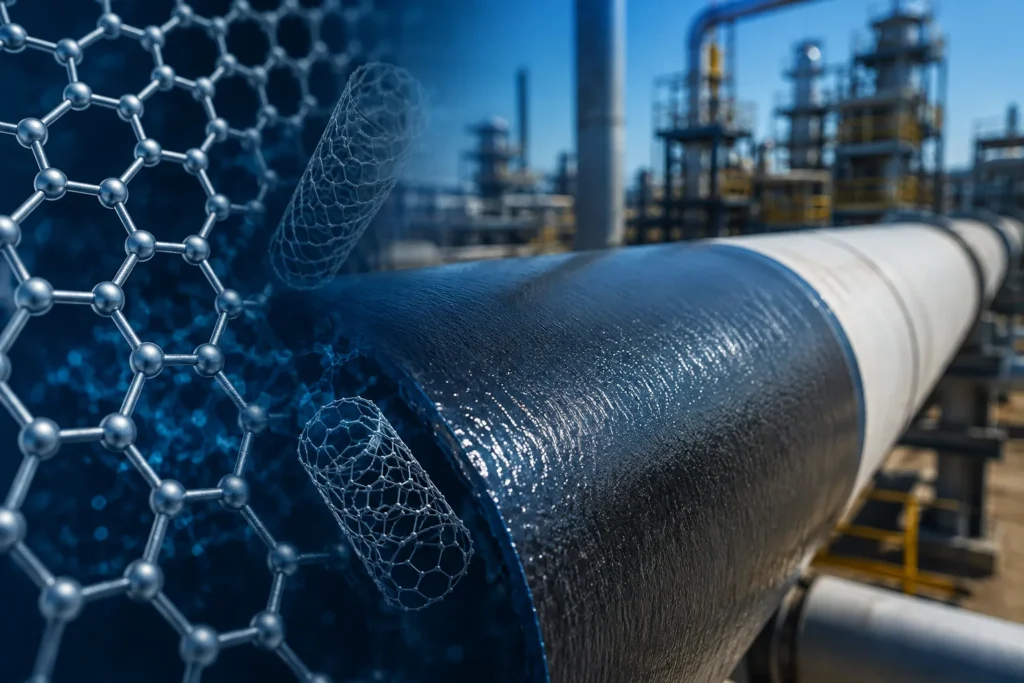
Initial interest centers on so-called carbon-enhanced coatings, formulations in which materials such as graphene, graphene derivatives, and carbon nanotubes (CNTs) can be incorporated as additives to explore new performance capabilities in protective coatings.
The initiative is particularly relevant at a time when new energy value chains associated with hydrogen, CO₂, and ammonia are introducing service conditions and compatibility challenges that require a reassessment of how materials and protection systems perform within industrial infrastructure.
However, the agreement does not mean that AMPP and ACC have developed a new anticorrosion coating, nor that a graphene-based solution is ready to replace conventional technologies. The objective is to bring advanced materials knowledge together with accumulated expertise in corrosion, coatings, and asset protection, creating a framework for research, education, and the potential evolution of technical criteria.
Advanced Corrosion-Resistant Coatings Enter AMPP’s Agenda
The Memorandum of Understanding between AMPP and ACC took effect on July 6, 2026, and will remain in force for three years. Its scope includes knowledge exchange, research, education, and cooperation on technical and standards-related activities concerning materials performance.
The first area of work will specifically focus on studying coatings enhanced with carbon materials.
The choice is significant. Coating-based protection systems are among the primary barriers used to isolate metallic surfaces from environments capable of promoting degradation mechanisms. Their performance, however, depends on multiple variables, including surface preparation, formulation, adhesion, permeability, thickness, application conditions, temperature, chemical exposure, and aging.
Introducing advanced materials into these formulations opens new possibilities, but it also creates the need to demonstrate how those properties are maintained once a coating leaves controlled laboratory conditions and enters actual service.
For this reason, the collaboration seeks to connect two technical communities that typically address different aspects of the problem: specialists in advanced carbon materials and professionals dedicated to corrosion, coatings, and asset protection.
Can Graphene Change Corrosion Protection?
Graphene has attracted interest across different engineering fields because of its physical and structural properties. In coating technologies, that interest also extends to graphene derivatives and carbon nanotubes, whose incorporation as additives can modify certain characteristics of a formulation.
However, there is a fundamental difference between the properties of a material and the performance of a complete coating system.
An industrial coating does not operate as an isolated ideal sample. It must properly adhere to the substrate, retain its properties through thermal and mechanical cycles, withstand the service environment, and maintain acceptable performance even as it ages and develops imperfections that may arise during application or operation.
Therefore, discussing advanced corrosion-resistant coatings based on carbon materials requires more than demonstrating promising properties of graphene or CNTs. It is necessary to determine how these materials interact with resins, pigments, substrates, and application processes, while also evaluating their performance over time.
This is precisely where collaboration between materials specialists and an organization focused on protection and performance can provide greater value: moving a promising technology from its fundamental properties toward criteria that make it possible to assess its industrial usefulness.
Hydrogen, CO₂, and Ammonia Raise Material Performance Requirements
The alliance also comes at a time of transformation in energy infrastructure. The growth of projects associated with hydrogen, CO₂ capture and transportation, and new ammonia value chains is expanding the range of conditions under which pipelines, vessels, storage facilities, and other assets must operate.
Each service presents different challenges, and it should not be assumed that a single degradation mechanism applies to all of them.
In hydrogen-related systems, for example, material compatibility can become particularly important under certain combinations of metallurgy, stress, pressure, temperature, and exposure. In facilities handling CO₂, the presence of water and other impurities can significantly alter corrosivity conditions. Ammonia, in turn, introduces specific considerations regarding material selection and operating conditions.
Therefore, the transition toward new energy molecules does not eliminate traditional integrity challenges. In certain cases, it introduces different combinations of material, environment, and loading conditions that must be understood before selecting a protection strategy.
Coatings enhanced with advanced carbon materials could become one of the technologies investigated for certain services, but their suitability will need to be established through technical evaluation and performance evidence, rather than solely on the basis of the individual properties of their components.
A Critical Gap Exists Between the Laboratory and an Industrial Asset
This transition will likely be one of the main challenges for any new generation of coatings.
A material may deliver favorable results under controlled testing conditions yet behave differently when exposed for years to moisture, temperature changes, mechanical stresses, radiation, chemicals, or localized damage.
In addition, real-world infrastructure contains welds, complex geometries, interfaces, difficult-to-access areas, and variations in surface preparation. The application process itself also introduces variables that can directly influence final performance.
Consequently, the industrial value of graphene, its derivatives, or carbon nanotubes will not depend exclusively on their intrinsic properties. It will depend on the ability to integrate them into protection systems that can be consistently manufactured, applied, inspected, and maintained.
Long-term reliability will be particularly important for owners and operators of critical assets. Incorporating a new technology requires understanding not only its initial performance, but also its degradation mechanisms, application limits, and the criteria needed to determine when a protective barrier remains effective.
The Agreement Could Bring Research, Industry, and Standards Closer Together
AMPP and ACC plan to develop joint activities that may include webinars, technical meetings, workshops, publications, and research initiatives. They may also explore cooperation between technical committees and standards-related activities, connecting specialists from industry and academia.
Research could include industry surveys, university studies, consortium-based projects, and the dissemination of findings.
The first public step already has a date. On September 10, 2026, the AMPP Forefront Series will address “Advanced Carbon Materials in Coatings Applications,” focusing on graphene, graphene derivatives, and carbon nanotubes as additives for protective coating technologies.
The event will provide an opportunity to begin moving the institutional agreement toward a more concrete technical discussion.
The true impact of the alliance, however, will require more time to assess. An MoU does not automatically transform an emerging technology into an established industrial practice, nor does it create new standards on its own.
Its importance lies in creating a framework in which materials developers, researchers, engineers, and asset owners can jointly examine where these technologies can provide value and what evidence will be required for their reliable use.
For advanced corrosion-resistant coatings, that process may be just as important as the material itself. Graphene and carbon nanotubes offer a new field of research, but their behavior within complete systems and under real industrial conditions will ultimately determine the extent to which they can transform the protection of energy infrastructure.
Source: Pipeline & Gas Journal