Table of Contents
- ADNOC Gas to Add a New Processing Train in Habshan
- What Happens Inside the New Processing Train?
- NGL Recovery Increases the Value of the Gas Stream
- Why Does ADNOC Need to Expand Its Capacity in Habshan?
- Wison Secures the Largest EPC Contract in Its History
- $4.04 Billion Is Part of a Much Larger Expansion
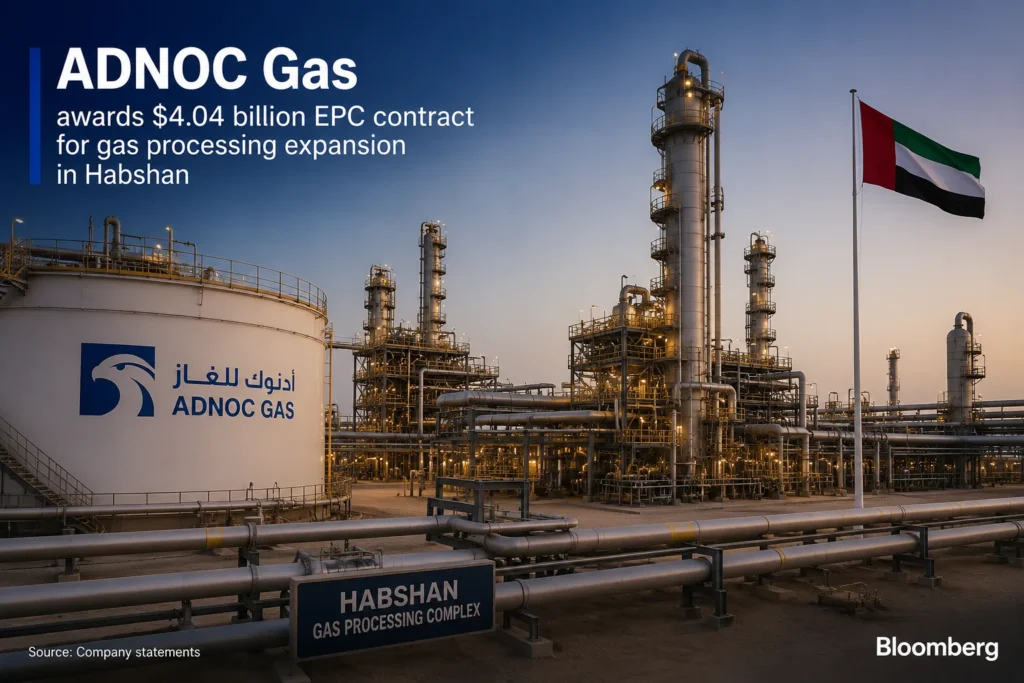
ADNOC Gas is moving forward with a new expansion of its processing infrastructure in Abu Dhabi after awarding Wison Engineering an Engineering, Procurement and Construction (EPC) contract valued at approximately $4.04 billion. The scope corresponds to Phase 2 of the Rich Gas Development (RGD) project and includes, as its main component, the construction of a new natural gas processing train in Habshan.
The new infrastructure will incorporate gas pipelines, separation and condensate stabilization units, acid gas removal systems, deep natural gas liquids (NGL) recovery, and a 220 kV switch station. Together, these facilities will expand processing capacity and increase the operational flexibility of one of the United Arab Emirates’ main gas processing hubs.
For Wison Engineering, the award represents the largest EPC contract in its history. For ADNOC Gas, the project represents another component of a broader expansion aimed at transforming larger volumes of rich gas into marketable products and supporting the growth of the country’s downstream and petrochemical value chains.
ADNOC Gas to Add a New Processing Train in Habshan
Habshan occupies a strategic position within the United Arab Emirates’ gas infrastructure. The new project will expand the complex through the construction of a large-scale processing train designed to handle the different stages required before conditioned streams and recoverable products can be obtained.
The contract will be executed under an Engineering, Procurement and Construction (EPC) model. This places engineering, equipment and materials procurement, construction, and integration of the planned facilities under a single scope.
One of the most significant aspects is precisely the diversity of systems included. The separation units will manage the different phases present in the incoming streams, while condensate stabilization will be used to condition the recovered liquid hydrocarbons. These facilities will be complemented by acid gas removal units and a deep NGL recovery system.
The scope also includes gas pipelines and a 220 kV switch station, demonstrating that the expansion requires process, transportation, and power supply infrastructure capable of operating as an integrated system.
What Happens Inside the New Processing Train?
Extracting gas from a reservoir does not mean that the gas can be sent directly to all its commercial destinations. Depending on the composition of the produced stream, liquids may need to be separated, certain components removed, and heavier hydrocarbons recovered before the different usable streams can be obtained.
The Habshan project addresses several of these functions. Separation is an essential stage for managing the phases present in the inlet stream. The recovered condensate must subsequently be stabilized to achieve the conditions required for its handling and further use.
The acid gas removal units, meanwhile, will be responsible for treating acidic components present in the processed streams. The information published about the contract does not provide design parameters or specify concentrations, licensed technologies, or the individual capacities of these units. Therefore, it would not be technically accurate to attribute any particular configurations to them.
The other fundamental component will be the deep recovery of natural gas liquids (NGL). This is precisely where the new train gains importance beyond simply increasing the volume of gas processed.
NGL Recovery Increases the Value of the Gas Stream
A rich gas stream can contain hydrocarbons that have value as products or feedstocks once they are separated and conditioned.
NGL recovery makes it possible to utilize some of these components rather than keeping them within the gas stream. Depending on the composition and the subsequent fractionation scheme, natural gas liquids can supply different industrial and petrochemical value chains.
This helps explain why ADNOC Gas links the project to the growth of the United Arab Emirates’ downstream and petrochemical sectors.
The economic importance of a processing complex, therefore, does not depend exclusively on how many cubic feet of gas it can handle. The composition of the incoming gas, the products that can be recovered, and the potential integration of those streams with other facilities also play a role.
At this point, it is important to maintain a technical distinction: the available information confirms that the project will incorporate deep NGL recovery, but it does not provide recovery yields, product composition, or individual volumes. Any additional estimate would require engineering information that is not yet part of the public announcement.
Why Does ADNOC Need to Expand Its Capacity in Habshan?
The answer is related to the growth strategy of the gas business and the need to have sufficient infrastructure to transform larger production streams into marketable products.
Increasing upstream production without simultaneously developing treatment capacity can create a downstream bottleneck. The gas produced requires facilities capable of receiving it, conditioning it, separating its components, and subsequently connecting it to transportation and consumption chains.
The new Habshan train expands precisely this intermediate capacity. ADNOC Gas states that the infrastructure will increase its processing capacity and improve operational flexibility, while also supporting the expansion of the country’s downstream and petrochemical activities.
The inclusion of a 220 kV switch station also highlights another element of these megaprojects that is often less visible: processing gas on a large scale requires considerable auxiliary energy infrastructure. Compression, pumping, treatment, refrigeration, separation, and auxiliary systems require a reliable electricity supply to maintain continuous operations.
For this reason, the EPC scope should be understood as an integrated facility rather than as the isolated addition of a single piece of process equipment.
Wison Secures the Largest EPC Contract in Its History
For Wison Engineering, the scale of the project marks a significant step up. The contract corresponding to RGD Phase 2 is valued at approximately $3.9 billion, to which the scope related to the 220 kV switch station is added, bringing the total reported value to around $4.04 billion.
According to the information disclosed, this is the largest EPC contract secured by the company to date. Execution will require the integration of engineering for large-scale processing facilities, international procurement, onshore construction, and the management of multiple systems within a single program. Wison plans to combine its local operations in Abu Dhabi with its global supply chain to execute the scope.
The economic scale also illustrates how the expansion of the Middle East’s gas industry is generating projects that require increasingly substantial EPC capabilities and supply chains capable of coordinating equipment, materials, and large-scale construction.
$4.04 Billion Is Part of a Much Larger Expansion
The contract value must be understood within its proper context. The approximately $4.04 billion does not represent the full cost of ADNOC Gas’ Rich Gas Development. It corresponds to the scope awarded to Wison Engineering for Phase 2 and the associated electrical infrastructure described in the announcement.
The RGD program includes additional investments and contracts intended to expand ADNOC Gas’ rich gas processing capacity. Therefore, presenting the $4.04 billion as the total investment in the entire project would lead to an inaccurate interpretation of its scale.
What is significant about this award is the type of infrastructure that will begin to take shape in Habshan. Gas pipelines, separation, condensate stabilization, acid gas removal, deep NGL recovery, and power supply will form a new processing chain within one of the United Arab Emirates’ main gas hubs.
When the new train enters operation, its importance will not lie solely in adding nominal capacity. Its real value will be in enabling larger rich gas streams to be processed, conditioned, and transformed into useful products for the subsequent stages of the energy value chain.
That is the strategic component behind the contract: expanding the gas business requires more than producing additional molecules from reservoirs. It also requires building the infrastructure capable of converting them into streams that can effectively reach the market.
Source: Pipeline & Gas Journal