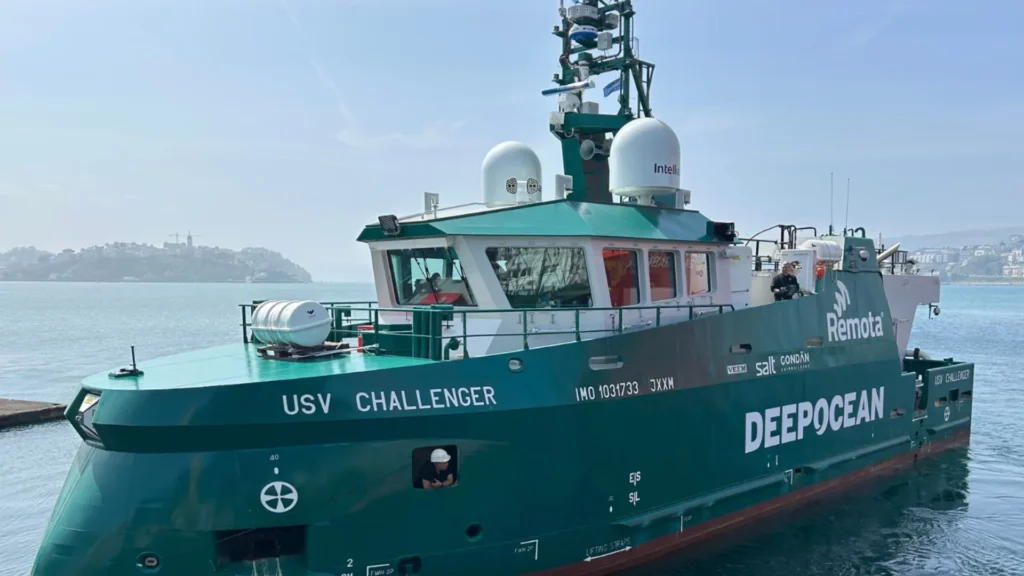
The 24-metre-long unmanned surface vessel (USV) Challenger completed its first fully remote project with vessel and remotely operated vehicle (ROV) operations managed entirely from land.
As reported by DeepOcean on September 4, the control was carried out from its Remote Operations Center (ROC) located in Haugesund. The operation is the first application of the Challenger in a project where both the USV and the associated ROV were managed remotely.
The Challenger belongs to USV A/S, a joint venture formed by DeepOcean, Solstad Offshore and Østensjø Rederi. The vessel project was conceived to develop a new mode of execution of submarine services with less dependence on conventional vessels.
The ROV intervened on an underwater collector
During the project, Challenger worked through simultaneous operations (SIMOPS) on board the vessel BB Ocean. The scope included work carried out by ROV on the roof protection structure of an underwater collector.
Specifically, the underwater vehicle carried out adjustment and disconnection tasks of this structure to support the installation activities carried out at Equinor’s Underwater Test Centre in Kårstø.
In this way, the operation made it possible to execute from land functions that traditionally require personnel and support teams directly involved in offshore operations.
Johnny-Andrè Spangberg, Group Business Development Director and Head of USV at DeepOcean, highlighted the completion of the submarine project for Equinor and the possibilities offered by these next-generation submarine services.
USV operations controlled from Haugesund
One of the central technical aspects of the project was the joint management of the vessel and the ROV from the DeepOcean ROC in Haugesund.
This model allows specialists to supervise and execute operations from ground facilities while the USV remains deployed in the work area.
Likewise, the concept is aligned with DeepOcean’s strategy of applying technological solutions to inspection, engineering, installation and maintenance services in ocean operations.
USV Challenger reaches up to 30 days of autonomy
The USV Challenger was designed by Salt Ship Design and built by GONDAN Shipbuilders. Its construction began in March 2024 after the order placed by USV A/S.
The vessel was subsequently launched at Astilleros Gondán on February 26, 2025. The christening ceremony was held in March and its delivery was completed in May of the same year.
On a technical level, the Challenger incorporates a diesel-electric hybrid propulsion system and is prepared to remain at sea for up to 30 days. The project was developed with the aim of reducing CO2 emissions by more than 90% compared to conventional methods.
The combination of maritime autonomy, shore control and remote ROV operation poses an alternative for certain underwater work that currently depends on larger manned vessels.
Source: Offshore Energy
Photo: DeepOcean