Table of Contents
- Degradation control in asset integrity
- What is RBI?
- RBI as a tool for managing damage mechanisms
- What are Integrity Operating Windows (IOW)?
- Who defines IOWs?
- Difference between an operating limit and an IOW
- Relationship between IOWs and damage mechanisms
- What are CMLs and TMLs?
- How are CML/TML locations selected?
- How RBI, IOW, and CML/TML are related
- Integration with Asset Integrity Management
- Operational benefits of integration
- Conclusion
- References
Degradation Control enables the management of damage mechanisms that affect the condition of industrial assets throughout their service life. Corrosion, erosion, cracking, and other deterioration processes can compromise mechanical integrity, safety, and operational availability when they are not properly identified and monitored. The integration of Risk-Based Inspection (RBI), Integrity Operating Windows (IOW), and CML/TML management provides a structured methodology to assess risks, control process variables, and verify the actual progression of damage in industrial equipment and systems.
Degradation control in asset integrity
Industrial facilities operate under conditions that promote various damage mechanisms. Elevated temperatures, contaminants, pressure fluctuations, corrosive fluids, and metallurgical phenomena can accelerate material degradation.
In this context, Control is part of the Asset Integrity and Asset Integrity Management programs. Its purpose is to identify potential damage mechanisms, monitor their evolution, and implement measures to maintain risk within acceptable levels.
An effective program should answer questions such as:
- What damage mechanisms can affect the asset?
- Where are they most likely to occur?
- Which operational variables influence their development?
- How can the rate of deterioration be verified?
- What level of risk does each mechanism represent?
The answers to these questions are obtained through the integration of methodologies such as RBI, IOW, and CML/TML management.
What is RBI?
Risk-Based Inspection (RBI) is a methodology used to plan inspections based on the risk associated with each asset or process circuit.
Its application is widely developed in API RP 580 and API RP 581, which establish criteria for evaluating the probability and consequence of failure.
The objective of Risk-Based Inspection is to allocate inspection resources proportionally to the existing risk, avoiding approaches based solely on fixed inspection frequencies.
Components of RBI analysis
The assessment considers two main elements:
1. Probability of Failure: Refers to the likelihood that a loss of containment will occur due to specific damage mechanisms, such as:
- Internal corrosion
- External corrosion
- Corrosion under insulation
- Erosion-corrosion
- Mechanical fatigue
- Hydrogen-induced cracking
- Sulfidation
- High-temperature damage
2. Consequence of Failure: Evaluates the potential effects on:
- Personnel safety
- Environment
- Operational continuity
- Production
- Repair costs
- Corporate reputation
The results make it possible to identify critical equipment, prioritize inspections, and define strategies.
RBI as a tool for managing damage mechanisms
Risk-Based Inspection (RBI) allows organizations to identify the damage mechanisms that may affect asset integrity and evaluate the risk associated with each of them. To accomplish this, it considers factors such as construction materials, operating conditions, inspection history, and expected degradation processes.
Although RBI does not directly control degradation, it provides information about which damage mechanisms may occur, where they are most likely to develop, and what their consequences could be.
For example, an RBI analysis may identify the risk of internal corrosion in a carbon steel line transporting fluids containing CO₂ and free water. Based on this information, Integrity Operating Windows (IOW) can be established to control critical process variables, and CML/TML locations can be defined in areas with the highest probability of deterioration.
In practical terms:
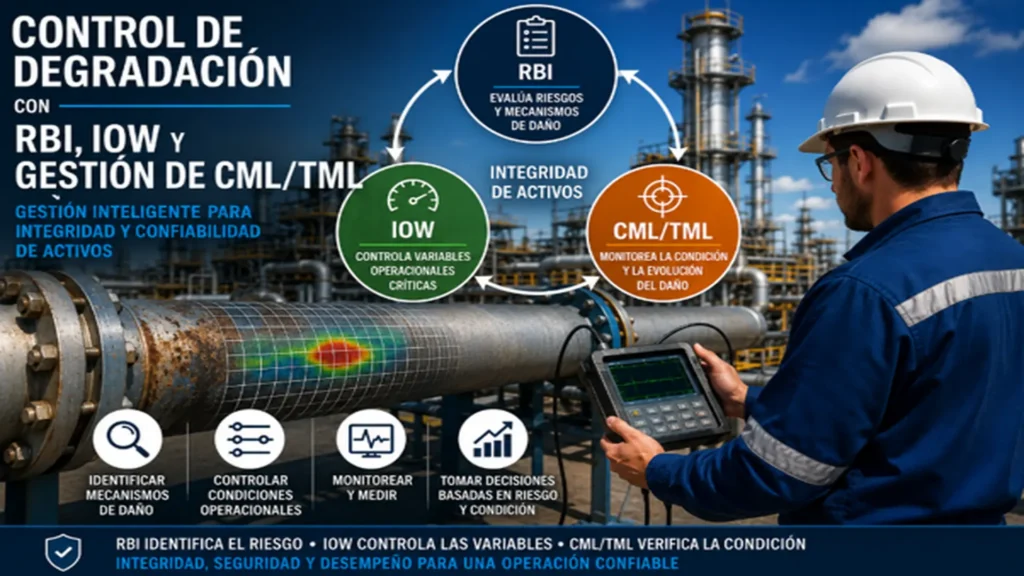
- RBI identifies the risk and damage mechanisms.
- IOWs control the operational variables that influence their development.
- CML/TMLs verify the actual progression of damage through inspection and monitoring.
In this way, Risk-Based Inspection provides the technical information used to guide inspection, corrosion monitoring, and control strategies within Asset Integrity and Asset Integrity Management programs.
What are Integrity Operating Windows (IOW)?
They are established limits for process variables whose deviation may promote the initiation or acceleration of damage mechanisms. Their purpose is to maintain operating conditions within ranges compatible with the mechanical integrity of equipment. IOWs translate the results of RBI studies and corrosion analyses into operational parameters that can be easily managed by operations and process teams.
Variables commonly controlled through IOWs include:
- Temperature
- Pressure
- Flow velocity
- pH
- Chloride concentration
- Water content
- Sulfur concentration
- Oxygen concentration
- Fluid chemical composition
When a variable exceeds an IOW, the probability increases that a previously identified damage mechanism will be initiated or accelerated.
Who defines IOWs?
Defining IOWs requires coordinated participation from several technical disciplines.
Typically involved are:
- Process engineering: Analyzes operational variables that may affect equipment integrity.
- Corrosion specialists: Evaluate damage mechanisms associated with process conditions.
- Materials engineering: Determines metallurgical limitations of construction materials.
- Mechanical Integrity Personnel: Validate the potential impact on asset condition.
- Operations: Provide information related to actual process unit performance.
The information used to establish IOWs typically comes from: RBI studies, damage mechanism assessments, failure history, operational data, Corrosion management programs, API RP 584 recommendations
Difference between an operating limit and an IOW
Although both concepts use limit values, their objectives are different.
Operating limit: Associated with process performance and production requirements.
Examples:
- Operating design pressure
- Reaction temperature
- Production flow rate
IOW: Specifically associated with protecting mechanical integrity
Examples:
- Maximum temperature to prevent accelerated sulfidation
- Chloride concentration limit to prevent SCC
- Minimum flow velocity to prevent solids deposition
A process may remain within its operating limits while simultaneously operating outside an IOW. For this reason, IOWs constitute an independent tool focused on asset integrity.
Relationship between IOWs and damage mechanisms
The relationship between IOWs and damage mechanisms arises directly from analyses conducted during RBI and corrosion evaluations.
Each IOW is established to control a variable capable of influencing a specific mechanism.
| Damage Mechanism | Controlled Variable |
|---|---|
| CO₂ corrosion | Temperature and water content |
| H₂S corrosion | H₂S concentration |
| Chloride SCC | Chloride concentration |
| Sulfidation | Temperature |
| Under-deposit corrosion | Flow velocity |
| Naphthenic corrosion | Operating temperature |
Repeated deviation from an IOW can increase corrosion rates and alter the risk levels originally established through Risk-Based Inspection.
What are CMLs and TMLs?
Condition Monitoring Locations (CMLs) and Thickness Monitoring Locations (TMLs) are selected locations used to monitor asset condition and evaluate the progression of damage mechanisms.
These points constitute the primary source of information for verifying whether the degradation rates estimated during RBI analyses match the actual behavior of the equipment.
1. CML: A CML is any location used to monitor a condition related to integrity
It may include:
- Thickness measurements
- Temperatures
- Vibrations
- Cracking
- Corrosion parameters
2. TML: Is a specific type of CML used for periodic corrosion thickness monitoring
The measurements obtained make it possible to calculate:
- Thickness loss
- Corrosion rate
- Remaining life
- Next inspection date
How are CML/TML locations selected?
CML/TML selection should be performed considering the damage mechanisms identified during the RBI analysis. The location of these points should not be based solely on accessibility criteria.
Identification of damage mechanisms
Each damage mechanism generates specific deterioration patterns.
- Erosion-corrosion tends to concentrate at elbows and flow-direction changes, flow-accelerated corrosion affects areas of high turbulence, and corrosion under insulation develops in areas susceptible to moisture ingress.
- Equipment geometry: Elbows, tees, nozzles, reducers, injection connections, welds, and low points in piping
- Operating history: Areas where thickness loss has previously been detected represent priority candidates.
- RBI results: Circuits with higher probabilities of failure require more robust monitoring coverage.
- Accessibility and repeatability: Measurements must be repeatable at the same location to ensure reliable trending.
How RBI, IOW, and CML/TML are related
The relationship between RBI, IOW, and CML/TML establishes an integrated system for managing degradation in industrial assets.
Each tool fulfills a specific function within the management process.
- RBI identifies and defines risk: damage mechanisms, probability of failure, consequence of failure, and critical equipment.
- IOWs control process variables: reducing the likelihood that damage mechanisms will initiate or accelerate.
- CML/TMLs verify actual behavior: providing field information to validate corrosion rates, thickness loss, and damage progression.
When these three tools operate in a coordinated manner, the organization has sufficient information to make condition- and risk-based decisions.
Integration with Asset Integrity Management
Modern Asset Integrity Management programs integrate information from operations, inspection, corrosion, and risk management.
Within this approach, RBI, IOW, and CML/TML function as complementary elements that allow organizations to:
- Identify integrity threats
- Control variables influencing damage
- Verify actual asset condition
- Update risk models
- Optimize inspection frequencies
- Prioritize maintenance investments
The integration of these tools improves the quality of information used for decision-making related to Asset Integrity Management and Corrosion Management.
Operational benefits of integration
Organizations that integrate RBI, IOW, and CML/TML management typically achieve improvements in several performance indicators.
The most relevant benefits include:
- Reduced degradation-related failures
- Better control of corrosion rates
- Increased operational availability
- Optimization of inspection resources
- Extended asset service life
- Reduced safety risks
- Improved reliability of Asset Integrity programs
- Strengthened Industrial Corrosion Monitoring strategies
Conclusion
Degradation Control requires tools that enable organizations to identify damage mechanisms, control the conditions that promote their development, and verify their progression through inspection data. Risk-Based Inspection (RBI), Integrity Operating Windows (IOW), and CML/TML management perform complementary functions within Asset Integrity programs. Their integration facilitates risk- and condition-based decision-making, optimizes Asset Integrity Management, and provides reliable information to preserve the safety, availability, and service life of industrial assets.
References
- American Petroleum Institute. (2024). API Recommended Practice 580: Risk-Based Inspection (4th ed.). API Publishing Services.
- American Petroleum Institute. (2016). API Recommended Practice 581: Risk-Based Inspection Technology (3rd ed.). API Publishing Services.
- American Petroleum Institute. (2022). API Recommended Practice 584: Integrity Operating Windows (3rd ed.). API Publishing Services.
- American Petroleum Institute. (2020). API Recommended Practice 571: Damage Mechanisms Affecting Fixed Equipment in the Refining Industry (3rd ed.). API Publishing Services.
- American Petroleum Institute. (2021). API Recommended Practice 970: Corrosion Control Documents (1st ed.). API Publishing Services.