Table of Contents
- What is Dinnteco Technology?
- The global problem of atmospheric discharges
- Protection area
- Physical principles applied in Dinnteco Technology
- Dinnteco Technology vs. traditional lightning rods
- Proven benefits of Dinnteco Technology
- International success stories
- Innovation in electrical safety
- Dinnteco Technology: conclusions and perspectives
Dinnteco Technology addresses a problem that is no longer optional. In a world where critical infrastructure, industrial assets, and human life increasingly depend on highly sensitive electrical and electronic systems, protection against atmospheric discharges has become a strategic imperative. Electrical storms do not discriminate between continents, climates, or economic sectors: they affect airports, petrochemical plants, wind farms, data centers, sports stadiums, and rural communities with equal devastation. In this scenario, the Dinnteco Group emerges as a cutting-edge technological response, redefining global standards for atmospheric protection through its revolutionary DDCE system (Dinnteco Electrostatic Charge Desionizer). This article presents a comprehensive view of Dinnteco Technology: its scientific foundation, its field application, and its differential value compared to traditional solutions.
What is Dinnteco Technology?
Dinnteco Internacional S.L. is a Spanish technology company specializing in the development, manufacturing, and commercialization of advanced lightning prevention systems. Founded with an innovative vocation in the field of safety against atmospheric electrical discharges, Dinnteco has consolidated its presence in more than 50 countries, becoming a global reference for industries operating in high-risk electrical discharge environments.
The value proposition is based on years of applied research, international certifications, and a philosophy that prioritizes prevention over attraction or simple reaction to the lightning phenomenon.
The foundation of its technology portfolio is the DDCE, the core of Dinnteco Technology and an advanced passive protection device that acts on the atmospheric electric field around the protected structure before the discharge occurs. Unlike conventional lightning rods, whose design dates back to Benjamin Franklin’s experiments in the 18th century, the DDCE system represents a technological leap in atmospheric discharge protection engineering: it does not seek to attract or conduct lightning, but to prevent its impact on the protected structure. This distinction is not semantic; it is the foundation of a technology that has demonstrated measurable results in installations worldwide and is supported by laboratory tests to fully comply with international standards against atmospheric discharges.

Dinnteco’s proposal is structured around three fundamental pillars: safety of people and infrastructure, operational continuity, and optimization of return on investment. For sectors such as energy, telecommunications, aviation, heavy industry, industrial and pleasure vessels, and technified agriculture, where a single discharge can translate into millions of dollars in losses, critical equipment failures, and unplanned downtime, the value of effective and preventive protection is unquestionable. Dinnteco America, a subsidiary of Dinnteco Internacional in the Americas, brings this solution to the markets of North, Central, and South America, adapting all technical proposals to local regulations and climatological conditions.
The global problem of atmospheric discharges
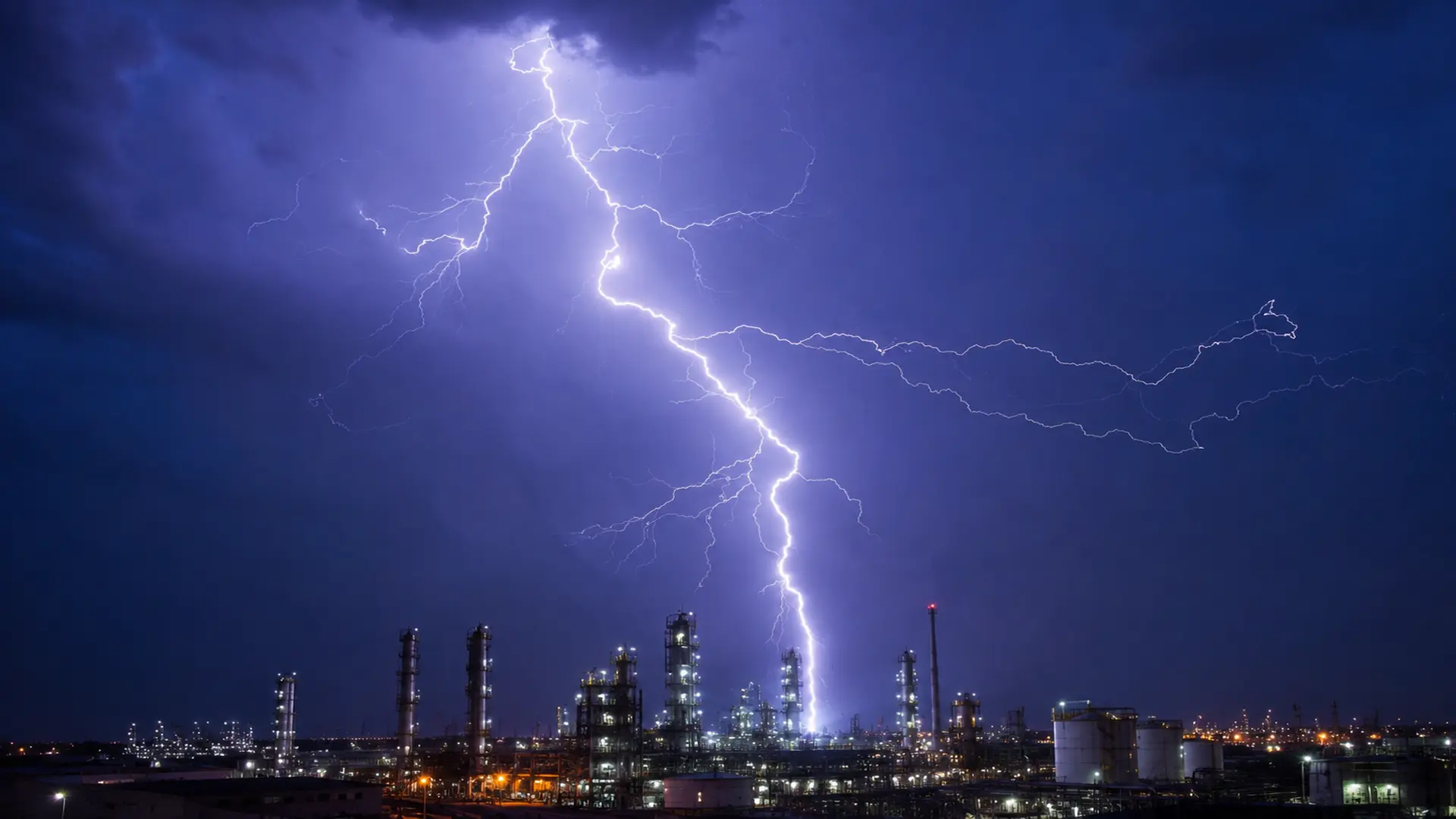
Atmospheric electrical discharges constitute one of the natural phenomena with the greatest combined impact on human life, infrastructure, and the global economy. It is estimated that Earth receives around 1.4 billion lightning strikes per year, equivalent to approximately 44 discharges per second across the planet. This massive electrical activity causes thousands of direct and indirect deaths annually, with figures that in high-incident regions such as sub-Saharan Africa, Southeast Asia, and South America far exceed the statistics of developed regions with better warning and protection systems. In the United States alone, the National Weather Service records dozens of annual deaths from direct lightning strikes, in addition to hundreds of seriously injured with permanent sequelae.
Beyond the human impact, the economic impact of lightning is colossal. Direct damage to infrastructure, power grid outages, destruction of electronic equipment, fires in industrial and forest facilities, are added to the indirect costs of operational interruption, data loss, insurance, and asset replacement. In sectors such as telecommunications, where an affected tower can leave thousands of users without service, or in the oil industry, where a damaged installation can generate explosions with catastrophic consequences, exposure to the risk of atmospheric discharges is a critical management factor. Globally, damages related to extreme weather phenomena, among which electrical storms occupy a prominent place, have reached accumulated losses of trillions of dollars in the last three decades.
| Lightning strikes per year | Global frequency | Most vulnerable sectors | Cumulative impact |
|---|---|---|---|
| ~1.4B | 44/sec | Energy, Telecom, Aviation, Mining, Agriculture | Trillions USD |
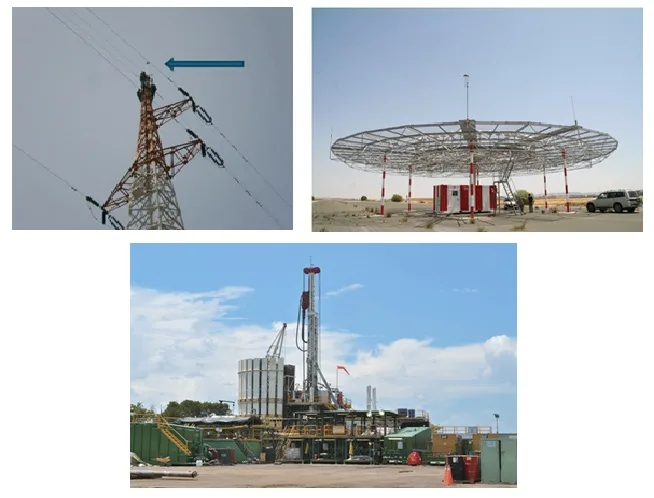
The industries most vulnerable to atmospheric discharges include: the energy sector (generating plants, substations, transmission lines, and wind farms), telecommunications (cell towers, data centers, and antennas), aviation (airports, navigation equipment, and visual aids), the chemical and petrochemical industry (refineries, processing plants, and storage of flammable materials), technified agriculture (silos, greenhouses, and automated irrigation systems), and public buildings with high occupancy (stadiums, hospitals, and convention centers). For all these sectors, the adoption of effective protection technologies not only reduces risk, but represents a growing requirement from regulators, insurers, and international safety standards.
How the Dinnteco DDCE system works
Advanced passive operation principle
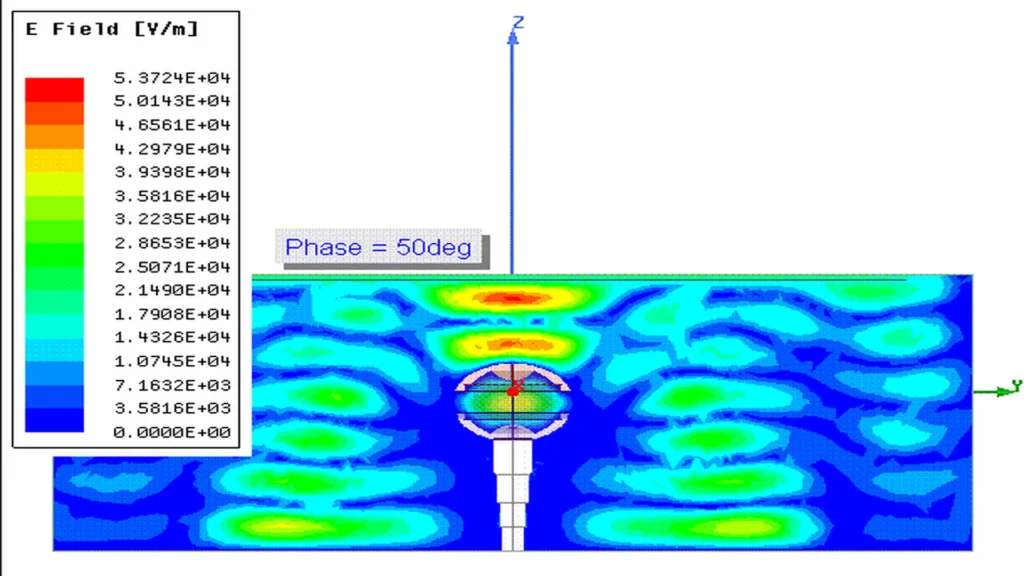
The Dinnteco Electrostatic Charge Desionizer (DDCE) operates under a principle similar to traditional protection systems: electric field compensation, although with a fundamental difference: the compensation time, which in the case of the traditional system is instantaneous and in the case of the DDCE is continuous and unlimited, which generates a radically opposite final effect: instead of waiting for the discharge to conduct it in a “controlled” manner to ground, the DDCE device acts in advance on the local atmospheric electric field, preventing the impact of lightning on the protected structure. The central mechanism is the continuous and controlled compensation of ions with opposite charge to that accumulated at the base of the storm cloud, which generates a progressive neutralization of the electrical gradient in the coverage area. By preventing charge buildup on the surface or protected structure, the DDCE substantially reduces the likelihood of an upward leader developing prior to a lightning strike.
This 24/7 process of continuous electric field compensation makes the DDCE act as a continuous electrostatic charge sink (similar to a continuous passive deionization process). It does not require an external power source, since the device takes advantage of the atmospheric electric field generated by the storm itself to activate its compensation mechanism when a potential difference is generated in the device.
The greater the intensity of the electric field—that is, the more intense the storm activity—the greater the “deionizing” response of the DDCE, which guarantees proportional and self-adaptive protection to the actual conditions of each meteorological event. This autonomous operation characteristic is one of the main technological differentiators of the system, thus eliminating dependence on electrical power, batteries, or active monitoring systems for its basic operation.
The fundamental conceptual difference from a conventional lightning arrester lies in the intervention paradigm: while the Franklin lightning arrester is a reactive system that generates an upward leader and attracts the downward leader in an attempt to conduct the discharge, the DDCE is a preventive system designed to prevent a strike on the protected structure by inhibiting the generation of the upward leader in the DDCE and in the structure connected to it for the purpose of protection. This distinction has highly significant practical implications, since the conduction of a discharge—even when directed to ground in a controlled manner—generates transient overvoltages, high-energy electromagnetic fields, very significant Joule heating, and interference, among other things, which can damage sensitive electronic equipment within a considerable radius around the point of impact. By preventing the strike, the DDCE also eliminates these side effects with a high degree of probability.
Protection area
The calculation of the coverage radius in plan view of DDCE equipment is performed by applying the Rolling Sphere method described in standard UNE EN IEC 62305 or similar national or international standards where the product is installed (for example, NFPA 780 standard) and, depending on the required protection level (Level I, II, III, or IV), the following rolling sphere radii will be applied: Level I (R = 20 m), Level II (R = 30 m), Level III (R = 45 m), and Level IV (R = 60 m). This will result in a coverage radius in plan view (r) and a resulting protection area based on this radius r.
Structures that are entirely within the protection area defined by (r) and that are at the same electrical potential as the lower hemisphere of the equipment will be considered protected by the DDCE.
Natural structures (trees, terrain, bodies of water, or others) will not be considered protected, nor those that, even being within the protection area, have their own ionizing protection systems (passive or active lightning rods of any type).
Note: the coverage distance in plan view (d) of the DDCE can be extended up to 30/60/120 m (depending on model) in some types of structures, provided that certain requirements are met (consult the manufacturer).
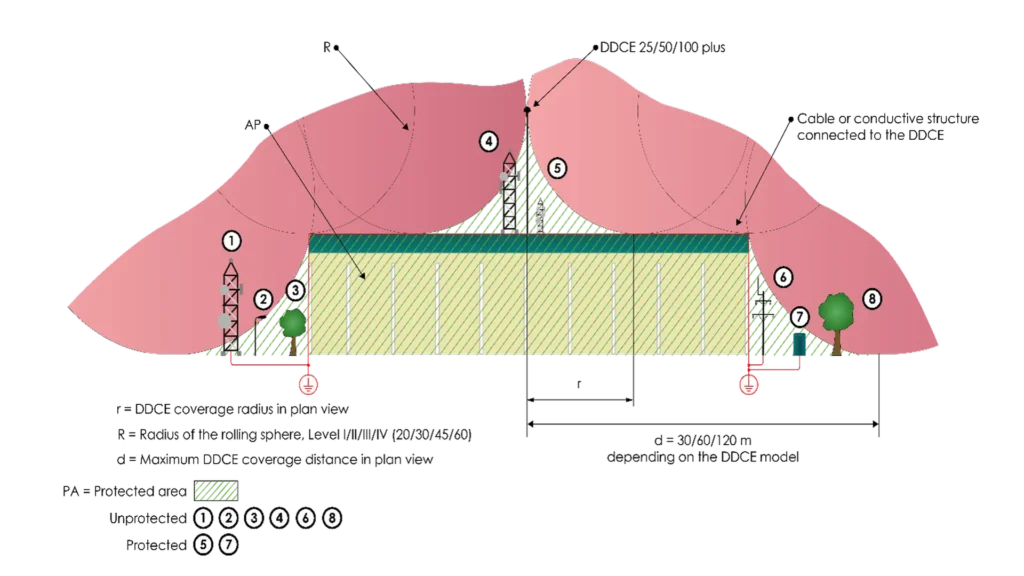
- Telecommunications tower with part of its structure outside the PA and connected to the DDCE ground terminal (not protected).
- Metal lamppost located within the PA and not connected to the DDCE ground terminal (not protected).
- Natural structure (tree) located within the PA (not protected).
- Telecommunications tower with part of its structure outside the PA and not connected to the DDCE ground connection (not protected).
- Telecommunications tower with its structure within the PA and connected to the DDCE ground connection (protected).
- Power tower with ionization system installed, located within the PA and connected to the DDCE ground terminal (not protected).
- Tank located within the PA and connected to the DDCE ground terminal (protected).
- Natural structure (tree) with part of its surface outside the PA (not protected).
This makes it a highly efficient solution for protecting all types of structures or large expanses of terrain or complex installations with multiple structures. This extended coverage or distance (d) can significantly reduce the number of devices required to protect a given perimeter depending on certain characteristics of the structure to be protected, with the consequent economic benefit in the project stage.
To maximize the efficiency of ionic compensation, the DDCE must be installed at the highest point of the structure or on specially designed masts that position it above the profile of the installation to be protected. The device design also contemplates the possibility of installation at multiple points for large-scale projects, with protection zones that overlap and complement each other to ensure continuous coverage without blind spots.
Regarding operational requirements, the DDCE stands out for its minimal maintenance and extended service life. By not containing moving parts, not requiring external electrical power, and being manufactured with materials highly resistant to corrosion and adverse weather conditions, the device operates autonomously for years with annual preventive maintenance interventions. This characteristic makes Dinnteco Technology especially attractive for installations in remote or difficult-to-access locations, such as wind farms in high mountains, offshore platforms, telecommunications towers in rural areas, or military installations in extreme environments.
Physical principles applied in Dinnteco Technology
Dinnteco DDCE technology is based on well-established principles of atmospheric physics and electrostatics. The process of lightning formation begins with the separation of electrical charges inside a storm cloud (cumulonimbus): internal convective currents drag ice and water particles, generating an accumulation of negative charges at the base of the cloud and positive charges at the top. This polarization creates an intense electric field between the cloud and the earth’s surface, which in turn induces the accumulation of positive charges in elevated structures such as towers, buildings, trees, and antennas. When the voltage gradient exceeds the dielectric threshold of air (approximately 3 MV/m under normal conditions), the stepped propagation of the downward leader begins, advancing from the cloud toward the ground in search of the path of least electrical resistance.
The DDCE intervenes precisely in this prior phase, taking advantage of the storm’s electric field as an activation signal. Upon detecting an increase in the intensity of the local electric field, an indicator of the imminent formation of a leader, the device increases its compensation of ions of opposite charge (positive if the base of the cloud is negative, which is the most frequent case, although the equipment has no polarity). This controlled ion compensation reduces the potential gradient in the protected zone, preventing the development of the upward leader and, consequently, the propagation of lightning toward that area. The practical result is a substantial reduction in the density of direct strikes within the device’s protection area, quantifiable through high-sensitivity and high-efficiency lightning detection systems (for example, the VAISALA system) or other systems installed before and after implementation.
| Key concept: atmospheric ionization |
|---|
| Ionization is the process by which atoms or molecules in the air acquire electrical charge by gaining or losing electrons. The DDCE is based on this phenomenon to generate an “ionic shield” that locally modifies the atmospheric electric field, reducing the probability of upward leader formation. This principle, applied passively and in a controlled manner, is the scientific basis of the most advanced lightning prevention system available in the international market. |
Dinnteco Technology vs. traditional lightning rods
The comparison between Dinnteco’s DDCE system and the conventional Franklin lightning rod clearly illustrates the technological evolution in the field of atmospheric protection. The classic lightning rod, based on Franklin’s 18th-century principle, is a conductive element that generates an upward leader and attracts the downward leader, offering lightning a preferential path to ground, attempting to minimize damage through controlled conduction of the discharge energy. While this solution has proven its usefulness for more than two centuries, it presents structural limitations that Dinnteco Technology overcomes. The following comparative table summarizes the fundamental differences between both approaches:
| Characteristic | Franklin Lightning Rod (conventional) | Dinnteco DDCE System |
|---|---|---|
| Protection paradigm | Reactive: conducts lightning when it strikes | Preventive: neutralizes the field before impact |
| Mechanism of action | Generates an upward leader, attracts the downward leader, and channels the discharge to ground | Compensates ions that balance the local electric field, preventing the generation of the upward leader |
| Secondary effects | Transient overvoltages, EMI, damage to nearby equipment | Minimal: no discharge, no overvoltages |
| Power source | Not required (simple passive) | Not required (advanced passive, autonomous) |
| Maintenance | Periodic: inspection of conductor and ground connections | Minimal: annual |
| Protection of electronic equipment | Limited: requires additional surge suppressors | High: the absence of discharge eliminates electromagnetic disturbance |
| Standards and certifications | IEC 62305, NFC 17-102, UNE 21186 | IEC 62305, IEC 61400-24. European certifications, evaluation under IEC standards and national standards |
| Estimated service life | Variable (depends on strike frequency) | Long service life due to absence of discharge wear |
The DDCE acts as the first and most effective line of defense: prevention. In installations where regulations require the presence of ground conduction systems, the DDCE takes advantage of such systems. This compatibility makes the Dinnteco solution a versatile option for both new projects and the upgrade of existing installations that already have conventional lightning rods.
Proven benefits of Dinnteco Technology
The effectiveness of Dinnteco Technology does not reside solely in its theoretical foundations, but in the documented results in hundreds of operational installations around the world. The primary and most compelling benefit is the demonstrated reduction in the risk of direct lightning strikes within the protected zone. Installations that historically recorded multiple strikes per storm season have reported, after implementation of the DDCE system, the virtual absence of direct strikes during consecutive years of operation. These results, obtained through the use of comparative meteorological records, constitute the most solid empirical evidence of the system’s effectiveness.
The comprehensive protection offered by the DDCE simultaneously covers three critical dimensions: the safety of people (workers, operators, and visitors at the facilities), the integrity of electronic equipment and control systems (PLCs, SCADA, communication systems, precision instrumentation), and the structural preservation of facilities (buildings, metal structures, storage, and process equipment). This three-dimensional coverage is especially valuable in sectors such as the petrochemical industry, where a single discharge event can trigger a chain of consequences ranging from plant shutdown to a major accident with casualties and environmental damage.
- Low maintenance cost: without moving parts or impact wear, inspection intervals are long and the cost of each intervention is minimal compared to conventional systems.
- Long service life: the materials used in the manufacture of the DDCE resist extreme weather conditions, including saline, tropical, desert, and high-altitude environments.
- Operational continuity: by preventing impact and its secondary electromagnetic effects, the DDCE significantly reduces unplanned downtime associated with storm events.
- Regulatory compliance: the system has been evaluated under the most demanding international electrical safety regulatory frameworks, facilitating its integration into projects requiring certification before regulatory authorities and insurance companies.
- Reduction of insurance costs: in several markets, the adoption of advanced protection systems such as the DDCE has resulted in favorable renegotiation of industrial facility insurance policies.
- Implementation in more than 50 countries: consolidated presence on five continents, with thousands of DDCE units in operation.
- Patents in more than 80 countries: the technology has industrial protection and registered copyright. For support and related information, you can visit dinntecoamerica.com or dinnteco.com, or contact us to support you with your requirements.
International success stories
Installations in critical sectors
The global presence of Dinnteco Technology spans more than 50 countries on five continents, with thousands of DDCE units installed in some of the most demanding and technically challenging environments in the world. Among the sectors with the greatest representation in the company’s portfolio of success stories are: airports and civil aviation (where protection of navigation systems, ILS, and communication equipment is critical), telecommunications towers (where service continuity is essential), wind farms (with high-altitude wind turbines particularly exposed to strikes), industrial and petrochemical plants (with explosion risk associated with the presence of flammable materials), stadiums and venues with high public attendance, and military and national security installations requiring high operational protection.
In the Americas, Dinnteco has executed representative projects in countries with high incidence of electrical storms, such as Brazil, one of the countries with the highest lightning density in the world, the United States, Colombia, Mexico, Central America (including the expansion of the Panama Canal), Ecuador, Peru, Bolivia, Argentina, and Venezuela, where installations in the energy, telecommunications, and agro-industrial sectors have adopted the DDCE system as a protection standard. In Europe, Dinnteco’s original market, installations in Spain, France, Germany, and Portugal, among others, include everything from historic buildings of high heritage value to latest-generation renewable energy plants. In the Middle East, Turkey, and Africa, Dinnteco technology has found application in telecommunications infrastructure, oil installations, and large-scale infrastructure projects where operational reliability admits no compromise. Finally, in Asia, in countries such as India, Singapore, Indonesia, the Philippines, and massively in Japan, Dinnteco technology is beginning to have significant weight in different sectors.
Measurable results
One of the most convincing aspects of Dinnteco’s business case is the availability of measurable and documented performance data over the operating time of its installations. In multiple projects, clients have been able to compare statistics of recorded lightning strikes before and after implementation of the DDCE system, obtaining in most cases a drastic reduction and, in many, the virtual elimination of direct strikes within the protected area during the operating period. These records, obtained through certified strike counters and cross-referenced with lightning detection network data, constitute objective and independent evidence of the system’s effectiveness.
In terms of operational continuity, Dinnteco clients in critical sectors such as telecommunications and energy have reported significant reductions in the number of unscheduled shutdowns attributable to electrical storm events. Considering that the cost of one hour of downtime in an industrial plant or telecommunications network can amount to tens or hundreds of thousands of dollars, the return on investment of the DDCE system is positive in short timeframes compared to installation and maintenance costs. Insurers and risk managers who have evaluated projects with Dinnteco technology have recognized this differential, in some cases reflecting it in preferential conditions for protected installations.
Innovation in electrical safety
The Dinnteco Group positions itself as much more than a manufacturer of protection devices: it is a reference for continuous innovation in the atmospheric electrical safety industry. The company maintains active research and development programs aimed at improving Dinnteco Technology in aspects such as the ionic emission efficiency of the DDCE, the extension of coverage distances under certain conditions, the adaptation of devices to specific environmental conditions, and the development of new generations of products that incorporate more advanced atmospheric physics principles. This sustained investment in R is what allows Dinnteco to remain at the forefront in a sector where technology and international standards evolve constantly.
In the area of strategic alliances, Dinnteco has established collaborative links with international standardization bodies, academic institutions, and research centers specializing in meteorology and atmospheric physics. These collaborations not only scientifically validate the operation of the DDCE, but also feed the continuous improvement cycle of the technology with new findings on lightning physics and the behavior of atmospheric electric fields in different geographical and climatological environments. Active participation in international technical forums ensures that Dinnteco’s technological proposal remains aligned with the most demanding global standards.
Looking to the near future, Dinnteco has already developed a product for integrating the DDCE system with intelligent monitoring platforms based on IoT (Internet of Things) technology. This technological convergence will allow risk managers and operations engineers to access real-time data on DDCE operation, continuous values of ground resistance, receive early warnings of storm conditions, and monitor the operational status of the device, among other concepts, enabling preventive maintenance plans more in line with the reality of each installation and generating automated reports for regulatory compliance (ground resistance) and insurance management. Intelligent connectivity will bring lightning protection into the 21st-century critical infrastructure ecosystem: predictable, traceable, and remotely manageable.
Dinnteco Technology: conclusions and perspectives
Dinnteco Technology represents a turning point in the history of protection against atmospheric discharges. After centuries of reactive paradigm condensed in the Franklin lightning rod, the DDCE system introduces a radically different and scientifically founded approach: active prevention of lightning impact on the protected structure, through modification of the local atmospheric electric field. The results obtained in thousands of installations in more than 50 countries, in sectors as demanding as aviation, renewable energy, the petrochemical industry, and telecommunications, validate the effectiveness of this approach and its differential compared to conventional methods in terms of real protection, area coverage, operational continuity, and return on investment.
Looking to the future, Dinnteco’s vision aligns with the demands of a world in accelerated energy and digital transformation. The resilient cities of tomorrow, 5G telecommunications networks, next-generation renewable energy parks, and digitalized critical infrastructure need levels of protection that conventional systems cannot guarantee on their own. DDCE Technology, integrated with IoT monitoring systems and backed by a company with an innovative vocation and global presence, is in optimal conditions to become the reference standard for atmospheric protection in the era of intelligent infrastructure. Lightning will continue to be a natural phenomenon of enormous power; the difference lies in whether our infrastructure is prepared to face it intelligently.
| Featured quote |
|---|
| “The best protection against lightning is not the one that conducts it, but the one that prevents it. This is the essence of preventive activity in any area of society and its activities, and of Dinnteco Technology.” — Dinnteco America, Technical and Commercial Division |
| Is your infrastructure protected? Talk to Dinnteco America |
|---|
| Our team of engineers specializing in atmospheric electrical safety can perform a personalized risk assessment for your installation, regardless of sector or project scale. From a telecommunications tower in a remote area to a large-scale industrial complex, Dinnteco America has the technical solution and field experience to protect what matters most. Contact us today: request a FREE risk assessment and discover how Dinnteco Technology can transform the safety of your operation. Dinnteco America | dinntecoamerica.com |
About Dinnteco America: commercial and technical arm of Dinnteco Internacional for the American market. Specialists in advanced solutions for prevention and protection against atmospheric discharges for industrial, energy, telecommunications, and aviation sectors.
This article has been prepared for informational, commercial, and educational purposes. Statistical data correspond to international meteorological and risk management sources. Images used are for illustrative purposes. © 2026 Dinnteco America. All rights reserved.