Table of Contents
- Lightning protection for vessels: Two fronts
- DDCE Marine: Prevention before the strike
- Electronic protection against indirect effects
- dinfil and SPD against induced overvoltages
- Each vessel requires a specific design
- Marine environment: Corrosion, salinity, and vibration
- RINA Type Approval for DDCE marine, dinfil, and dinmar
- From protection to vessel operational continuity
- Protect before repairing
- References
- Frequently Asked Questions (FAQs)
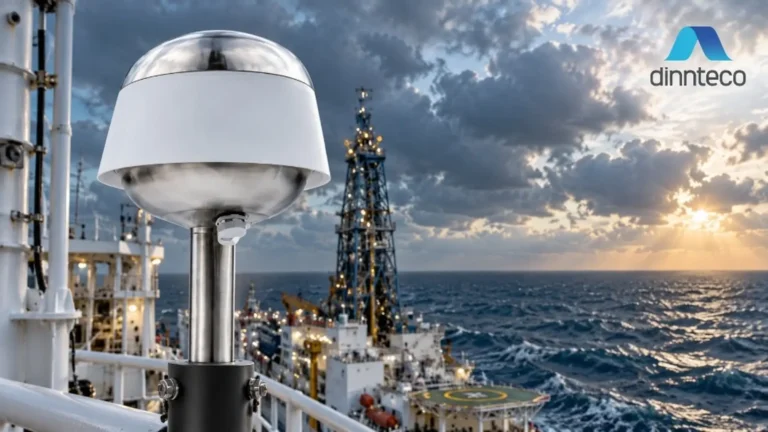
A modern vessel relies on electrical and electronic systems for navigation, communications, equipment control, and onboard operational functions. During an electrical storm, DDCE Marine forms part of a protection strategy that must consider both a possible direct lightning strike and disturbances capable of reaching the vessel’s electronic systems.
The risk does not end at the point where a discharge could occur. The electromagnetic fields associated with lightning can couple to conductive elements and induce overvoltages in circuits, power systems, navigation equipment, communications, and other sensitive systems, even when the discharge occurs outside the protected area.
For this reason, the marine solution provided by Dinnteco America addresses two complementary levels: preventing a direct strike on the protected vessel and managing the indirect effects that can compromise its electrical and electronic systems. Lightning protection for vessels must integrate both functions from the design stage.
Lightning protection for vessels: Two fronts
When lightning strikes a vessel, its effects are not limited to the point of contact. The current associated with the discharge can involve conductive structures and the grounding system, while rapid variations in the electromagnetic field can generate disturbances in nearby circuits and equipment.
For this reason, the assessment must consider both the exposed structure and the possible electrical paths toward the systems installed onboard.
A discharge occurring outside the protected area can also affect the vessel. The associated electromagnetic pulse can couple to conductive elements and generate overvoltages capable of reaching the onboard electrical installation and electronic systems.
Dinnteco’s marine documentation specifically warns that these indirect effects can enter the vessel through conductive parts of the hull, requiring complementary protection measures.
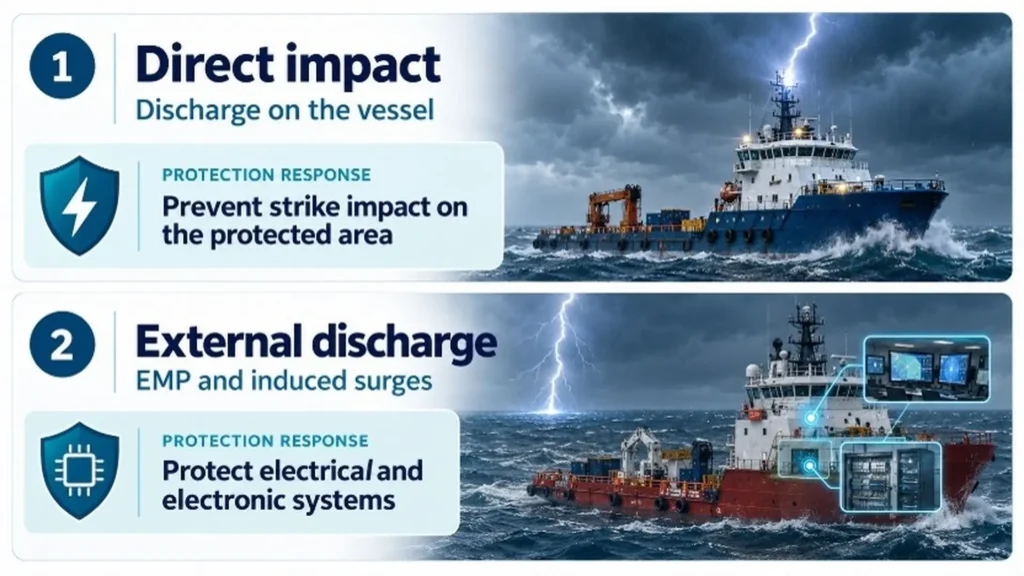
This distinction is important because addressing only the direct strike leaves another question unresolved: what happens to the electronics if lightning strikes near the vessel?
From a maritime safety perspective, the answer must consider both the structure and the systems required to navigate, communicate, and operate the vessel. Electronic protection is part of this assessment because an electrical disturbance can affect functions different from those compromised by the physical strike.
DDCE Marine: Prevention before the strike
DDCE Marine was developed specifically for marine applications and retains the technological principle of the DDCE family, adapted to vessel protection.
Dinnteco defines DDCE Marine as a passive collector system of electrostatic currents that conducts them to ground. Its operating principle is based on the continuous balancing or compensation of the variable electric field between the atmosphere and the ground through the controlled diversion of electrical charges accumulated in the surrounding environment. This process seeks to maintain electrical balance around the protected structure and prevent the conditions that favor the formation of the upward leader.
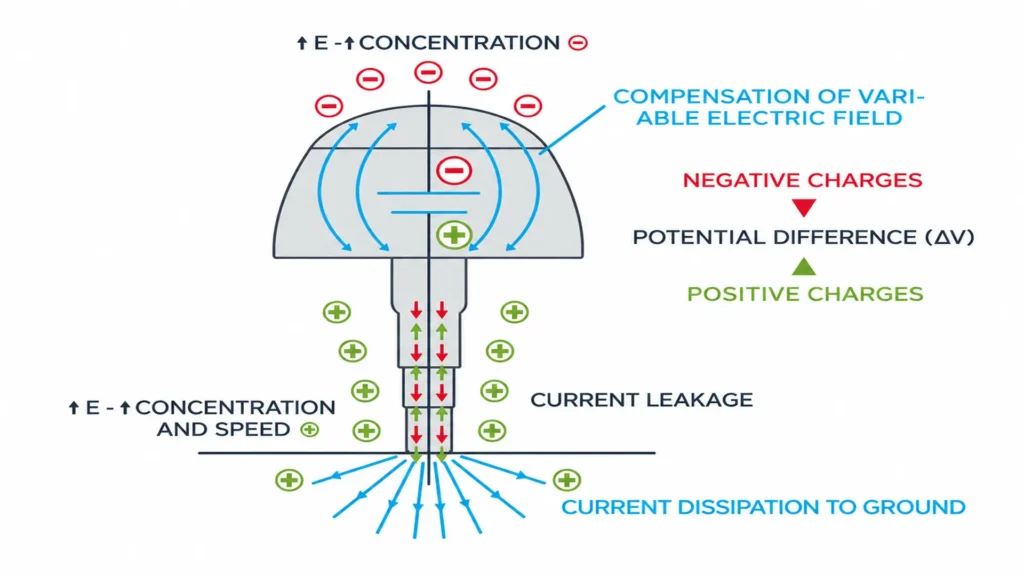
The technical documentation included in the RINA Type Approval relates this process to preventing the ionization of the air that gives rise to the upward tracer, meaning the upward ionized channel that can develop from the structure during the formation of the lightning channel.
The application of this principle in the marine environment can be seen in the following video, where DDCE Marine is installed as part of a vessel protection system.
Electronic protection against indirect effects
Preventing a direct strike addresses one part of the risk. Electromagnetic protection must also consider the effects of atmospheric discharges occurring outside the protected area, since they can generate electromagnetic pulses and overvoltages capable of reaching the onboard electrical installation and electronic equipment.
Electromagnetic pulses associated with a nearby discharge can couple to conductive elements and generate transients that reach wiring, power systems, and electronic equipment. On a vessel, these paths can involve conductive parts of the hull and connections associated with the electrical installation and grounding system. Therefore, navigation, communications, instrumentation, and control must be considered within the electronic protection design, even when the direct strike occurs outside the protected area.
Dinnteco’s marine documentation expressly distinguishes protection against the direct effects of lightning from protection against its indirect effects. This separation allows a specific function to be assigned to each component and prevents the solution from being interpreted as though all protection depended on a single device.
For a possible direct strike, the system is designed to prevent the lightning discharge from becoming established on the protected vessel. For indirect effects generated by external discharges, the design must consider induced overvoltages and the measures required to limit their propagation toward the electrical and electronic systems.
From a maritime safety perspective, this distinction is relevant because navigation, communications, and control depend on equipment that can be sensitive to electrical disturbances even when it has not received a direct physical strike.
dinfil and SPD against induced overvoltages
For protection against external disturbances, Dinnteco incorporates dinfil, a high-reactance ground filter designed to protect against high-frequency ground-induced surges associated with atmospheric discharges, electromagnetic pulses, and other sources.
The operating principle of the dinfil filter is based on the high reactance of its winding to high-frequency alternating components. When a high-frequency current attempts to pass through the most active part of the winding, the self-inductance produced by the magnetic flux generates a counter-electromotive force that opposes the passage of its alternating component. In this way, the filter acts on high-frequency disturbances associated with electromagnetic pulses and induced overvoltages.
Dinnteco coordinates this function with a surge protective device (SPD). Once the high-frequency components have been addressed by dinfil, the SPD complements the protection by limiting the remaining transient overvoltages and diverting impulse current according to the configuration of the installation.
Therefore, the solution should not be interpreted as the installation of a single isolated component. Within the architecture proposed by Dinnteco, DDCE Marine is associated with preventing a direct lightning strike on the protected vessel. The treatment of indirect effects incorporates complementary solutions, including dinfil and the surge protective devices required for the installation.
This division is consistent with the RINA Type Approval, which identifies the lightning protection system as comprising DDCE Marine, the dinfil filter, and dinmar. The approval documentation also distinguishes protection against direct lightning strikes from protection against external induced overvoltages.
In lightning protection for vessels, the value of this architecture lies in matching each damage mechanism with a specific technical response rather than assigning the entire protective function to a single element.
Each vessel requires a specific design
Two vessels may operate under similar weather conditions and still require different protection configurations. Geometry, height, construction materials, metallic elements, electrical configuration, grounding system, equipment distribution, and the required protection level all directly influence the design.
System integration must also be addressed from both a physical and an electrical perspective. Dinnteco’s marine documentation considers the installation of the DDCE for protection against direct lightning strikes, the use of dinfil against specific indirect effects, and the connection of the system to the vessel’s grounding plates. Therefore, component location, electrical connections, and the path to ground form part of the design and should not be defined independently.
Dinnteco’s documentation considers Protection Levels I, II, III, and IV according to the applicable design criteria. The final selection must take into account the specific characteristics of the vessel and the installation conditions; therefore, a configuration used on one vessel cannot automatically be transferred to another without prior assessment.
Protection designs using DDCE must be developed by official Dinnteco International installers and distributors. This criterion seeks to ensure that the solution is integrated with the vessel’s actual architecture and that lightning protection for vessels considers both exposure to a direct strike and the electronic protection requirements associated with induced disturbances.
Marine environment: Corrosion, salinity, and vibration
The electrical function of a marine system is only one aspect of its operation. Its components must also withstand the physical conditions of the environment in which they remain installed.
Salinity, humidity, vibration, and environmental exposure are part of a vessel’s operational life. Therefore, the evaluation of equipment intended for marine service must consider its behavior under the marine environment and the mechanical stresses associated with the installation.
The DDCE marine, dinmar, and dinfil models were evaluated by LABENCOR in accordance with UNE EN ISO 9227 NSS:2023 through corrosion and salinity testing. Dinnteco publishes report CNS2_2410013 for this evaluation and reports a satisfactory result, with no incidents during testing.
Dinnteco also reports that six units were subjected by VIRLAB, a laboratory specializing in vibration testing, to tests in accordance with IEC 60068-2-6:2007, under report No. 253753. Following the tests, visual inspection detected no structural anomalies in the evaluated equipment.
These tests evaluate two different requirements of marine service: the resistance of the components to a saline environment and their mechanical behavior under vibration. Their results must be interpreted within that specific scope and complement, but do not replace, evaluations associated with the electrical function of the system.
RINA Type Approval for DDCE marine, dinfil, and dinmar
RINA, an international classification and certification organization serving the marine sector and a founding member of IACS, issued Type Approval Certificate ELE025924XG in October 2025 for DDCE Marine, the dinfil filter, and dinmar. The organization provides classification, statutory certification, and equipment approval services for the marine and offshore industries.
The certificate identifies the product as Lightning Protection, Dinnteco International S.L. as the applicant, and Dinnteco Factory Gasteiz S.L.U. as the manufacturer. The Type Approval was issued on October 21, 2025, and remains valid until October 20, 2030.
The Type Approval Certificate ELE025924XG states compliance with IEC, EN, UNE-EN, and BS-EN 62305, Parts 1, 2, 3, and 4, for DDCE Marine and dinmar, and with IEC 62561 Part 1 for the dinfil filter. The same document defines two main segments of the system: protection against direct lightning strikes and protection against external induced overvoltage, the latter being optional.
The Type Approval provides a specific reference for marine applications and is not limited to a single component: it includes the preventive system and the complementary dinfil and dinmar elements within the approved product scope.
The Type Approval does not replace the design of the installation. The final configuration continues to depend on the characteristics of the vessel, its electrical system, the required protection level, and the technical requirements applicable to the project.
For an onboard electronic protection and atmospheric discharge protection solution, this distinction is relevant: approved equipment provides evidence regarding the product, while the operation of the installation also depends on correct selection and integration.
From protection to vessel operational continuity
The effects of an atmospheric discharge can continue long after the storm has ended. A failure in navigation, communications, power supply, or control systems may require diagnostics, component replacement, and testing before the vessel can fully recover its operational capability.
On vessels with a high degree of electronic integration, the consequences should not be assessed solely in terms of the cost of the affected equipment. The unavailability of certain systems can restrict navigation or keep the vessel out of service while repairs are performed.
On a vessel, electromagnetic pulses can reach circuits, wiring, and sensitive equipment even when they have not been directly struck. For this reason, electronic protection must form part of the overall protection design, particularly when a failure could compromise functions required to keep the vessel operational after an electrical storm.
From a maritime safety perspective, reducing the exposure of electrical and electronic systems to the effects of atmospheric discharges contributes to a more comprehensive protection strategy. The technical assessment must consider both the risk of a direct strike and electromagnetic disturbances and overvoltages that may propagate through the electrical installation.
Protect before repairing
A vessel combines structure, electrical systems, navigation, communications, and electronics within a single operating environment. During an electrical storm, these elements may be exposed both to a possible direct lightning strike and to electromagnetic disturbances generated by nearby discharges.
Dinnteco’s marine solution addresses both mechanisms through differentiated functions. The preventive system acts against a possible direct strike on the protected vessel, while complementary measures address overvoltages that could reach the electrical and electronic systems.
RINA Type Approval provides an additional reference for evaluating the marine application of the equipment, but implementation must begin with the specific characteristics of the vessel, its electrical architecture, and the required protection level.
A properly designed strategy seeks to reduce the exposure of both the vessel and its systems to the effects of electrical storms, reducing the likelihood of damage and subsequent unplanned interventions.
References
- Dinnteco International. DDCE Marine, Product Information.
- Dinnteco International. Marine, Protection Against Direct and Indirect Lightning Effects.
- Dinnteco International. Standards and Certifications.
- Dinnteco International. DDCE Coverage.
- RINA Services S.p.A. Type Approval Certificate ELE025924XG. 2025.
Frequently Asked Questions (FAQs)
What is the function of DDCE Marine?
DDCE Marine is a passive collector system of electrostatic currents that conducts them to ground. Its operating principle is based on balancing or compensating the variable electric field to prevent the generation of the upward leader on the DDCE and on the vessel it protects.
Why is dinfil used together with DDCE Marine?
A lightning discharge can occur outside the protected area and generate electromagnetic disturbances. dinfil acts on the high-frequency components of induced overvoltages, while an SPD complements the protection against the remaining transient disturbances within the installation.
Which products are included in the RINA Type Approval?
The Type Approval Certificate ELE025924XG includes DDCE Marine, the dinfil filter, and dinmar. RINA Services issued it on October 21, 2025, and it remains valid until October 20, 2030.
Can the same configuration be used on every vessel?
No. The design must consider the vessel’s characteristics, geometry, electrical configuration, grounding system, installed equipment, and required protection level. Coverage must be determined in accordance with the applicable design methods and the specific installation conditions.