Table of Contents
- Main types of Non Destructive Testing
- Limitations of NDT in large scale assets
- Advanced ultrasonic techniques for long range inspection
- Guided wave technology in industrial applications
- How to select the right NDT method
- Common mistakes in NDT selection and implementation
- Integration of NDT with asset integrity programs
- Operational impact of advanced NDT
- ROI of NDT inspection strategies
- The evolving role of NDT in industrial decision making
- From inspection to strategic decision-making
- References
- Frequently Asked Questions (FAQs)
Nondestructive testing (NDT) plays a critical role in modern industrial operations by enabling the evaluation of materials, components, and systems without compromising their functionality. In sectors such as oil & gas, petrochemicals, power generation, and infrastructure, the correct selection of inspection techniques directly influences asset reliability, safety, and operational efficiency.
While multiple NDT methods are available, each with specific advantages and limitations, the challenge for engineers and asset managers lies not in understanding the techniques individually, but in determining which method is most appropriate under real operating conditions.
This decision becomes particularly complex in large-scale assets such as pipelines, storage tanks, and structural systems, where accessibility, coverage, and cost-efficiency are critical variables.
Main types of Non Destructive Testing
NDT encompasses a wide range of inspection methods designed to detect discontinuities, evaluate material properties, and assess structural integrity. The most used techniques include key methods such as visual testing, radiographic testing, and magnetic particle testing, among others.
Visual Testing (VT): The simplest and most widely used method, visual testing, also known as visual inspection, relies on direct observation or optical tools to identify surface defects, corrosion, misalignment, or deformation.
Ultrasonic Testing (UT): UT uses high-frequency sound waves to detect internal flaws, measure thickness, and evaluate material integrity. It is widely used in weld inspection, corrosion monitoring, and thickness measurements.
To understand its evolution and industrial applications, you can consult this analysis on industrial ultrasound:
Radiographic Testing (RT): Radiographic testing (RT) employs X-rays or gamma rays to produce images of internal structures, allowing for the detection of volumetric defects such as voids, inclusions, and cracks.
Magnetic Particle Testing (MT): Magnetic particle testing (MT) applies to ferromagnetic materials and detects surface and near-surface discontinuities using magnetic fields and ferrous particles.
Liquid Penetrant Testing (PT): PT is used to reveal surface-breaking defects by applying a liquid penetrant that seeps into discontinuities and becomes visible after development.
Eddy Current Testing (ECT): ECT uses electromagnetic induction to detect surface and near-surface defects, particularly in conductive materials.
Limitations of NDT in large scale assets
While these techniques are effective in controlled inspection environments, their application in large industrial systems, especially pipelines, presents operational challenges.
In many cases, traditional inspection methods require localized, point by point evaluation, which limits coverage and increases execution time. For long-distance pipelines or buried systems, this approach becomes inefficient and costly.
Additionally, accessibility constraints—such as insulation, underground installation, or restricted environments—can significantly reduce the effectiveness of conventional inspection strategies.
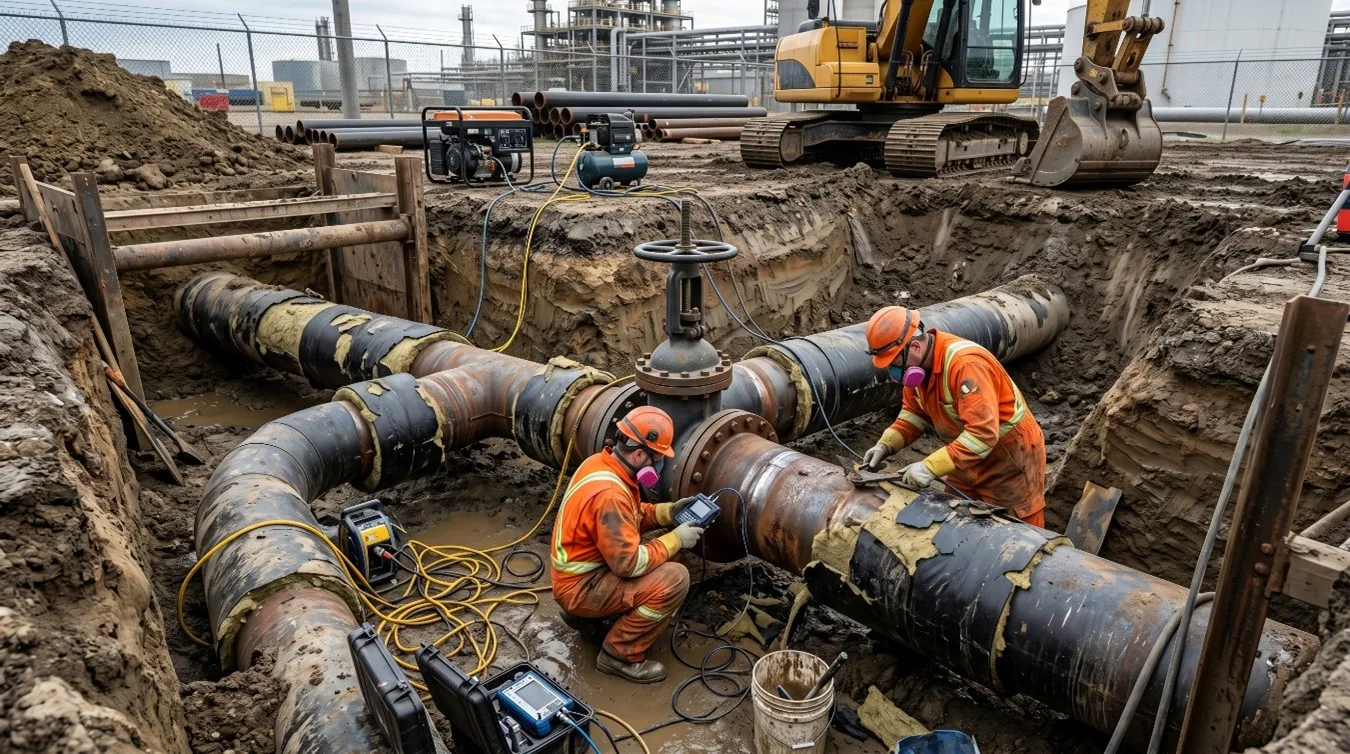
Limitations of conventional ultrasonic testing in pipelines
Ultrasonic Testing (UT) is one of the most reliable and widely used NDT techniques. However, when applied to extensive pipeline systems, it reveals important limitations.
Traditional UT methods require direct contact and localized measurements, meaning that each inspection point must be individually accessed. In long pipelines, this translates into:
- High inspection time
- Increased operational costs
- Limited coverage
- Dependence on accessibility
In complex environments—such as buried pipelines or insulated systems (CUI)—these limitations can significantly affect inspection efficiency and integrity program effectiveness.
These constraints have led the industry to explore more advanced techniques capable of addressing large-scale inspection challenges.
Advanced ultrasonic techniques for long range inspection
To overcome these limitations, advanced inspection technologies such as Guided Wave Testing (GWT) have been developed.
Unlike conventional UT, guided wave inspection allows operators to evaluate extended sections of piping from a single test location. This capability significantly enhances inspection coverage while reducing operational complexity.
Guided waves propagate along the structure of the pipe, enabling the detection of anomalies such as:
- Corrosion
- Wall thinning
- Cracks
- Structural discontinuities
This approach is particularly valuable for screening large pipeline sections, identifying areas that require further detailed inspection.
In this context, guided wave technologies have evolved beyond the traditional point inspection approach, incorporating continuous monitoring capabilities and real-time analysis. The following content, courtesy of Inspenet TV, shows how these solutions are being applied in real industrial environments:

Guided wave technology in industrial applications
In industrial practice, guided wave inspection has become an essential tool for pipeline integrity management, particularly in complex or hard-to-access systems.
Technologies developed by companies such as Guided Ultrasonics Limited are designed to enable long-range inspection solutions that complement conventional non-destructive testing methods.
Technologies developed by companies such as Guided Ultrasonics Limited focus on enabling long-range inspection solutions that complement conventional NDT methods.
These systems are designed to:
- Increase inspection coverage
- Reduce operational costs
- Improve inspection planning
- Support data-driven decision-making
By integrating guided wave testing into inspection strategies, operators can achieve a more efficient balance between coverage and detail, optimizing the allocation of inspection resources.
In this context, such scenarios often require the support of specialized providers with expertise in advanced techniques, particularly in critical assets or complex configurations where data reliability is essential for decision-making.
When should guided wave inspection be considered?
Guided wave inspection is not a replacement for all NDT methods. Instead, it is a strategic tool that should be applied under specific conditions where conventional methods face limitations.
In these contexts, selecting the appropriate technology and specialized provider not only impacts inspection quality, but also the ability to reduce uncertainty and effectively manage operational risk.
Typical scenarios include:
- Buried pipelines where excavation is not feasible
- Corrosion under insulation (CUI) conditions
- Long-distance pipeline systems requiring rapid screening
- Offshore pipelines with limited accessibility
- Areas with high operational risk or restricted access
In these cases, guided wave technology provides a first-level screening capability that helps prioritize detailed inspections and maintenance actions.
How to select the right NDT method
Selecting the appropriate NDT technique requires a comprehensive understanding of both the asset and the inspection objectives. The decision should consider multiple factors:
1. Type of defect to be detected
- Surface vs internal
- Volumetric vs planar
2. Material properties
- Ferromagnetic vs non-ferromagnetic
- Conductivity
3. Accessibility
- Direct access vs restricted environments
- Presence of insulation or coatings
4. Coverage requirements
- Localized inspection vs large-area screening
5. Operational constraints
- Downtime limitations
- Safety considerations
6. Cost-efficiency
- Inspection time
- Resource allocation
In many cases, the optimal approach involves combining multiple NDT techniques, using advanced methods like guided waves for screening and conventional methods for detailed evaluation.

Common mistakes in NDT selection and implementation
Incorrect selection or application of NDT methods can lead to inefficient inspections and increased operational risk. Some common mistakes include:
- Relying exclusively on a single inspection technique
- Ignoring accessibility limitations
- Underestimating inspection coverage requirements
- Failing to integrate inspection results into integrity programs
- Not considering advanced technologies when needed
Avoiding these errors requires a strategic approach that aligns inspection techniques with asset conditions and operational objectives.
Integration of NDT with asset integrity programs
Modern asset integrity strategies are based on systematic inspection, monitoring, and maintenance planning. NDT plays a fundamental role in this framework.
Techniques such as guided wave testing are increasingly integrated into:
- Risk-Based Inspection (RBI) programs
- Pipeline inspection strategies under API 570, where criteria for in-service evaluation are established
- Corrosion management systems
- Preventive maintenance planning
By combining screening technologies with detailed inspection methods, operators can optimize inspection intervals, reduce uncertainty, and improve long-term asset performance.
Operational impact of advanced NDT
The selection of appropriate NDT techniques has a direct impact on operational efficiency and cost management.
Advanced inspection methods, including guided wave testing, contribute to:
- Reduction in inspection time
- Lower operational costs
- Improved detection of critical defects
- Better planning of maintenance activities
- Increased asset availability
ROI of NDT inspection strategies
The implementation of advanced technologies such as guided wave testing not only improves operational efficiency but also generates a direct impact on the return on investment (ROI) of integrity programs.
By enabling the screening of large pipeline sections from a single inspection location, this technology significantly reduces costs associated with labor, execution time, and asset accessibility—especially in complex environments such as buried pipelines or insulated systems.
Additionally, by facilitating early detection of anomalies, it helps prevent potential failures, minimize unplanned shutdowns, and optimize maintenance planning.
From a strategic perspective, this translates into better resource allocation, reduced operational risk, and improved asset reliability, directly impacting overall business performance.
Collectively, these factors position advanced inspection solutions as high-value investments rather than operational expenses, aligning technical decisions with the financial objectives of the organization.
From a business perspective, these benefits translate into improved reliability and reduced lifecycle costs, making advanced NDT solutions a strategic investment rather than an operational expense.
The evolving role of NDT in industrial decision making
As industrial systems become more complex, the role of NDT is evolving from a purely inspection function to a decision-support tool.
Engineers and asset managers increasingly rely on inspection data to:
- Prioritize interventions
- Optimize resource allocation
- Extend asset life
- Improve safety performance
In this context, the integration of advanced technologies such as guided wave inspection is becoming a key element in modern integrity strategies.
From inspection to strategic decision-making
Understanding the different types of non destructive testing is essential, but the real value lies in knowing how and when to apply each method.
Conventional techniques such as UT, RT, and PT remain fundamental tools. However, in complex industrial scenarios, particularly in pipeline systems, advanced technologies are required to overcome operational limitations.
Guided wave inspection represents one of these advancements, enabling efficient long-range screening and supporting more effective integrity management programs.
For operators facing large-scale inspection challenges, integrating advanced solutions into their inspection strategies is no longer optional; it is a necessity. In this context, working with specialized providers such as Guided Ultrasonics Limited can contribute to more efficient inspection planning, improved coverage, and enhanced long-term asset reliability.
References
- American Society for Nondestructive Testing. (n.d.). NDT methods. ASNT. https://www.asnt.org/what-is-nondestructive-testing/methods
- American Society for Nondestructive Testing. (n.d.). Visual testing (VT) method for NDT inspections. ASNT. https://www.asnt.org/what-is-nondestructive-testing/methods/visual-testing
- International Organization for Standardization. (2021). ISO 9712:2021: Non-destructive testing — Qualification and certification of NDT personnel. ISO.
- American Petroleum Institute. (2024). API Standard 570: Piping inspection code: In-service inspection, rating, repair, and alteration of piping systems (5th ed.).
- Guided Ultrasonics Limited. (n.d.). Guided wave inspection. Guided Ultrasonics Limited. https://www.guided-ultrasonics.com/inspection/
- Guided Ultrasonics Limited. (n.d.). Guided Wave Testing (GWT). Guided Ultrasonics Limited. https://www.guided-ultrasonics.com/technology/
- Lowe, M. J. S., Alleyne, D. N., & Cawley, P. (2006). Long range guided wave inspection usage: Current commercial capabilities and research directions. Imperial College London / Guided Ultrasonics Limited. https://www.guided-ultrasonics.com/wp-content/uploads/2023/02/Lowe-2006-Long-Range-GW-Review.pdf
- International Committee for Non-Destructive Testing. (2024). ICNDT guide to qualification and certification of personnel for NDT. ICNDT. https://www.icndt.org/ICNDT%20Guidelines%202024.pdf
- Guided Ultrasonics Limited. (n.d.). Screening for cost-effective NDT. Guided Ultrasonics Limited. https://www.guided-ultrasonics.com/inspection/screening/
Frequently Asked Questions (FAQs)
What is the most commonly used NDT method?
Ultrasonic Testing (UT) is one of the most widely used methods due to its versatility and ability to detect internal defects.
When should guided wave testing be used?
It is particularly useful for long pipelines, buried systems, and areas with limited access where conventional methods are inefficient.
Can guided wave testing replace traditional UT?
No, it complements traditional UT by providing large-scale screening. Detailed inspections still require conventional techniques.
What industries use NDT the most?
Oil & gas, petrochemicals, power generation, aerospace, and infrastructure are among the main sectors.
Why is NDT important for asset integrity?
Because it enables early detection of defects, reduces failure risk, and supports safe and efficient operation.
.