Table of Contents
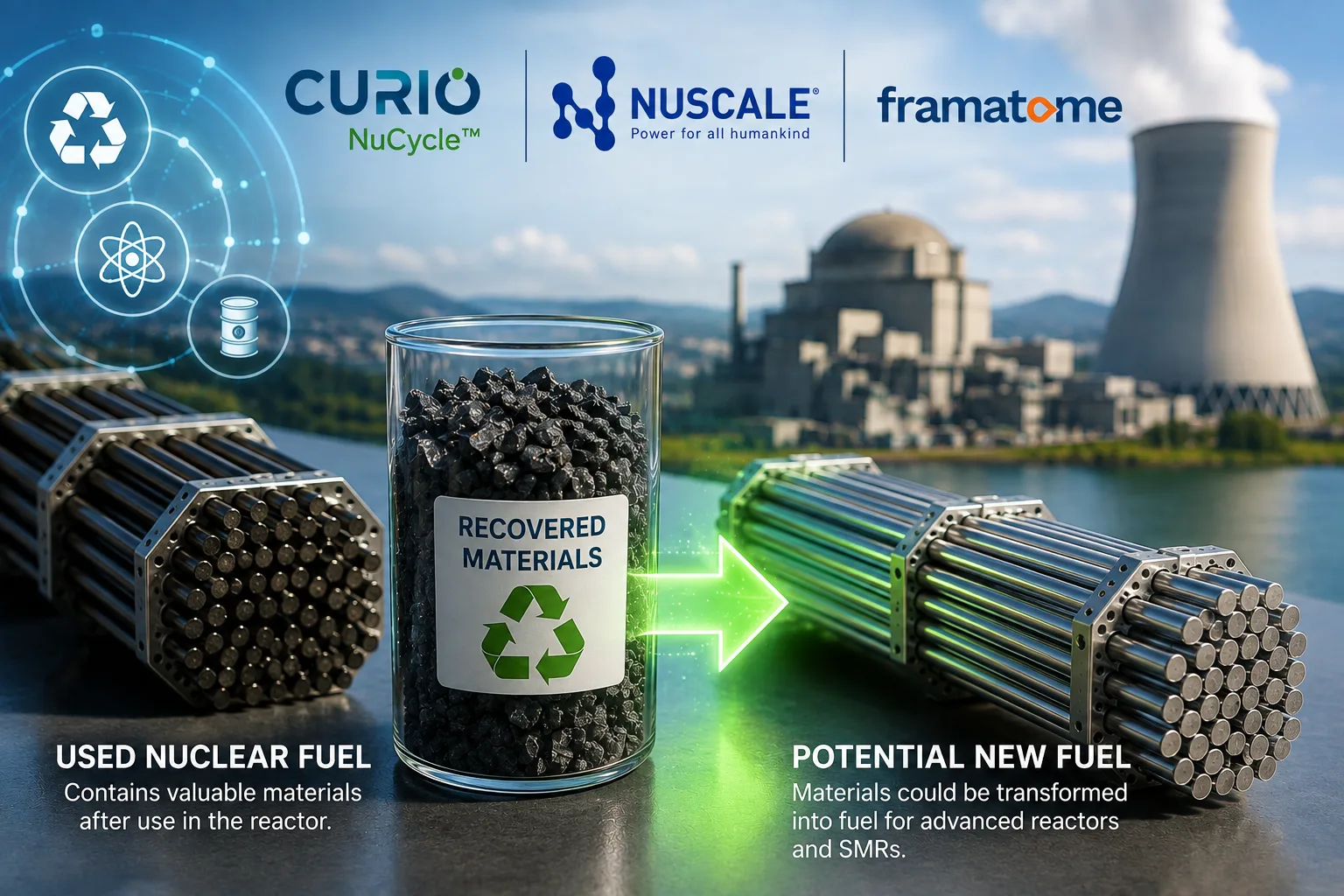
Used nuclear fuel could take on a new role in the expansion of advanced reactors. Curio, NuScale Power, and Framatome signed a memorandum of understanding (MOU) to evaluate an integrated solution that would enable the recovery of materials from irradiated fuel and assess their potential transformation into new products and fuels for future nuclear technologies.
The agreement, announced on August 6, connects three areas that typically appear at different stages of the nuclear fuel cycle: materials recycling, fuel manufacturing, and advanced reactor development. The companies will conduct technical assessments and feasibility studies before determining whether the pathways under consideration can advance toward commercial agreements.
The initiative will use NuCycle, Curio’s technology for recovering materials contained in used nuclear fuel, as its starting point. The objective is not simply to reduce waste, but to assess whether some of these materials can be reintegrated into the nuclear value chain and contribute to future fuel supply.
Used nuclear fuel enters a new energy equation
The expected growth of small modular reactors (SMRs) and other advanced technologies is increasing attention on a fundamental issue: establishing a fuel supply chain capable of supporting their deployment.
Curio, NuScale, and Framatome will evaluate pathways ranging from material recovery through NuCycle to their eventual conversion into products or fuels. The work also includes potential future opportunities in engineering, development, qualification, manufacturing, and commercialization.
However, the agreement is still at the evaluation stage. The companies will conduct technical studies, feasibility analyses, supply chain assessments, and interface reviews, meaning that the MOU does not imply that a commercial fuel produced through this pathway currently exists.
This distinction is important. Before a recovered material can become commercial nuclear fuel, it must undergo technical, regulatory, qualification, and manufacturing processes to ensure its performance and safety.
The industry’s interest lies in determining whether used fuel can move beyond being considered exclusively a material destined for storage and instead become, at least in part, a source of resources for new fuel cycles.
NuCycle seeks to recover value from nuclear materials
NuCycle technology represents the initial component of the proposal.
Curio is developing this process with the goal of separating and recovering materials contained in used nuclear fuel for future energy applications. The company maintains that its technology could significantly reduce the residual volume that ultimately requires management as nuclear waste.
The original POWER source cites a potential reduction of up to 97%, although information currently published by Curio in its own technology description indicates a 96% reduction in waste volume. For editorial accuracy, the latter figure should be treated as an estimate provided by the company itself rather than as independently demonstrated commercial performance.
The concept seeks to make use of elements that still retain energy or strategic value instead of managing all used fuel under a linear approach.
If the assessments prove favorable, the collaboration could open opportunities to connect these recovered materials with subsequent fuel development and manufacturing processes.
NuScale and Framatome are already preparing fuel for future SMRs
The new collaboration is not starting from scratch. NuScale and Framatome have maintained a relationship for years related to the supply of fuel for the U.S. company’s modular reactors.
In March 2026, the two companies expanded their cooperation to incorporate Framatome’s European facilities into the future manufacturing of fuel for NuScale customers. At the same time, the Richland, Washington, facility began preparations to manufacture the NuFUEL-HTP2 design for U.S. SMRs.
The program calls for the production of at least 444 fuel assemblies for NuScale’s first U.S. customer, with deliveries expected to begin in 2030. The NuScale Power Module is a Generation III+ reactor whose fuel is based on technology developed from designs used in pressurized water reactors.
This existing infrastructure explains the complementary roles of the three companies: Curio provides the recovery technology, Framatome brings expertise in fuel development and manufacturing, and NuScale represents an advanced reactor platform that will require a supply chain prepared for future deployments.
However, the newly announced MOU does not establish that materials recovered through NuCycle will be used directly in NuScale’s current modules. That is precisely part of the scope that technical assessments and future development stages will need to define.
Recycling could strengthen the nuclear fuel supply chain
The agreement comes as the United States seeks to strengthen a nuclear fuel supply chain capable of supporting the expansion of its nuclear capacity and reducing supply vulnerabilities.
For advanced reactors, building new units represents only part of the challenge. It will also be necessary to ensure fuel availability, manufacturing capacity, industrial infrastructure, and solutions for managing the material once it has been used.
That is where the importance of connecting different stages of the fuel cycle lies.
Framatome already has industrial experience with fuels manufactured from reprocessed materials. The company produces MOX fuel assemblies using recovered plutonium combined with depleted uranium, demonstrating that the recycling of certain nuclear materials has commercial precedents, although this does not mean that NuCycle uses exactly the same technological pathway.
The proposal by Curio, NuScale, and Framatome now seeks to explore what opportunities could emerge from integrating recovery, fuel development, manufacturing, and next-generation reactor technologies within a single strategy.
The challenge will be taking the integrated fuel cycle to commercial scale
The signing of the MOU opens a technological pathway, but several stages remain before it can be considered a new commercial source of nuclear fuel.
The results of the studies will need to determine which materials can be recovered, what products can be developed from them, and what technical, economic, and regulatory requirements would be necessary to incorporate them into future supply chains.
If the model moves forward, used nuclear fuel could take on a different role within the industry: in addition to representing a long-term management challenge, it could become a source of usable materials for new energy applications.
The real breakthrough, therefore, is not yet the production of a new fuel. It lies in the attempt to connect the end of one nuclear fuel cycle with the beginning of the next.
Source: POWER