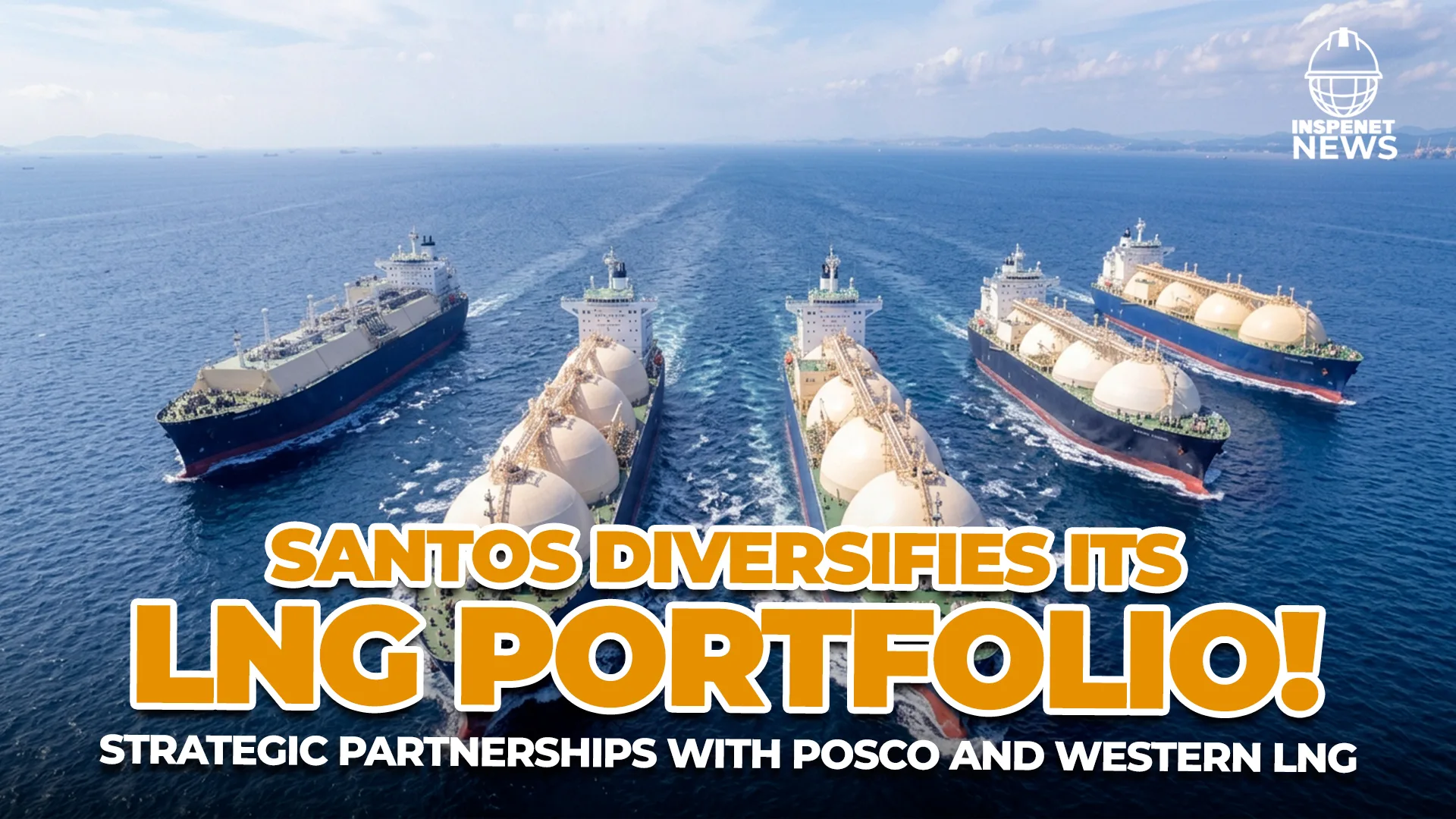
Santos expands its LNG portfolio with new agreements in Asia
Strategy gains traction in Asia-Pacific; the Australian energy company agreed on commercial terms to supply liquefied natural gas to POSCO Steel for ten years and made progress on a separate agreement to acquire production from the Canadian Ksi Lisims LNG project.
Both transactions have distinct objectives within the portfolio. Santos seeks to secure a new source of LNG in Canada while expanding its commercial commitments with Asian clients. The company expects this to provide greater flexibility in managing volumes and responding to its buyers' needs.
The agreements are not yet final; their implementation will depend on the negotiation of the respective purchase agreements and the corresponding corporate approvals.
Santos agrees to supply LNG to POSCO for 10 years
On the one hand, Santos agreed the main commercial terms with the South Korean company POSCO Steel to supply it with LNG for a period of ten years.
The liquefied natural gas will come from Santos' global portfolio, with deliveries scheduled to begin in 2030 or 2031 under the delivered ex ship (DES) arrangement. This means that Santos would be responsible for transporting the cargo to the designated port of destination.
However, the supply is still contingent upon the negotiation and signing of an LNG purchase agreement. It will also require the necessary corporate approvals.
The deal allows Santos to strengthen its business relationship with Asia through long-term contracts. At the same time, POSCO secures a way to guarantee its energy supply for the next decade.
Santos seeks 1 million tons of Canadian LNG annually
Furthermore, the Australian company signed a non-binding framework agreement with Western LNG to purchase approximately 1 million tonnes per annum (mtpa) from the Ksi Lisims LNG project.
The potential contract would last up to 20 years and would begin around 2031. Unlike the agreement with POSCO, this supply would be made under the free on board (FOB) modality in British Columbia.
In this case, Santos would acquire the LNG at the Canadian loading point and would have more leeway to decide where to subsequently market those volumes.
The agreement does not yet constitute a final purchase; the parties must negotiate the final contracts and meet the agreed conditions before the supply can be finalized.
Ksi Lisims opens a new supply source to Asia
In addition, Ksi Lisims LNG would allow Santos to add Canada to a portfolio currently supported by its production from Australia and Papua New Guinea.
The project envisions a floating LNG export facility with a capacity of 12 million tons per year in British Columbia. It is being promoted by the Nisga'a Nation, Rockies LNG, and Western LNG.
Furthermore, the project's location is relevant to Santos's business strategy. The Canadian Pacific coast offers a relatively short route to North Asian markets.
Ksi Lisims is also designed to use hydroelectric power during the liquefaction process. With this, its developers aim to produce LNG with lower emissions intensity.
The project obtained its British Columbia Environmental Assessment Certificate in 2025 and has attracted long-term purchase agreements with international energy companies.
Santos seeks to increase sales without increasing upstream investment
In turn, the Canadian operation presents an additional advantage for Santos; the company could increase the volumes available for sale without depending exclusively on new in-house production.
This strategy allows the incorporation of third-party supplies into its global portfolio, in this way Santos can combine its own production and externally acquired liquefied natural gas to serve different markets.
The company would also have greater capacity to distribute shipments according to customer demand and regional price conditions.
Therefore, the supply from Canada could complement the assets Santos already holds in Oceania. The company seeks to leverage this combination to strengthen its commercial presence in Asia-Pacific.
Energy security gains importance in Santos GNL's strategy
Meanwhile, long-term contracts continue to play a key role in the Australian energy company's plans. Santos believes that combining different supply sources can offer greater flexibility to its Asian customers.
Kevin Gallagher, Santos' CEO, noted that the company is combining its commercial expertise with flexible third-party supply to generate value within its global LNG portfolio.
The company links this strategy to the energy security of its customers in Asia. Access to Canadian production would add a new geographic source and reduce dependence on a single supply region.
According to Santos, the relative proximity between Canada's west coast and the main markets in northern Asia can also enhance the competitiveness of these shipments.
POSCO adds a long-term supply agreement
Finally, the agreement with POSCO adds one of South Korea's leading steel groups to Santos' long-term customer portfolio.
Liquefied natural gas can play various roles within the South Korean company's industrial energy consumption. The agreement's anticipated duration also provides a supply outlook spanning a decade.
Santos ' strategy : securing new sources of liquefied natural gas while simultaneously expanding commercial commitments with buyers in Asia.
If the final agreements proceed as planned, the company will have a more diversified portfolio from the beginning of the next decade to connect its own production and third-party supply with Asian demand.
News of additional interest
British recycling leaves diesel behind with hydrogen
Elsa Recycling, a plant located in Stockport, UK, replaced its diesel-powered generators with hydrogen energy units to cover peak consumption periods. The system, developed by GeoPura, works in conjunction with the facility's solar panels and the electrical grid supply to keep its recycling processes running.
The plant processes plastic, paper, and cardboard using equipment such as shredders, compactors, and sorting systems that require large amounts of electricity. According to reports, it is the first recycling facility in the UK to combine hydrogen, solar power, and grid electricity in this way. This change eliminates the use of diesel as a backup fuel source and reduces emissions associated with its operations.
Aker BP finds new gas deposit in the North Sea
Aker BP discovered gas in the Alpehumle prospect, located about 25 kilometers north of the Duva field in the North Sea. The exploration detected a 10-meter gas plume in the Agat Formation, which contains high-quality sandstone. Initial estimates place recoverable resources between 1 and 15 million barrels of oil equivalent.
The drilling was carried out by Saipem's Scarabeo 8 platform and included a main well and a diversion well to study the deposit. Although the diversion well encountered a water-bearing zone, both wells allowed for the collection of samples and data to better understand the area. Aker BP controls 40% of the license, while Inpex Idemitsu, Okea, and Harbour Energy hold the remaining shares.
Enbridge prepares new route for Texas gas
Enbridge has opened a non-binding bidding process to gauge commercial interest in the West Texas Express, a pipeline that would carry natural gas from Waha in the Permian Basin to El Paso and other nearby markets. The project includes more than 150 miles of new infrastructure and an initial capacity of up to 2 billion cubic feet per day.
The initiative comes as associated gas production continues to grow in the Permian Basin. Enbridge aims to serve the demand of power plants, utilities, industries, and data centers in West Texas, as well as markets in Mexico, New Mexico, and Arizona. The company expects to begin operations during the fourth quarter of 2029 if it obtains sufficient commercial support and the necessary regulatory approvals.
Guangdong changes the role of gas in its electricity grid
Guangdong is changing how it uses its gas-fired power plants in response to the rapid growth of solar and wind energy. These plants will largely cease continuous operation to focus on meeting peak demand and supporting the grid when renewables are less productive. Between 2020 and 2026, gas-fired capacity increased from 27 to 61 GW, while solar and wind capacity grew from 14 to 105 GW.
The new model eliminates guaranteed operating hours and forces gas-fired power plants to compete on cost. In return, they will receive higher payments for remaining available when the system needs additional energy. Wood Mackenzie estimates that spot LNG would need to be around $6 per MMBtu for efficient gas-fired plants to compete with certain coal-fired plants under the analyzed conditions.