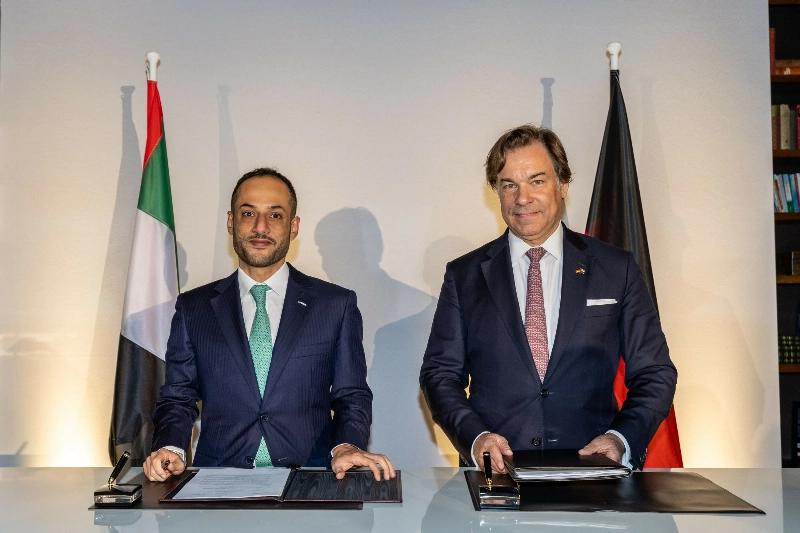
Khazna Data Centres and Siemens signed a memorandum of understanding (MoU) to explore technologies for the next generation of data centers specialized in artificial intelligence.
The agreement, signed during the UAE-Germany Business Forum held in Munich, addresses AI-ready infrastructure, technology testing, advanced electrical architectures, digital twins, and engineer training.
The importance of the agreement lies in a transformation occurring within data centers: AI workloads are increasing computing density and, with it, the demands on power supply, automation, cooling, protection, and operational continuity.
Siemens and Khazna intend to study these needs directly from design to commissioning and facility optimization.
From denser servers to new electrical grids
Accelerators used for AI concentrate an increasing amount of power in relatively small spaces. This changes the scale of the electrical problem: it is no longer enough to size the data center for a certain total power; it is also necessary to manage power density, distribution, conversion, protection, and availability.
In this scenario, Khazna and Siemens will explore 800 VDC power architectures—that is, 800-volt direct current distribution within specific parts of the infrastructure.
The technology can reduce some conversion stages between the power grid and high-density electronic loads, although its application requires resolving aspects of protection, insulation, conversion, and compatibility with the complete data center architecture.
Siemens is already working with Reinhausen on a solid-state transformer capable of receiving up to 36 kV and delivering 800 VDC for AI-ready data centers. The company notes that this architecture can reduce intermediate conversion stages and improve the density and efficiency of the power supply system.
The digital twin arrives at the data center
Khazna and Siemens will explore its use to model and optimize increasingly complex AI facilities. The application can range from design simulation and validation to systems integration, commissioning, and operational optimization.
This changes when certain engineering problems are detected. Instead of discovering during construction that a specific electrical configuration, automation system, or operational strategy has limitations, a digital model allows for the simulation of different scenarios before physically deploying the infrastructure.
For high-density data centers, this capability becomes especially valuable because electrical power, cooling, automation, and availability are coupled. A change in the computing load can simultaneously alter electrical consumption and thermal demand, requiring an evaluation of the entire system’s behavior.
Infrastructure is designed before installing hardware
The collaboration proposes a significant evolution in data center engineering: moving from designing facilities around known IT equipment to developing infrastructure ready for successive generations of AI accelerators and workloads.
This requires modularity. Computing technology changes much faster than the lifespan of a data center’s electrical infrastructure. Therefore, a rigid architecture can become limited when power demands increase or server configurations change.
The combined use of simulation, automation, and scalable electrical architectures seeks to reduce this risk. The goal is not only to achieve more power but to be able to add computational density without compromising the stability, availability, and efficiency of the electrical system.
For an operator like Khazna, whose international portfolio is growing, this issue also has a standardization dimension. A validated technological architecture can subsequently become a reference applicable to different facilities and grid conditions.
SOURCE and PHOTO: https://www.gulftoday.ae/