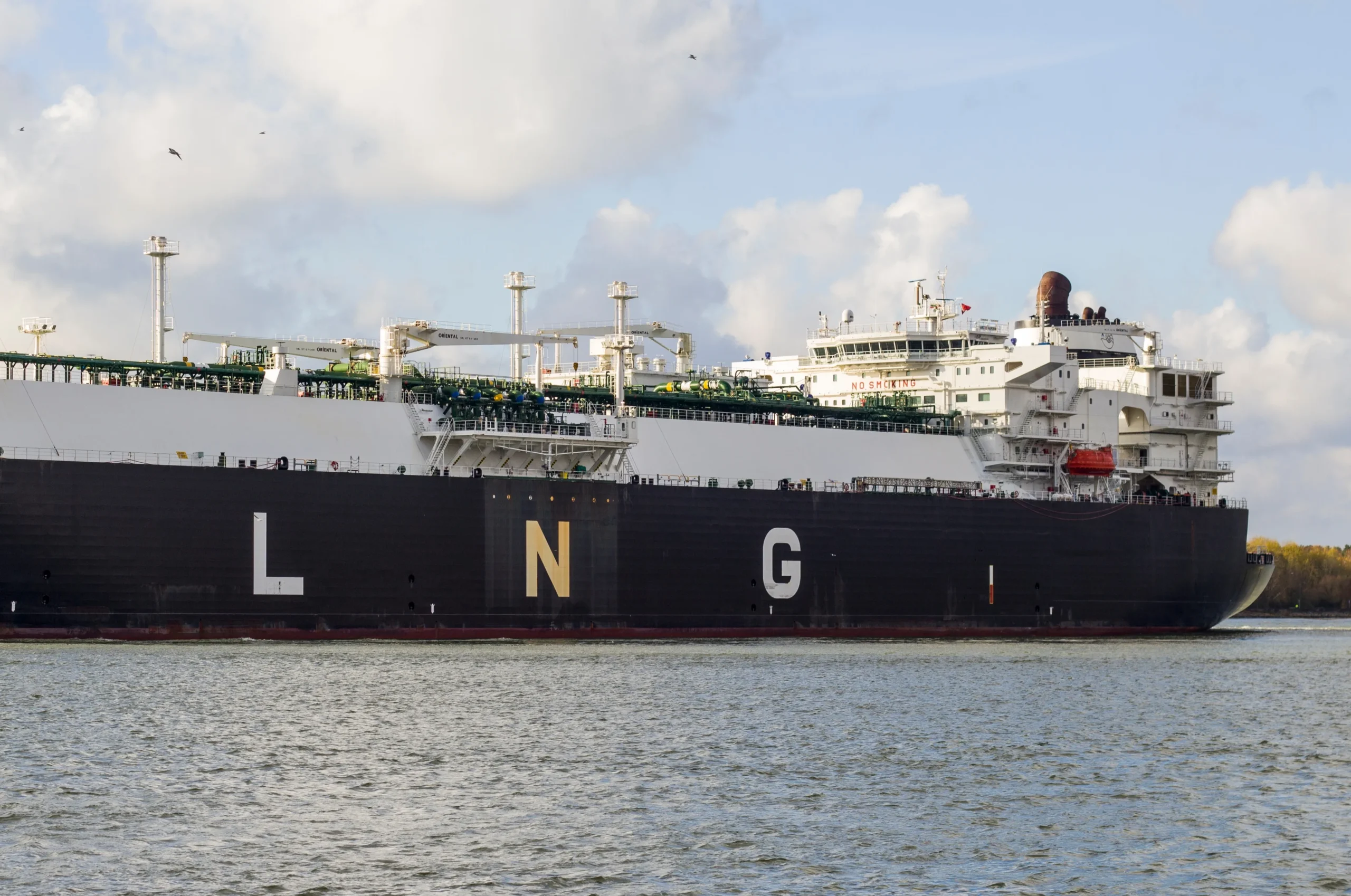
Lloyd’s Register, HD Hyundai Heavy Industries y HD Korea Shipbuilding & Offshore Engineering they obtained approval in principle to develop a 185,000 m³ LNG carrier equipped with hybrid electric propulsion.
The project aims to reduce fuel consumption and emissions through an electrical architecture designed to integrate batteries and other energy technologies. The initiative will also allow for an analysis of the necessary technical and safety requirements before extending these systems to a larger number of LNG carriers.
Hybrid electric propulsion for an LNGC of 185,000 m³
The Approval in Principle (AiP) will allow Lloyd’s Register, HD Hyundai Heavy Industries (HHI) and HD Korea Shipbuilding & Offshore Engineering (KSOE) to continue with the development and verification of the hybrid electric propulsion system.
The work will focus on aspects such as system architecture, redundancy, and battery integration, these elements are especially important on an LNG carrier, where equipment availability and safety must be maintained during extended operations.
The collaboration also aims to define technical requirements for a technology whose standards continue to evolve. The experience gained with this LNGC could later serve as a reference for other electrification projects within the maritime sector.
Lower fuel consumption and emissions
Energy efficiency is one of the main objectives of the project, by combining electricity generation, energy storage, and load management, the system can better adjust electricity production to the actual needs of the vessel during each phase of operation.
Andy McKeran, Lloyd’s Register’s Growth Director, noted that hybrid electric propulsion offers potential to improve efficiency and reduce emissions. However, he cautioned that its application at this scale requires robust design and high safety standards.
This approach is already beginning to appear in other concepts of LNG carriers modular electrical systems can allow generating equipment to operate more efficiently, while batteries respond to rapid variations in energy demand.
Electrification also offers greater flexibility to incorporate new energy sources in the future without having to completely redesign the propulsion system.
Batteries are gaining ground on LNG carriers
Battery integration will be one of the technical aspects that companies will evaluate during developmen, energy storage can help absorb dynamic loads and supplement generators when rapid changes in electricity demand occur.
The modular configuration also allows for greater redundancy in the power distribution, the goal is to maintain system availability even when certain components fail, while simultaneously improving the vessel’s operational flexibility.
Hongryeul Ryu, executive vice president and chief technology officer of HD Hyundai Heavy Industries, explained that the project made it possible to identify both the advantages and limitations associated with the application of advanced electric propulsion systems.
According to the executive, this knowledge will serve as a basis for further development propulsion systems more efficient for future ships.
A platform ready for new technologies
The scope of the project could extend beyond LNG shipping, Lloyd’s Register, HHI and KSOE hope to gain knowledge that can later be applied to other electric propulsion systems and technologies such as fuel cells.
One of the advantages of the electrical architecture is that different generation sources can feed the same network, which then distributes the energy to both the propulsion system and the rest of the ship’s electrical consumers.
Kwang-Pil Chang, senior executive vice president of HD KSOE’s Advanced Research Center, believes that electric propulsion will play a significant role in the transition to more efficient vessels.
For this reason, KSOE will continue to develop solutions aimed at expanding the application of these systems to different types of vessels.
Electrification transforms the design of LNGCs
The project also reflects a broader transformation within naval design, future LNG carriers will need to combine energy efficiency, operational flexibility, and the ability to integrate new technologies aimed at reducing emissions.
Hybrid electric propulsion can serve as a platform for that evolution, its architecture allows combining electric generation, batteries, and eventually fuel cells within the same energy system.
With the preliminary approval of the 185,000 m³ LNGC, Lloyd’s Register and HD Hyundai companies will now move forward with the technical definition and safety verification of a configuration that could expand the use of electrification in large LNG carriers.
Source: Offshore Energy
Photo: Shutterstock