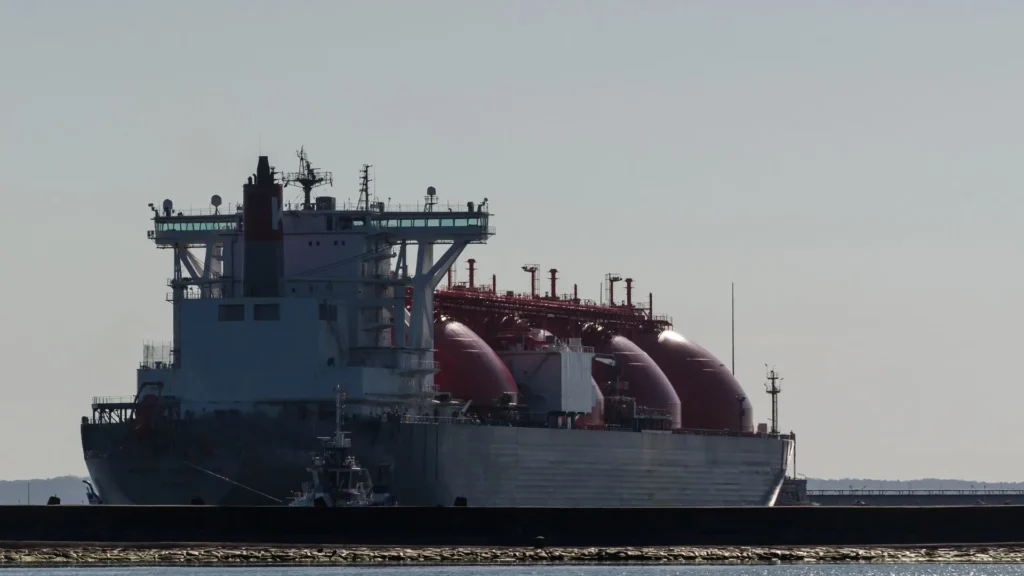
The LNG exports U.S. averaged 17.4 billion cubic feet per day (Bcf/d) during the first half of 2026, driven primarily by the addition of new liquefaction capacity, according to the U.S. Energy Information Administration’s (EIA) Monthly Natural Gas Report. This volume represents a 23 % increase compared to the same period in 2025. This is the fastest growth recorded since the country began large-scale LNG exports in 2016, furthermore, the EIA projects that U.S. GNL exports will average 17.3 billion cubic feet per day (Bcf/d) during the second half of 2026, and could increase to 18.7 billion cubic feet per day by the first half of 2027.
LNG exports grow with new terminals in the US
The increase is mainly linked to the commissioning of new facilities and the expansion of existing terminals; Plaquemines LNG is already operating at full capacity, while Corpus Christi Stage 3 it exports from six of its seven liquefaction trains. Once these developments are completed, they will together add approximately 4 Bcf/d of nominal capacity to the US export infrastructure.
Furthermore, Golden Pass LNG began exports in April 2026. The facility will continue to increase shipments from Train 1 through the end of the year, adding approximately 0.7 Bcf/d of nominal capacity. Train 2 at Golden Pass LNG is also scheduled for completion by the end of 2026, the phased commissioning of these projects will allow the United States to have greater capacity to supply the international market.
Global prices favor US exports
While available infrastructure increased, global market conditions also favored US LNG exports, with international prices remaining at levels that incentivized near-maximum production during the first half of 2026. In March, disruptions to shipments crossing the Strait of Hormuz they reduced the global LNG supply by about 20%, mainly due to the impact on volumes from Qatar.
As a result, Asian buyers had to compete for available shipments on the spot market, Asia receives approximately 80 % of Qatar’s LNG exports, so the disruption to these flows increased pressure on the market. In Europe, the average price at the Netherlands’ Title Transfer Facility (TTF) reached $ 14.74/MMBtu during the first half of 2026, compared to $ 13.10/MMBtu in the same period of 2025, this is the highest half-year average since 2022, when the TTF reached $ 32.42/MMBtu during the first half of the year, amidst reduced European supplies of Russian pipeline gas.
US LNG gains ground in Asia
Meanwhile, the Japan-Korea Marker (JKM), the benchmark for LNG imports in East Asia, averaged $ 15.56/MMBtu, $2.38/MMBtu higher than the price recorded during the first half of 2025. Warm weather and increased demand in the spot market helped support these prices. Additionally, disruptions in the Strait of Hormuz altered the trade flows available to Asian buyers.
In this scenario, US LNG shipments to Asia increased by 108 % compared to the first half of 2025, with an increase of 2.3 Bcf/d. Europe also received higher US volumes, although growth was more moderate, exports increased by 0.1 Bcf/d, equivalent to approximately 1% year-on-year. Furthermore, sales to Latin America and the Caribbean, along with the Middle East and North Africa, increased by a combined 0.8 Bcf/d, a 46 % increase compared to the same period in 2025.
Among the main destinations for US LNG were Egypt and the Netherlands, each receiving 1.7 Bcf/d. Italy received 1.4 Bcf/d, France 1.2 Bcf/d, and the United Kingdom 1.1 Bcf/d, thus, the expansion of US liquefaction capacity coincides with an international market that maintains high demand for flexible cargoes. The entry of new terminals and liquefaction trains could sustain the growth of theLNG exportsduring the first half of 2027.
Source: Hydrocarbon Processing
Photo: Shutterstock