Technip Energies and EDF signed a strategic framework agreement to support the execution, construction management, and delivery of the EPR2 new nuclear power plant program.
The agreement is non-exclusive and provides for the integration of experienced Technip Energies personnel into key operational roles within EDF, primarily in project management and construction. These professionals will work in integrated teams alongside the French utility’s staff.
The collaboration aims to bring Technip Energies’ accumulated experience in large-scale energy and industrial projects—where coordination among engineering, procurement, construction, and commissioning is critical—to the nuclear program.
Managing deadlines will be the main challenge
The agreement aims to strengthen execution discipline and improve the predictability of timelines for EDF’s new nuclear construction projects.
This aspect is particularly relevant for a program that calls for six EPR2 reactors, distributed in pairs among the Penly, Gravelines, and Bugey power plants. The first unit is planned for Penly, which will also serve as a benchmark for subsequent projects.
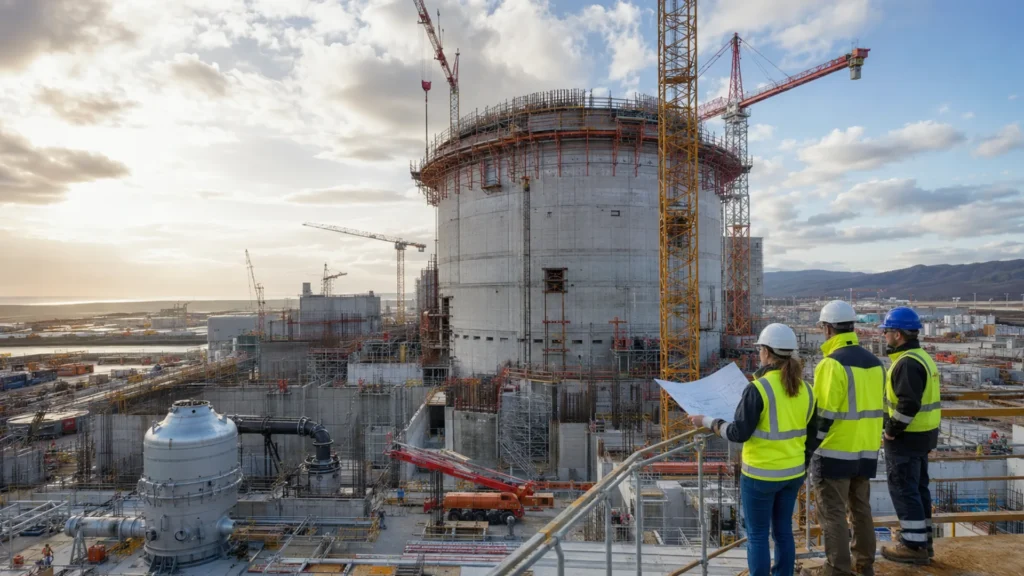
The construction of nuclear reactors requires managing thousands of interfaces between contractors, mechanical systems, civil structures, electrical components, instrumentation, and control systems, as well as supply chains subject to strict quality requirements.
A deviation in the manufacturing or installation of a critical component can spread to other activities and affect the project’s critical path.
A program valued at 72.8 billion euros
EDF estimated the projected cost of building the six reactors at 72.8 billion euros for 2020. The company also allocated a budget of 2.7 billion euros for 2026 to advance the program.
Among the project’s key variables are:
- 6 next-generation EPR2 reactors.
- 3 nuclear sites in France.
- 2038: the target year for the first unit to come online.
- Intervals of 12 to 18 months between subsequent reactors.
- More than 30,000 direct and indirect jobs projected by EDF.
In March 2026, the French government stated that EDF must maintain its cost and schedule targets and implement industrial oversight recommendations before the end of the year. The final investment decision is still scheduled for late 2026.
Integrity begins during construction
Although the agreement focuses on project management, its impact also extends to the future mechanical integrity of the facilities.
Material traceability, manufacturing inspections, weld supervision, and compliance with tolerances must be integrated from the earliest stages. In nuclear facilities, the quality of construction directly affects reliability and maintainability over decades of operation.
The regulatory evaluation of the EPR2 reactors covers safety systems, mechanical and electrical equipment, containment, cooling, emergency power sources, and classified control systems. It also includes the qualification of components under accident conditions and extreme external events.
Therefore, program management must link each construction milestone to verifiable engineering, quality, and inspection records.
EDF aims to prevent cost and delivery overruns
EDF will contribute its expertise in reactor engineering and its nuclear supply chain, while Technip Energies will contribute its capabilities in managing complex projects.
The companies hope that this collaboration will enable them to deliver the units within budget, on schedule, and in accordance with the planned safety standards. However, the outcome will depend on the ability of the integrated teams to standardize processes, share lessons learned across sites, and identify deviations before they impact construction.
The next key milestone will be the final investment decision for the program. From that point on, the focus will shift from planning to France’s actual ability to coordinate engineering, suppliers, construction, and quality control on a nuclear scale.
Source: Technip Energies