Table of Contents
- Oil tanker disabled off the coast of Oman
- Iran faces a daily gasoline deficit of 20 million liters
- Markets fall amid the Hormuz naval blockade: investors prioritize economic pressure over military escalation
- Strait of Hormuz naval blockade keeps pressure on oil
- 90% of Iranian oil exports pass through Hormuz
The Strait of Hormuz naval blockade is disrupting energy flows through one of the world’s most important maritime routes. On Monday, the strait recorded its lowest daily commodity vessel traffic since early May, with only two tankers transiting the passage, both sailing into the Persian Gulf, according to maritime tracking data cited by Reuters.
The decline in traffic shows how U.S. pressure on Iranian exports is moving beyond financial sanctions and directly affecting maritime logistics. The situation is particularly significant because the Strait of Hormuz is a strategic artery for global oil and gas flows, while markets simultaneously assess supply risks and Washington’s shift toward greater economic pressure on Tehran.
Oil tanker disabled off the coast of Oman
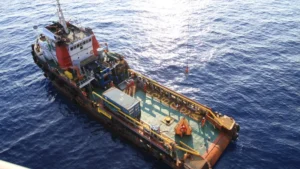
On Tuesday, an oil tanker was struck by an unidentified projectile and disabled approximately nine nautical miles (16.7 km) northeast of Ash Shishah, Oman. The incident was confirmed by the United Kingdom Maritime Trade Operations (UKMTO), the British maritime security organization monitoring the region.
The attack comes as the merchant fleet increasingly avoids the area out of caution. KCM analysts say that “Iran still retains the ability to respond by disrupting maritime traffic, which continues to add a residual premium to oil prices.”
Iran faces a daily gasoline deficit of 20 million liters
The most severe impact of the blockade is not measured only in barrels that cannot be exported: it is also being felt at fuel pumps. Mostafa Nakhai, a member of the Iranian Parliament’s Energy Commission, revealed that the country is accumulating a daily gasoline deficit of approximately 20 million liters—equivalent to around 125,000 barrels—as a direct consequence of the strait’s closure.
Iran was already facing a structural gap in its fuel demand before the conflict. With the passage closed, gasoline imports—which had helped cover that deficit—have been blocked, increasing pressure on the domestic distribution network. The Persian Gulf Star Refinery in Bandar Abbas, designed specifically to reduce that dependence, is operating under restrictions because of its proximity to the theater of operations.
Iran was producing around 3.3 million barrels of crude oil per day before the February 28 airstrikes, according to production tracking data. The U.S. Department of Energy estimates that production has already fallen by 400,000 barrels per day, a 12% decline from pre-conflict levels.
Markets fall amid the Hormuz naval blockade: investors prioritize economic pressure over military escalation
Despite the severity of the physical blockade, the market moved lower. Brent fell $2.96 (-3.21%) to $89.21 per barrel, while WTI dropped $2.84 (-3.34%) to $82.17, their lowest levels since August 17.
The logic behind the move: traders interpreted Washington’s shift toward economic pressure—rather than military escalation—as reducing the extreme risk to regional supplies. Ole Hansen, commodity strategist at Saxo Bank, noted that “the sanctions announcement was not as forceful as some traders had expected.”
The Hormuz naval blockade remains a structural risk factor that markets cannot ignore. The supply disruption has led importing countries to draw down their strategic and commercial reserves. Follow the sector through Inspenet’s energy security coverage and the latest energy news on Inspenet.
Strait of Hormuz naval blockade keeps pressure on oil
Despite the severity of the physical blockade, the market moved lower. Brent fell $2.96 (-3.21%) to $89.21 per barrel, while WTI declined $2.84 (-3.34%) to $82.17, reaching their lowest levels since August 17.
The reaction shows that the market is not responding solely to the reduction in maritime traffic. Traders are also assessing Washington’s shift toward greater economic pressure on Tehran and the extent to which that change could reduce the risk of a new military escalation capable of causing even greater disruptions to regional supplies.
Ole Hansen, commodity strategist at Saxo Bank, said the sanctions announcement was not as forceful as some traders had expected. That perception helped moderate part of the risk premium previously built into crude oil prices.
The Strait of Hormuz naval blockade nevertheless continues to represent a structural risk factor that markets cannot ignore. The sharp decline in tanker traffic demonstrates that the restrictions are already having physical consequences for a route that is fundamental to international energy trade.
The disruption of flows is also increasing pressure on importing countries, which must assess alternative routes, cargo availability, and the use of strategic and commercial inventories while uncertainty in the strait persists. The performance of Brent and WTI will therefore depend not only on sanctions against Iran, but also on how long navigation remains restricted and whether the situation leads to further supply disruptions.
90% of Iranian oil exports pass through Hormuz
Tehran’s strategic dependence on the strait makes the blockade a tool of maximum pressure. Around 90% of the crude oil Iran sells abroad passes through Hormuz, meaning there are no alternative routes of comparable scale. Road exports to Pakistan and Afghanistan have far less capacity than maritime transportation.
A Columbia University study warns that the blockade would need to last more than six months to cause critical and irreversible damage to Iran’s oil industry. As of August 25, the closure has been in effect since late February, approaching the threshold at which the effects on upstream production could begin to become structural. Follow Inspenet’s analysis of the oil and shipping sectors.
Sources: Reuters Energy — Naval blockade and impact of Iran sanctions