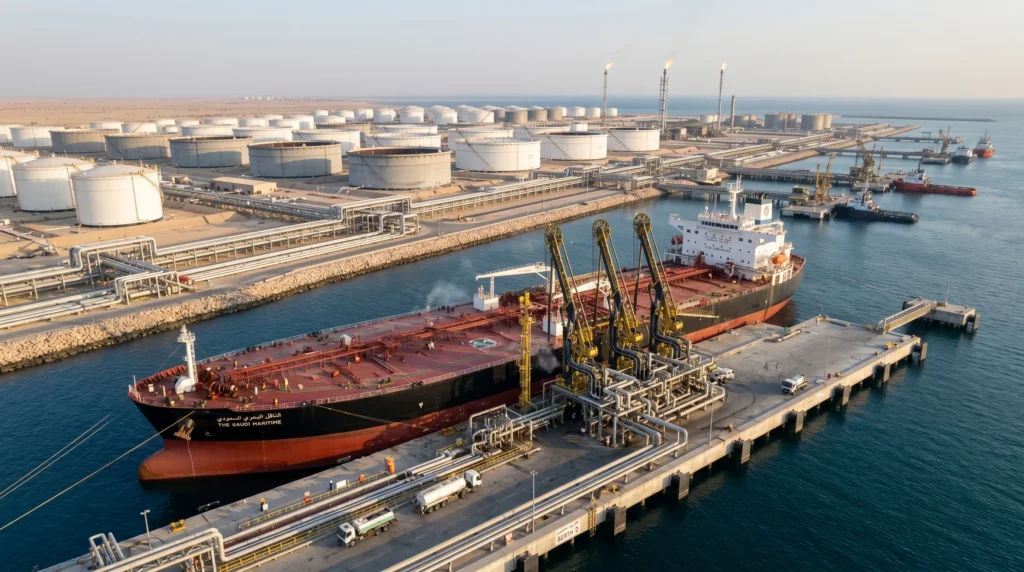
Saudi Aramco China will remain near record-low export levels in July 2026, with just 12 million barrels allocated—equivalent to about 387,000 barrels per day—according to Reuters on June 11, citing market sources and cargo-tracking data. The volume represents one of the lowest levels on record for Saudi supply to the world’s largest oil importer and reflects a combination of weak demand in China, rising competition from alternative crudes, and high inventories at independent refineries.
Saudi Aramco China: July exports at a record low
Sinopec, the world’s largest refiner by processing capacity, did not purchase Saudi cargoes for a second consecutive month. Sinopec’s decision is significant because it has historically been the anchor of China’s imports of Arab crude. China’s independent refineries, known as “teapots,” continue to prioritize discounted Russian crude, which offers higher margins than Arab Light in the current pricing environment.
Mu Yi, a Kpler analyst specializing in Middle East oil flows, noted that “Chinese demand for Saudi crude is at its weakest point in years, and it is not just about prices: it is a structural reconfiguration of refinery preferences.” The data contrasts with Saudi Arabia’s historical role as a benchmark supplier to the Asian market. The 50% cut in Saudi shipments to China recorded in May foreshadowed this trend, now confirmed for July.
Saudi Aramco China and the aggressive OSP cut for Asia
Saudi Aramco responded with a significant cut to its official selling prices (OSPs) for Asia in July, according to Reuters on June 8. Despite the reduction, Chinese buyers have not responded with higher volumes. Riyadh’s strategy of defending market share through more competitive pricing faces a structural obstacle: Chinese refineries have diversified their supply sources and no longer depend on Arab crude as they did a decade ago. The cut to Aramco’s OSPs for Asia announced in June failed to revive purchases in the short term.
Saudi Aramco China and the reconfiguration of VLCC routes in Asia
The decline in Saudi Aramco China volumes has direct consequences for shipping routes. VLCCs (Very Large Crude Carriers) that operated on the Saudi Arabia–China route are being redirected to India, Europe, and the Americas, where demand for Arab crude remains stronger. Brazil, Guyana, and West African exporters are capturing part of the market share Saudi Arabia has lost in China, offering comparable-quality crudes at competitive prices with lower logistical risks due to the situation in Hormuz.
Venezuela is also emerging as a potential beneficiary of this reconfiguration: with the SLB–PDVSA agreement to modernize operations and the presence of international refiners in the country, Venezuelan crudes—mostly heavy—compete directly with the medium and heavy Arab grades that Aramco has lost in China. Rising Chinese interest in alternative crudes opens a window of opportunity for Latin American producers.
Saudi Aramco China and Riyadh’s strategy within OPEC+
The loss of market share in China complicates Saudi Arabia’s position within OPEC+. Riyadh needs to maintain its export volumes to sustain the fiscal revenues that finance the Vision 2030 Plan reforms, but the decline in Chinese demand puts downward pressure on prices without coordinated production cuts managing to offset it. Wood Mackenzie analysts estimate that Saudi Arabia would need Brent to remain above $80 to balance its budget in 2026, a threshold the current price level exceeds, albeit with a narrower margin than earlier this year.
This trade relationship encapsulates the struggle between Gulf oil and Russian and U.S. crude for primacy in the Asian market—the most important battle in the energy sector over the next decade. The outcome of that competition will determine investment flows, shipping routes, and the structure of crude pricing for years.
Source: Reuters