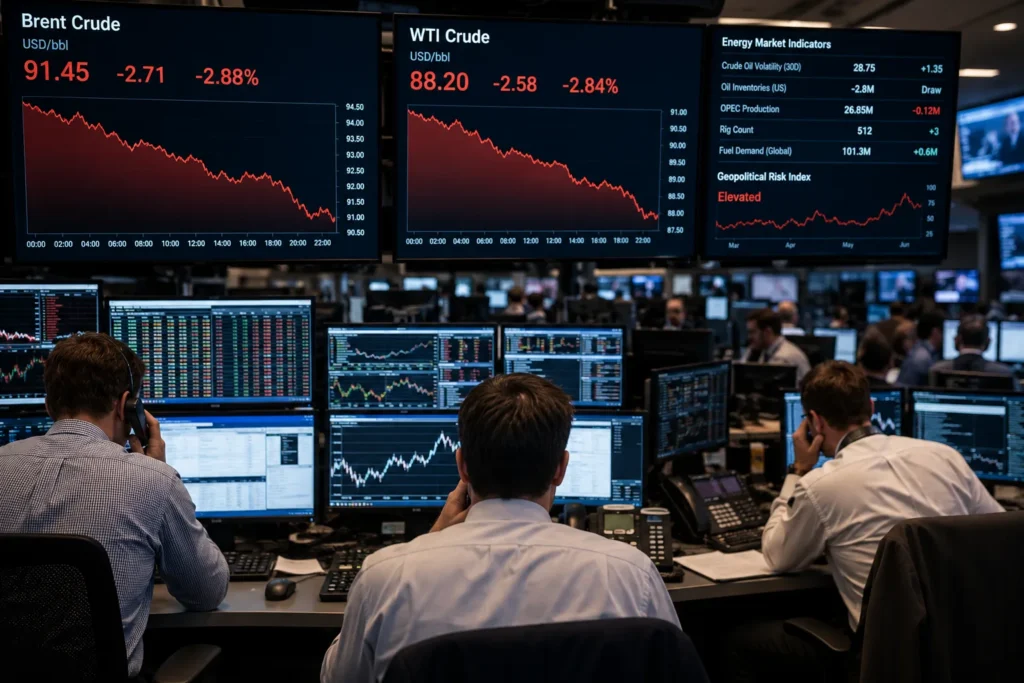
The oil price fell nearly 3% on June 9, 2026 after the United States suspended planned attacks against Iran and expectations of a diplomatic de-escalation increased. Brent closed at $91.45 per barrel and WTI at $88.20, marking lows of about seven weeks. Markets reacted by removing part of the geopolitical risk premium built up over the previous weeks, although analysts warn that the calm may be short-lived.
Oil prices shed the geopolitical premium after the pause
The geopolitical risk premium that had built up in oil prices during the weeks of escalation between Washington and Tehran partially evaporated in a single session. According to Reuters data, Brent traded as much as 3.2% below the previous close, the biggest one-day drop since mid-May. The reaction reflects how energy markets immediately price in any sign of easing in the Middle East, even when that signal lacks formal guarantees.
Ritterbusch and Associates, an analysis firm specializing in energy commodities, noted that “the suspension of the attacks is temporary relief, not a structural solution.” The analysis framed the decline as a technical correction rather than a shift in the price regime. Speculative long positions in Brent accumulated during May and early June began to unwind in the early hours of the June 9 session.
Hormuz: the residual risk that prices still underestimate
Despite the decline, the Strait of Hormuz remains under operational pressure. Iran has not changed its stance on maritime transit, and naval forces in the region remain on heightened alert. The strait accounts for approximately 20% of global seaborne energy trade, including flows of crude oil, LNG, and LPG to Asia. Any new incident could reactivate the risk premium as quickly as it dissipated.
Global inventories remain under pressure, according to the latest estimates from the Energy Information Administration (EIA). The rise in Brent to $97 recorded on June 3 illustrates how quickly the market responds to adverse news. An effective closure of the strait would push prices above $120 per barrel within days, according to IEA stress models.
Impact of oil prices on refiners and traders
For refiners, the drop in oil prices represents partial relief in feedstock costs and a potential improvement in margins. Traders, by contrast, face a market with high implied volatility: 30-day Brent options continue to carry an elevated premium that reflects uncertainty over diplomatic developments. Maritime freight contracts also posted a slight correction, although war-risk insurance in the Persian Gulf continues to trade at a significant premium compared with alternative routes.
The LNG sector is also watching the situation closely. The reduction in Saudi exports to China recorded in May reflects how uncertainty around Hormuz was already affecting trade flows before the easing. A sustained diplomatic normalization would revive deferred contracts, but market participants prefer to wait for concrete signals before restoring previous volumes.
Outlook: oil prices between diplomacy and residual risk
The base-case scenario of the leading investment banks puts Brent in an $88–$95 range for July, contingent on flows through Hormuz remaining partially open. Goldman Sachs maintains its fourth-quarter target at $90, with upside risk if hostilities resume. The strategy of cutting Aramco’s official selling prices for Asia suggests that even Riyadh anticipates a moderate-demand environment in the second half of the year.
The June 9 drop does not resolve the underlying equation: as long as Hormuz remains militarily sensitive, the market will retain a structural risk premium that will prevent a sustained correction back to pre-conflict levels. The next catalyst—positive or negative—will determine whether $90 acts as a floor or a ceiling.
Source: Reuters