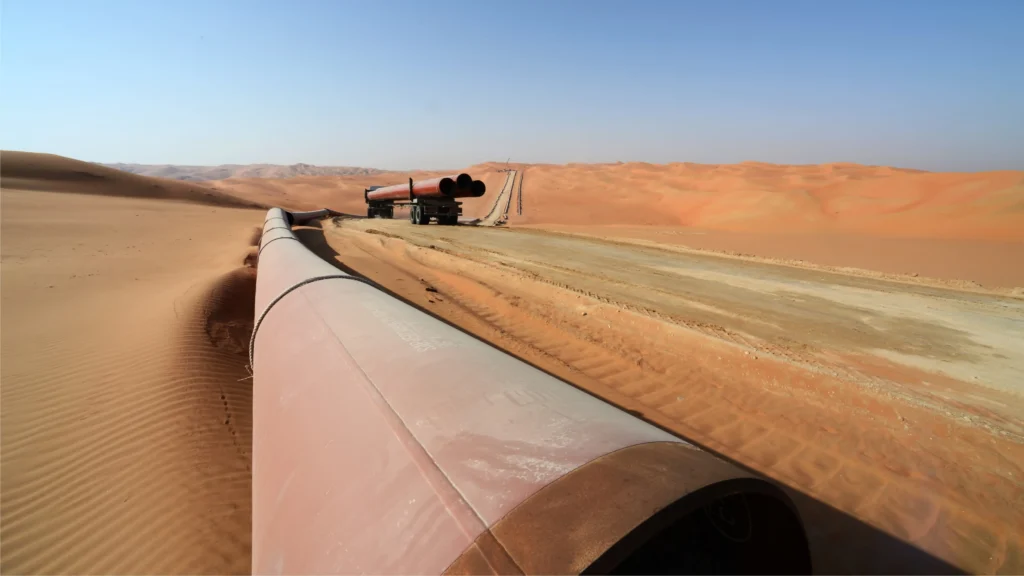
The United Arab Emirates will accelerate the construction of a new strategic oil pipeline with the aim of doubling its crude oil export capacity from Fujairah by 2027. The move seeks to reduce dependence on the Strait of Hormuz amid rising regional tensions and blockades attributed to Iran.
The decision was ordered by the Crown Prince of Abu Dhabi, Sheikh Khaled bin Mohammed bin Zayed, during a meeting of the government’s executive committee. There, he instructed ADNOC to accelerate the development of the West-East project, which is currently under construction.
Fujairah gains prominence as an energy hub in the Gulf
The new pipeline will reinforce Fujairah’s strategic importance as the UAE’s main oil export route to the Gulf of Oman. Currently, the Habshan-Fujairah pipeline, known as ADCOP, transports up to 1.8 million barrels per day and is the primary export route outside the Strait of Hormuz.
With the planned expansion, the country could increase its shipping capacity to approximately 3.6 million barrels per day. This would allow it to maintain trade flows even under scenarios of maritime disruption.
Likewise, Fujairah has become a crucial point for the country’s food and merchandise imports due to its direct connection to international shipping routes outside the Persian Gulf.
The Hormuz blockade puts pressure on the oil market
The acceleration of the project occurs in a context of high geopolitical tension; since the end of February, the Strait of Hormuz has faced severe restrictions following the military escalation between Iran, Israel, and the United States.
The partial disruption of maritime traffic has affected nearly a fifth of the world’s oil supply and triggered a sharp rise in energy prices. Some countries have begun implementing fuel rationing measures as markets react to potential risks of recession and inflation.
Meanwhile, the United Arab Emirates and several international buyers have resorted to special maneuvers to move oil shipments from the Gulf. These include the transit of vessels with their tracking systems deactivated to reduce the risk of attack.
ADNOC accelerates its expansion after leaving OPEC
The announcement also coincides with the recent departure of the United Arab Emirates from OPEC, a decision that frees the country from the production quotas imposed by the oil bloc.
ADNOC maintains its target of reaching a production capacity of 5 million barrels per day next year. The Emirati Ministry of Energy previously stated that the national infrastructure could be expanded to 6 million barrels per day if necessary.
The subsidiary ADNOC Drilling confirmed this week that it has sufficient operational capacity to support any further expansion of production or exports.
Saudi Arabia is also strengthening alternative routes
Saudi Arabia remains the only Gulf country with comparable infrastructure for exporting oil outside the Strait of Hormuz. Its East-West pipeline connects the oil fields to the port of Yanbu on the Red Sea and can currently transport around 7 million barrels per day.
Aramco CEO Amin Nasser recently described this network as a lifeline for sustaining Saudi exports during the regional conflict.
Meanwhile, Kuwait, Iraq, Qatar, and Bahrain remain almost entirely dependent on the strait for their energy exports, increasing their exposure to any prolonged disruption.
Source: Reuters
Photo: Shutterstock