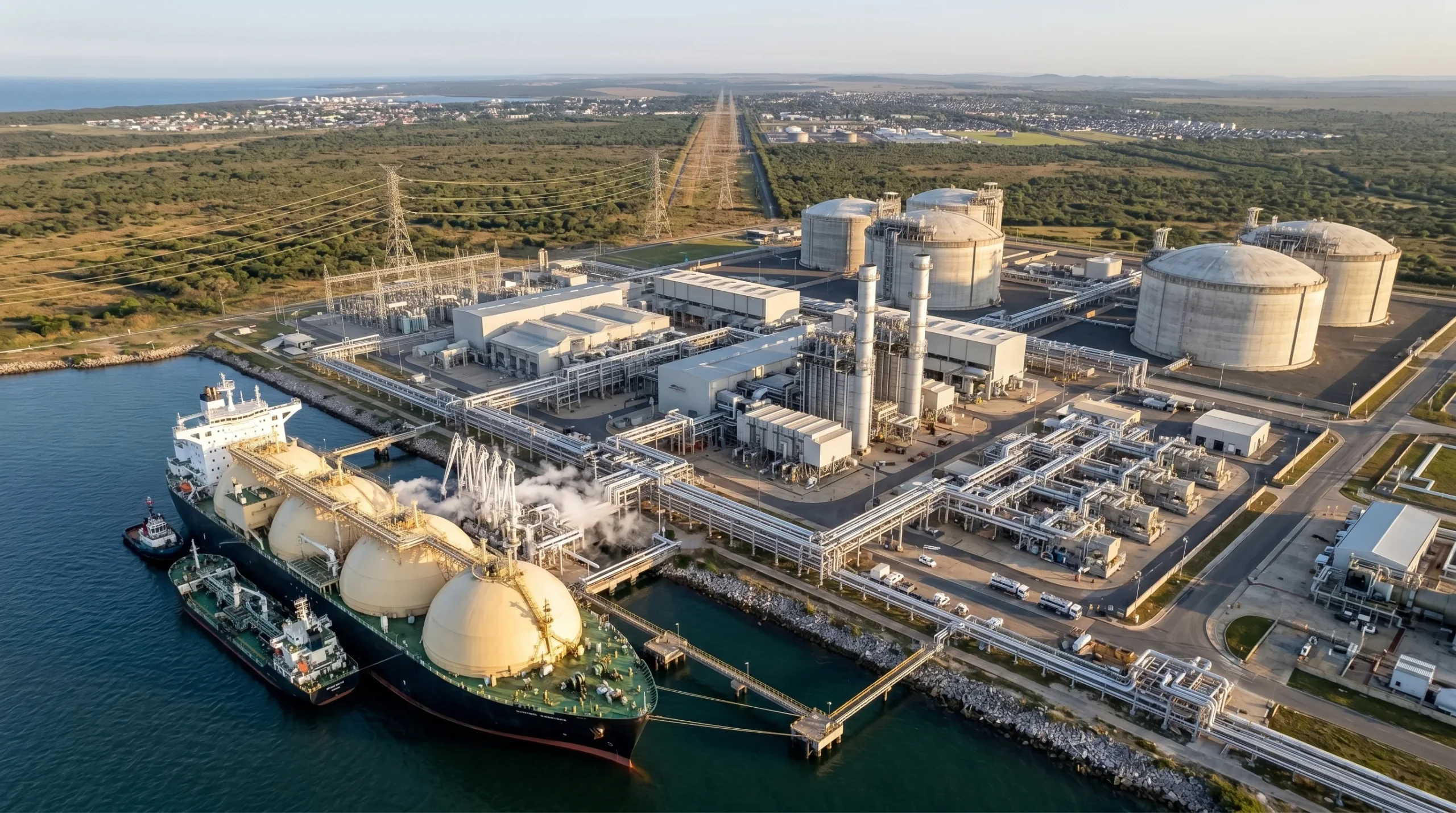
The Eskom LNG agreement with Zululand Energy Terminal, a long-term liquefied natural gas supply contract, has become the key element in supporting its 3,000 MW gas-to-power project in Richards Bay and accelerating South Africa’s energy diversification, according to Reuters.
The agreement connects three links of the gas chain—import terminal, regasification, and power generation—within a single project. For a country whose generation fleet depends mostly on coal, securing fuel before building the plant is the step that provides financial viability to the entire project.
The Eskom LNG Agreement for the Richards Bay Plant
The LNG supply contract supports a 3,000 MW gas-to-power project, one of the largest additions of flexible capacity planned for the South African grid. The long-term modality aims to provide price and volume predictability for the gas, a standard requirement for large-scale plant financing to reach closure.
The counterparty, Zululand Energy Terminal, is linked to the Richards Bay LNG terminal, a development with an estimated investment of approximately $1 billion. The infrastructure includes an initial phase of 2 million tonnes per annum (mtpa), with a planned scale-up to 5 mtpa as industrial and electrical demand grows.
The terminal’s operation is projected over a 25-year horizon, with Vopak and Transnet Pipelines previously selected for its management. This timeframe reinforces the structural nature of the agreement: it is not a one-off purchase of cargoes, but rather the anchoring of a stable supply chain for a quarter of a century.
The Eskom LNG Agreement and the Transition from Coal
The commitment to gas responds to the need to diversify a matrix dominated by coal and incorporate capacity capable of responding quickly to demand fluctuations. Combined-cycle gas plants can modulate their output in minutes, an attribute that makes them a natural backup for intermittent renewable sources.
Eskom had already been expanding its capacity through other means. The company recently completed the addition of new generation when it activated Unit 5 of the Kusile Power Station, demonstrating a sustained effort to stabilize a system affected for years by scheduled blackouts. However, the Eskom LNG agreement with Zululand Energy Terminal represents a decisive step toward gas-based energy security, complementing clean energies.
LNG, Infrastructure, and Opportunities for Operators
The project is part of a broader African trend toward gas monetization. The continent holds significant reserves that have historically been exported without being transformed into local energy; domestic electricity demand now offers a high-value alternative destination for LNG producers.
The scheme also revitalizes the terminal and regasification market, a segment experiencing global expansion driven by LNG demand. For the energy infrastructure industry, projects like this Eskom LNG agreement define the standards of scale and duration that other emerging markets will need to replicate. For more context on gas expansion on the continent, see our article on LNG expansion in Africa.
For operators, the development opens opportunities in infrastructure construction, storage, terminal operation, and maintenance of combined-cycle plants. If completed as planned, the Eskom LNG agreement would position Richards Bay as a new LNG import hub on the African east coast and as a central piece of South Africa’s electrical security. This project marks a milestone in the transformation of the South African power system toward more diversified and sustainable sources.
Source: Reuters